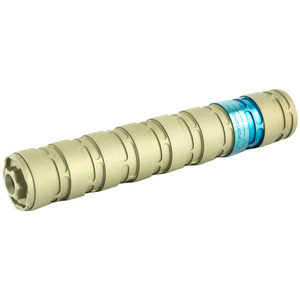
Why Shooters Buy Suppressors
A suppressor lowers the sound of a gunshot by about 20 to 35 decibels depending on the can and the caliber, which keeps most suppressed guns below the level that damages hearing. That's the main reason people buy them. They also cut recoil and muzzle flash, so the gun is steadier and easier to shoot well.
Folks call them suppressors, silencers, or cans, and it all means the same thing. The name "silencer" goes back to the original patent, but nothing actually goes silent. A good can just takes the sharp crack off the shot.
We stock suppressors for rifle, pistol, and rimfire, and you can shoot suppressed on our indoor range to hear the difference for yourself. They pair well with an AR 15 rifle or a threaded 9mm pistol, and they're one of the most popular firearm accessories we carry.
Rifle, Pistol, and Rimfire Suppressors
Suppressors are built around a caliber and a host gun, so the right one depends on what you're shooting. A can rated for a bigger round handles smaller ones too, but a small rimfire can won't safely handle a centerfire rifle round, so match the suppressor to the gun.
| Type | Common calibers | Best for |
|---|
| Rifle | 5.56, .308, .300 BLK | AR-15, bolt guns, hunting rifles |
| Pistol | 9mm, .45 ACP | Threaded handguns, PCCs |
| Rimfire | .22 LR, .22 WMR, .17 HMR | Plinking, small game, training |
| Multi-caliber | Rated up to .30 cal | One can across several rifles |
Rifle cans are the most popular since they take the bite off a .223 or .308. Pistol cans run quiet on a 9mm and many come apart for cleaning. Rimfire cans are cheap to feed and great for new shooters, and a multi-caliber can covers several guns with one tax stamp.
How to Choose a Suppressor
The best suppressor for you comes down to the gun you'll run it on and how quiet you need it, not just the brand on the tube. Before you buy, work through these five things:
- Caliber and host gun. Pick a can rated for your largest round. A .30-cal covers a lot of ground, while a 9mm or .22 can is purpose-built for that gun.
- Mounting system. Choose a simple direct-thread can or a quick-detach mount that swaps between guns in seconds.
- Material and weight. Titanium runs light for a hunting rifle, while stainless and Inconel hold up to heavy use but add weight.
- Sound versus size. A longer can is quieter, but a shorter one keeps the gun handy. It's a trade-off every buyer makes.
- Serviceability. Pistol and rimfire cans should come apart for cleaning. Most sealed rifle cans never need it.
The easiest way to settle it is to hear a few. Our team will walk you through the options at the shop before you commit to the paperwork.
Best Suppressors and Brands
The best suppressor is the one matched to your gun and your hearing goals, but a handful of brands stay popular for their sound, durability, and easy mounting. Our lineup covers the names shooters ask for most:
- SilencerCo -- the multi-caliber Omega and the flat Osprey pistol can
- Dead Air -- the Sandman rifle line and the Nomad rimfire and pistol cans
- Rugged -- the Surge rifle can and the modular Obsidian pistol can
- YHM and Banish -- solid all-around cans at a fair price
- Dead Air Mask and SilencerCo Sparrow -- proven .22 rimfire cans
If you have your eye on a model we don't have in stock, just ask, since we can usually source it for you. A short rifle can also pairs well with an SBR rifle if you want the quietest, most compact setup.
What a Suppressor Costs
Most suppressors sell for $400 to $1,200 for the can itself, with rimfire cans starting near $200 and premium multi-caliber rifle models running up to $1,500. On top of the can, the federal government charges a one-time $200 tax stamp per suppressor, so budget that into the total.
Total Impact backs every suppressor with a price-match guarantee. If you find the same can for less somewhere else, we'll match it. The $200 tax stamp is a fixed federal fee, the same no matter where you buy.
How to Buy a Suppressor Online
A suppressor is an NFA item, so buying one takes a few more steps than a regular firearm, but it's straightforward once you know the path. The can ships from us to a licensed FFL/SOT dealer, then you complete federal paperwork and a background check before pickup. Here's how it works:
- Order your suppressor. Pick your can and check out, then choose your FFL/SOT dealer for the transfer or pick up in our shop.
- We ship it to the dealer. We send the suppressor to a licensed FFL/SOT anywhere in the country. It does not ship to your door.
- File ATF Form 4. At the dealer, you file an ATF Form 4, pay the one-time $200 tax stamp, and submit fingerprints and a photo.
- Pass the background check and wait. The ATF runs the check and approves the transfer. With electronic Form 4 filings, approval now often comes back in weeks instead of months.
- Pick it up. Once your stamp comes back, you take the suppressor home.
You must be at least 21 to buy a suppressor, and they're legal to own in most states, though a handful ban them. We handle FFL/SOT transfers both in and out, so we can ship your can to a dealer near you or receive one you bought elsewhere.
Frequently Asked Questions About Suppressors
Are suppressors legal?
Yes, suppressors are legal to own in most states with the proper ATF paperwork and a $200 tax stamp. A handful of states ban them, so check your state law first, but the great majority allow private ownership once the transfer is approved.
How much does a suppressor cost?
Most suppressors run $400 to $1,200 for the can, with rimfire models starting near $200, plus the one-time $200 federal tax stamp on top. Total Impact price-matches any competitor on the can, so you always pay the best price.
How long does it take to get a suppressor?
Most transfers now clear in a few weeks to a few months after you file ATF Form 4 electronically. Wait times used to run close to a year, but the eForm system has cut that down a lot.
What is the quietest suppressor caliber?
Subsonic rounds like .22 LR and .300 Blackout run the quietest because the bullet stays below the speed of sound, so there's no sonic crack. A .22 rimfire can on a bolt-action is about as quiet as it gets.
Do I need a special license to buy a suppressor?
No, just a clean background check and a $200 tax stamp filed on ATF Form 4 through a licensed FFL/SOT dealer. You must be at least 21, and the dealer handles the paperwork with you.
Can I put one suppressor on different guns?
Yes, a multi-caliber suppressor rated for your largest round can move between guns as long as the threads or mount match. A .30-cal can, for example, will run on a 5.56 AR-15 and a .308 bolt gun with the right adapter.
Find Your Next Suppressor at Total Impact
Whether you're quieting down a hunting rifle or a carry gun, Total Impact has the suppressors, the price-match guarantee, and the range to help you choose with confidence. Browse the lineup above, and reach out if you want a can we can source for you.