
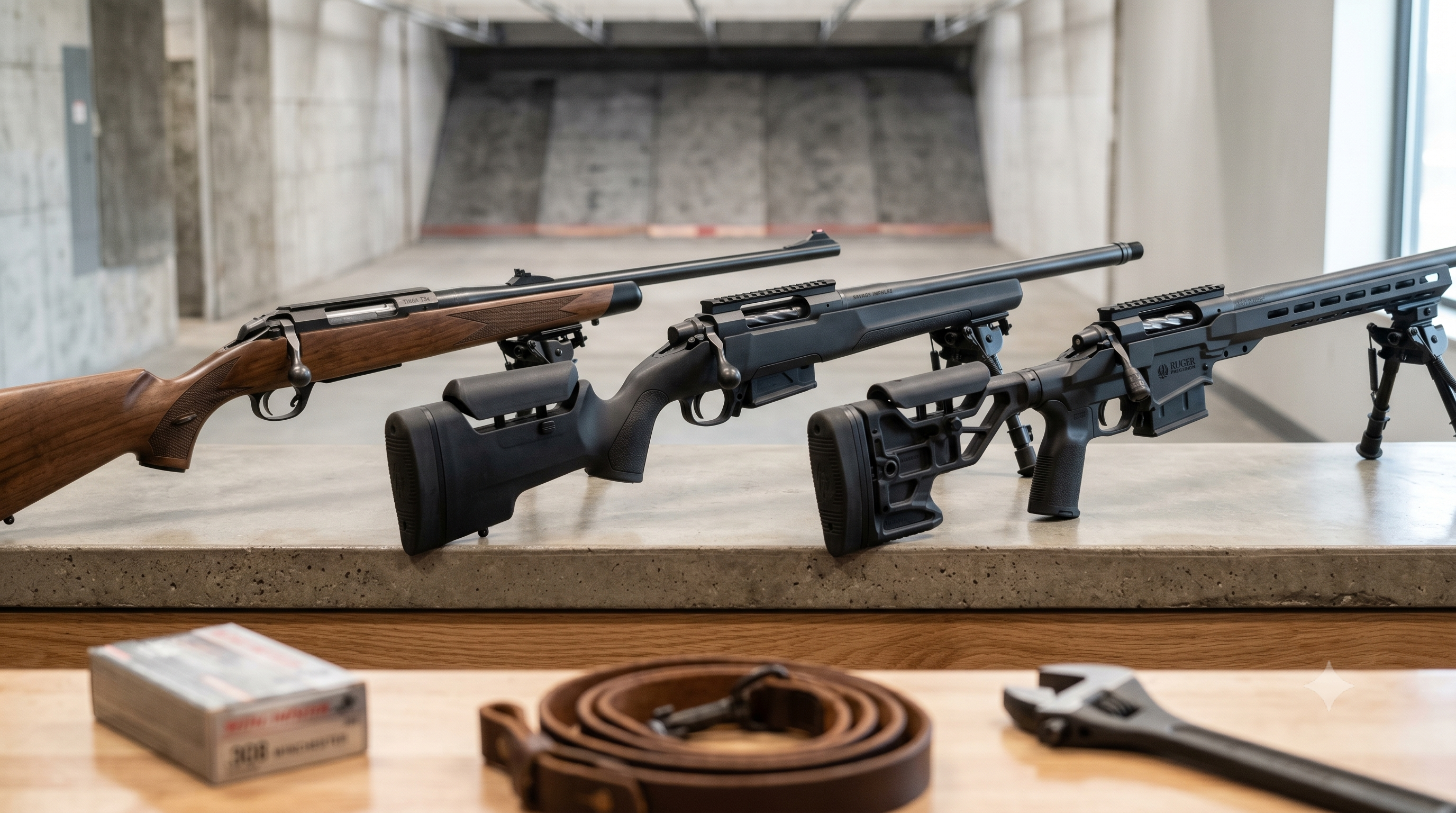
What Is a Bolt-Action Rifle? Anatomy, Action Types, and How to Choose One
Posted by Joel Sheran on Jun 9th 2026
A bolt-action rifle is a manually operated rifle where the shooter cycles each round by lifting, pulling back, pushing forward, and locking down a bolt handle on top of the receiver. It is the most popular hunting rifle type in North America thanks to its accuracy, reliability, and mechanical simplicity.
So you've decided you want a hunting rifle, or a precision rig for the range, and "bolt-action" keeps coming up everywhere. You don't need to walk into a shop pretending you already know everything. This guide covers what a bolt-action rifle is, the parts worth knowing, the different action types, common chamberings by use case, and when a bolt is the right call versus an AR.
How a Bolt-Action Rifle Works
A bolt-action uses a manually operated bolt to load, fire, and eject one cartridge at a time. Per Savage Arms, cycling a standard bolt is a four-motion sequence: lift the bolt handle, pull it back to extract the spent case, push it forward to chamber a fresh round, then push it down to lock. Straight-pull designs collapse this to two motions (back, forward), which we'll cover in the action types section.
A few terms worth knowing:
- Bolt body — the main shaft of the bolt that the bolt handle, lugs, firing pin, and extractor attach to.
- Bolt face — the forward-facing end of the bolt that forms the rear chamber wall. According to Shooting Sports Retailer, the bolt face seals the breech against escaping gases so the full energy of the burning powder is directed toward the muzzle.
- Lugs — small protrusions on the front of the bolt that mate with corresponding lugs cut into the receiver. When the bolt rotates down, the lugs lock the bolt closed for firing.
- Firing pin (or striker) — the spring-loaded pin inside the bolt that strikes the cartridge primer when the trigger releases the sear.
- Sear — the small lever that holds the firing pin under spring tension until the trigger is pulled.
What's actually happening inside the receiver
Walk through the four motions:
- Lift the bolt handle. The lugs rotate out of their locking recesses. On most modern designs, this is also when the firing pin gets cocked back against its spring.
- Pull the bolt back. The extractor pulls the spent case rearward; an ejector kicks it out of the open ejection port.
- Push the bolt forward. The bolt face strips a fresh cartridge from the top of the magazine and pushes it into the chamber.
- Push the bolt down. The lugs rotate back into their recesses and lock the action closed.
That sequence is why bolt-actions cycle slower than a semi-auto, and also why the lock-up is so consistent shot to shot.
The Anatomy of a Bolt-Action Rifle (Parts You Need to Know)
The rest of the rifle is built around getting the round from your hand to the target. Here are the parts you'll see called out at the counter and in product listings.
- Receiver — the central body of the rifle that houses the action. Everything else (barrel, stock, trigger, magazine) attaches to or threads into the receiver.
- Barrel — the rifled tube the bullet travels through. Most hunting-rifle barrels run 20" to 24" per Savage Arms. Heavy or "bull" contours dissipate heat better for repeated shots; lighter sporter contours are easier to carry on a long spot-and-stalk hunt.
- Chamber — the rear of the barrel cut to fit a specific cartridge. This is what matches the rifle to a caliber.
- Stock — the body you hold. Wood (traditional, classic feel), synthetic (lighter, weatherproof, the most common modern choice), or chassis-style (aluminum skeleton with bolt-on grip and fore-end, popular for precision builds).
- Trigger — the lever that releases the sear. Pull weight and break feel matter a lot for accuracy. Most modern bolt-actions ship with adjustable triggers.
- Magazine — where cartridges sit until the bolt strips them into the chamber. Two main configurations: detachable box magazine (DBM), which drops out for fast reloads and is the dominant modern design; and internal box magazine with hinged floorplate, the traditional setup loaded from the top with the bolt open and emptied through a release at the bottom.
- Sights and optics — most modern hunting bolt-actions ship without iron sights, with a Picatinny rail or pre-drilled receiver ready for scope mounts. Picatinny rail is the industry-standard mounting interface that lets you swap optics without a gunsmith.
- Muzzle — the front end of the barrel. Many modern bolt-actions ship threaded for muzzle brakes, suppressors, or thread protectors.
Two terms that come up in spec sheets:
- Free-floated barrel — the barrel only contacts the stock at the receiver, with daylight along the rest of its length. Reduces accuracy-killing harmonics and is standard on quality modern bolt-actions.
- Headspace — the precise distance between the bolt face and a fixed datum point in the chamber, which controls how the cartridge sits when it fires. Critical for safety and accuracy.
You don't have to memorize all of that. But if a salesperson says "this one ships with a free-floated heavy-contour barrel and a Picatinny rail," you'll know what they mean.
What Are the Different Types of Bolt-Action Rifles?
Most guides lump every bolt gun together, but the differences between sub-types drive a lot of buying decisions. Here's the clean version.
Two-lug vs three-lug
The lugs are protrusions on the bolt that lock into the receiver. Two-lug designs (most Remington 700s, most Tikka T3s) typically rotate 90 degrees between unlocked and locked. Three-lug designs typically rotate 60 degrees, per Shooting Sports Retailer.
Does the 30-degree difference matter? For accuracy, not really. The SSR author calls it "insignificant" in practical terms. Where the shorter rotation does help is ergonomics: 60 degrees gives you more knuckle clearance under a low-mounted scope, so cycling fast without smacking your hand on the ocular bell is easier. Plan to mount a big scope close to the bore? Worth a thought. Otherwise, treat it as a tie.
Push-feed vs controlled-round-feed
This is the one most beginners hear about and immediately overweight. The two designs handle the cartridge differently:
- Push-feed — the bolt pushes the cartridge forward out of the magazine and into the chamber. A small extractor built into one of the lugs, plus a spring-loaded ejector pin, handle the spent case on the way out. The Remington 700 lineage and most modern precision rifles (Ruger Precision Rifle, Bergara, custom builds) use push-feed.
- Controlled-round-feed (CRF) — a full-length extractor grips the cartridge rim as soon as it leaves the magazine and stays gripped through chambering, firing, and extraction. The Mauser, Winchester Model 70, and Ruger Scout lineage use CRF.
The trad-Mauser crowd will tell you CRF is always better. It isn't. CRF genuinely shines in adverse conditions and on dangerous game, where you absolutely cannot have a round short-stroke or fail to extract (think Africa dangerous-game guides, Alaska brown-bear hunts). For 95% of buyers, push-feed is fine, often cheaper, and dominates modern precision rifles precisely because it's easier to manufacture to extremely tight tolerances. Pick by use case, not tradition.
Action length: short, long, and magnum
The receiver comes in different sizes that match different cartridge lengths. Per Savage Arms, "A short action is lighter and faster-cycling, built for smaller cartridges. A long action can handle larger rounds but adds a bit of weight and longer bolt travel."
- Short action — sized for the .308 Winchester family. Includes .308 Win, .243 Win, 6.5 Creedmoor, 7mm-08, .22-250. Faster cycle, lighter rifle.
- Long action — sized for the .30-06 family. Includes .30-06 Springfield, .270 Winchester, .25-06.
- Magnum action — long-action receivers built for belted-magnum cases like .300 Win Mag, 7mm Rem Mag, and .375 H&H. Heavier, longer bolt travel.
When you see a rifle marketed as a "short-action 6.5 Creedmoor," that's why: the cartridge fits the smaller receiver, giving you a lighter, quicker-cycling rifle. Caliber drives action length, not the other way around.
Mini-action and straight-pull
A couple of niche but useful sub-types:
- Mini-action — a sub-class of short action sized for genuinely small cartridges like .223 Remington and 7.62x39, allowing a smaller, lighter rifle than a standard short action. Common on entry-level and youth-friendly rifles like the Ruger American Ranch and Howa Mini Action.
- Straight-pull — bolt cycles in two motions (back, forward) instead of four because the bolt does not rotate. Faster follow-up shots without sacrificing the bolt-action lock-up. Browning T-Bolt, Savage Impulse, and the classic Blaser R8 are the names you'll hear.
If you want to handle a few action types side by side, our bolt-action rifle selection is a good place to see what's in stock across two-lug, three-lug, push-feed, CRF, and short / long / magnum setups.
Common Bolt-Action Calibers and What They're For
"What caliber should I buy" is, honestly, the question. Match the cartridge to what you'll actually do with the rifle. Per HuntWise, the practical groupings shake out roughly like this:
- Small game and varmint — .22 LR (cheap, low-recoil, perfect for plinking and small game), .223 Remington (also the AR-15's cartridge; if you'd like to understand the difference between 5.56 NATO and .223 Remington, that one's worth a read).
- Medium game (deer, hogs, antelope) — .243 Winchester, .270 Winchester, .308 Winchester. The .308 is the most versatile single deer rifle most hunters will ever need.
- Large game (elk, moose, bear) — .30-06 Springfield, .300 Winchester Magnum, 7mm Remington Magnum.
- Long-range precision — 6.5 Creedmoor (the modern long-range darling, low recoil and excellent ballistics), .308 Winchester (still extremely capable inside 600 yards), .300 PRC for serious long-range work.
A note on the "you need a magnum" myth: you don't. A .308 Winchester in a short action ethically takes 95% of North American big game. Magnums make sense when the range or the energy actually requires it (elk at 500 yards, dangerous game), not as a default first rifle. A first-time buyer who picks up a stout magnum often shoots it less and shoots it worse than a moderate-recoil .308. Match the cartridge to the work, not the reputation.
Why Choose a Bolt-Action Over a Semi-Automatic? (Bolt vs AR)
This is the question most first-time buyers actually arrive with. Bolt or AR? The honest answer is "depends on what you'll do with it," but here's how the trade-offs really break down.
Where bolt-action wins:
- Accuracy at distance. Bolt-actions are favored for precision and dangerous game in part because tighter clearances and tighter tolerances are achievable than in semi-auto designs, per Shooting Sports Retailer. Consistent lock-up on each shot is what produces consistent groups.
- Cartridge flexibility. Bolt-actions chamber the full range from .22 LR up through dangerous-game magnums. AR-pattern semi-autos are limited (mostly .223/5.56 in the AR-15, .308/6.5 Creedmoor in the AR-10).
- Mechanical simplicity. Fewer moving parts, no gas system, easier to clean.
- Price ceiling. Quality entry-level bolt-actions (Ruger American, Savage Axis, Tikka T3x) often cost less than a comparable-quality AR build.
Where the AR wins:
- Rate of fire. Pull, recover, pull again. No bolt manipulation between shots.
- Modularity. Swap uppers, change calibers, add optics, lights, grips without a gunsmith.
- Defensive use. For home defense, the AR's combination of rate of fire, capacity, and ergonomics is hard to beat.
A common online take is that "bolt-action is outdated, semi-autos do everything better." That's true if your only metric is rate of fire, and the AR is the right tool for a lot of jobs. But for hunting most North American big game, for serious long-range precision, and for new shooters learning fundamentals, the bolt-action is still the default. One ethical shot beats a fast follow-up that wasn't needed.
Quick Florida note: FL has no semi-auto restrictions and no magazine-capacity cap, so the bolt-vs-AR choice in this state is preference and use-case, not law.
Cross-shopping the AR side? Our companion post on AR-15 build basics covering the upper, lower, and BCG walks through the platform so you can compare apples to apples. If you're leaning AR but new to it, our guide to buying your first AR-15 is the right next click.
A Brief History of the Bolt-Action Rifle
The bolt-action is older than you might think. Per Shooting Sports Retailer, the design was invented by Prussian gunsmith Johann Nikolaus von Dreyse in 1824 and introduced as a military rifle in 1848. Dreyse's rifles were nicknamed "needle guns" because the long, fragile firing pin had to penetrate a paper-wrapped cartridge to reach the primer. Soldiers were issued two spare needles, replaceable in under 30 seconds.
Antoine Alphonse Chassepot's 1863 design moved the primer behind the powder charge, allowing a shorter and more durable firing pin. By the Austro-Prussian War of 1866, more than 250,000 needle guns were in use across Europe. Metallic cartridges arrived in 1874, and modern bolt-actions are essentially incremental refinements on those original designs. The reason the platform has lasted: a manually locked bolt produces accuracy that's hard to beat.
Bolt-Action Use Cases: Hunting, Precision, Training
Most first-time bolt-action buyers fall into one of three buckets. Knowing which bucket you're in narrows the rifle choice fast.
Hunting
The most popular path. A traditional sporter or modern hunting bolt-action with a detachable box magazine, chambered for the game you're after. Per HuntWise, the most common modern hunting bolt-action models at any shop are the Remington 700 (60+ years in production, the most customizable platform on the market), the Ruger American (entry-level value), the Winchester Model 70 (the controlled-feed classic), the Tikka T3x (smooth-cycling Finnish-made), and the Savage 110 (adjustable, value-tier). Any of those is a defensible first hunting rifle. Browse our hunting rifles to see what's in stock.
Precision and long-range target shooting
A heavier-barreled chassis-style rifle in 6.5 Creedmoor or .308 Winchester. These trade weight for accuracy and heat tolerance, built to shoot small groups at distance from a bench or a bipod. They're also a great way to learn marksmanship fundamentals that translate to every other type of shooting. If precision is the goal, our tactical and precision rifles section is the place to start.
Training and plinking
A bolt-action .22 LR is one of the best fundamentals tools you can own. Cheap to feed, almost no recoil, forgiving of bad form so you can focus on grip, trigger press, and breath control. If your local shop has a range, shooting one is the cheapest hour of trigger time you'll ever buy.
Should You Get a Bolt-Action or a Lever-Action?
For most modern buyers, bolt is the better default. Bolt-actions handle a wider range of cartridges (including modern long-range and big-game rounds) and shoot more accurately at distance. Lever-actions remain great in their lane (close-to-medium-range woods hunting, classic feel, fast follow-ups) and .30-30 Win and .45-70 Govt are still terrific cartridges. For a first rifle aimed at general hunting or precision work, though, bolt is the safer bet.
Conclusion: Picking Your First Bolt-Action
Bolt-action rifles give you accuracy, reliability, mechanical simplicity, and the widest cartridge selection of any modern rifle platform. The right action type and caliber depend on what you'll do with the rifle: a short-action .308 for general deer hunting, a 6.5 Creedmoor chassis rig for long-range target work, a bolt .22 for fundamentals, or a controlled-round-feed magnum if you're heading somewhere genuinely dangerous.
If you're in the Sarasota area, come handle a few bolt-actions in person at the shop and shoot one on the indoor range before you commit. Shopping nationally? Browse bolt-action rifles on the site and reach out with questions. There's no dumb question at the counter. The team is there to help you walk out with the right rifle for what you actually want to do with it.