
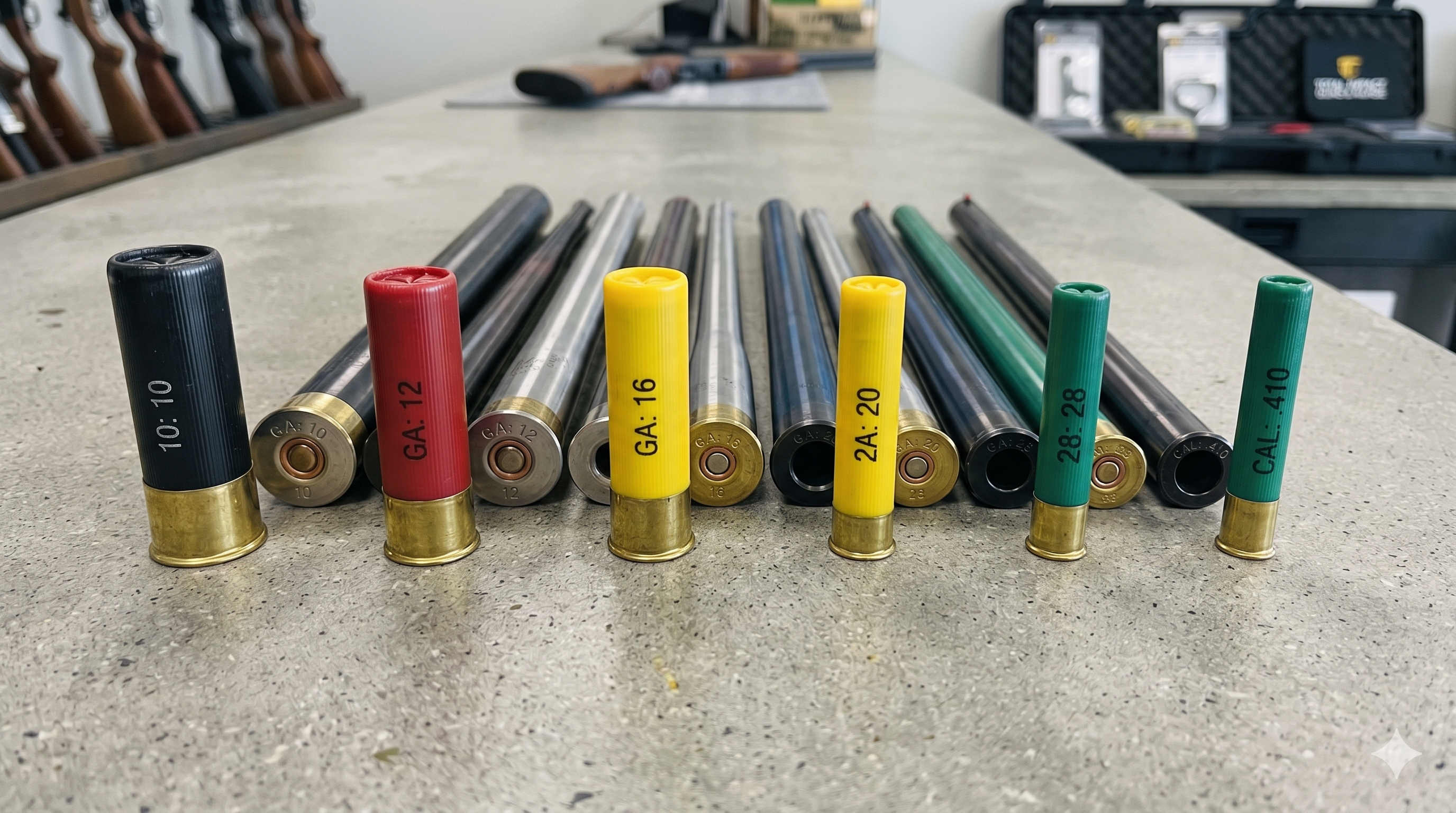
Shotgun Gauges Explained: 10, 12, 16, 20, 28, and .410
Posted by Joel Sheran on May 9th 2026
Shotgun gauges are one of those naming systems where the number works backwards. A 12-gauge has a bigger bore than a 20-gauge, a 10-gauge is bigger still, and the .410 isn't actually a gauge at all. If you've ever stood in front of a shotgun rack feeling like the labels are testing you, that's because they kind of are.
This guide walks all six shotgun gauges still in regular production, what each one is good for, and how to land on the right one without anyone upselling you on a 3 1/2-inch magnum 12 when a 20 would do the job better.
What Is a Shotgun Gauge?
Gauge measures the bore diameter of a shotgun in a system left over from the days before metric. The gauge number equals how many lead balls of bore-diameter size it takes to weigh one pound. Twelve balls the size of a 12-gauge bore weigh a pound. Twenty balls the size of a 20-gauge bore weigh a pound. Smaller balls, more per pound, bigger gauge number. That's the inverse-numbering quirk in one sentence, and it's why a 12 is bigger than a 20. The .410 is the exception. It skips the lead-ball math and is named for its actual bore diameter in inches, .410. If you forced it into the standard system it would be roughly a 36 gauge, per Wikipedia's gauge entry.
A handful of gauges are still produced today: 10, 12, 16, 20, 24, 28, 32, and .410. The 12 and 20 dominate the U.S. market by a wide margin; the rest occupy real but narrower niches.
Shotgun Gauge Comparison Chart
Before the gauge-by-gauge walkthrough, here's the cheat-sheet view. Every gauge in one place, with the specs that actually matter when you're picking one.
| Gauge | Bore diameter | Common shell length | Standard payload | Recoil tier | Weight tier | Primary use cases |
|---|---|---|---|---|---|---|
| 10 ga | 0.775 in / 19.7 mm | 3 1/2" | 1 3/4 - 2 1/4 oz | Heaviest | Heaviest (10-12 lb) | Late-season waterfowl, big-bore turkey |
| 12 ga | 0.729 in / 18.5 mm | 2 3/4", 3", 3 1/2" | 1 1/8 oz | Heavy | 7-8 lb | Anything: hunting, defense, clays, slugs |
| 16 ga | 0.665 in / 16.9 mm | 2 3/4" | 1 1/8 oz | Moderate | 6.5-7 lb | Upland, traditionalists |
| 20 ga | 0.615 in / 15.6 mm | 2 3/4", 3" | 1 oz | Lighter | 6-6.5 lb | Upland, all-day carry, recoil-sensitive shooters |
| 28 ga | 0.550 in / 14.0 mm | 2 3/4", 3" | 3/4 oz | Light | 5.5-6 lb | Skeet, upland, sub-gauge turkey with TSS |
| .410 | 0.410 in / 10.4 mm | 2 1/2", 3" | 1/2 - 11/16 oz | Lightest | 5-5.5 lb | Pest, snake, turkey with TSS, niche |
Bore-diameter and shell-length figures pull from Wikipedia's gauge reference. The recoil tiers reflect free-recoil energy at typical loads in Chuck Hawks' shotgun recoil table. Gun weights are typical for pump-action production guns at each gauge; the assumed gun weights in the recoil calculations match.
The next sections walk each one in detail.
10-Gauge: The Specialist
The 10-gauge is the biggest production shotgun gauge you can still buy off the shelf, and it almost stopped being one. When non-toxic shot rules came in for waterfowl, the 10's larger shell volume gave it room for low-density steel pellets the 12 couldn't match at the time. The 10 "narrowly escaped obsolescence" by becoming the steel-shot waterfowl gauge of choice, per Wikipedia. Then the 3 1/2-inch 12-gauge magnum closed most of that performance gap, leaving the 10 in a narrower lane than it once held.
Where it still earns its keep: late-season waterfowl over big water, where the blinds are far and shot weights run heavy. Some big-bore turkey hunters still favor it. Outside those two niches, the 10 is hard to recommend. Pump and semi-auto 10s are heavy (10 to 12 pounds is normal), the recoil is punishing even at that weight, and ammo selection is thin compared to 12-gauge. Worth knowing about; rarely worth buying unless you have a specific reason that starts with "geese over decoys at 50 yards."
12-Gauge: The Default
The 12-gauge is the most versatile shotgun ever made, and the U.S. market reflects it. If you're buying one shotgun and don't yet know what you'll mostly do with it, this is the answer. Hunting any North American game, home defense, skeet, sporting clays, trap, slug deer hunting. The 12 does all of it.
Bore diameter on a 12 is nominally 0.729 inch (about 18.5 mm), per the Wikipedia gauge entry. Some production guns run "overbore" barrels slightly larger than nominal, claimed to soften felt recoil and improve patterning.
The 12 is stiffer than the smaller gauges, but it's not punishing in a well-fitted gun with the right load. A 7.5-pound 12-gauge firing a 1-ounce target load produces about 17 ft-lbs of free recoil, per Chuck Hawks' shotgun recoil data. A 1 1/4-ounce hunting load in the same gun is closer to 32 ft-lbs. Gun weight and load matter as much as the gauge number. Heavy gun + light load is a 12 that's pleasant all day; light gun + magnum load is a 12 that bruises.
For home defense specifically, the 12 has been the standard for decades because of payload flexibility and ammo availability. Our complete home-defense firearms guide compares shotguns against handguns and rifles for the role.
If you're shopping, our 12-gauge shotgun lineup covers pumps, semi-autos, and over-unders across the price range.
16-Gauge: The Vintage Gauge That Refuses to Die
The 16-gauge gets written off a lot, and the framing is half-right. Ammo is harder to find than 12 or 20, costs more per box, and most major manufacturers offer a thin 16-gauge lineup. If you walk into a typical retailer expecting a wall of 16s, you'll be disappointed.
The other half of the framing is wrong. The 16 isn't dead. CZ still makes the Bobwhite in 16, and Browning brought the A5 Sweet Sixteen back. There's a small but real contemporary lineup, and the people who own a 16 tend to keep it for a reason. The reason is load math: a standard 16-gauge shell carries 1 1/8 ounces of shot, exactly the same as a 2 3/4-inch 20-gauge magnum and only 1/8 ounce less than a standard 12-gauge load, per Let's Go Shooting. Near-12-gauge payload out of a noticeably lighter, livelier gun. For upland hunters who carry all day, that's a real argument.
If you don't already love the 16 or have a specific reason to buy one (an inherited gun, a Sweet Sixteen you've always wanted), the 12 or 20 will serve you better and cost you less to feed. Don't start a collection on a 16. Don't write one off either.
20-Gauge: The All-Day Carry Gun
The 20-gauge is the second-most-common shotgun gauge in the U.S. and the gauge a lot of experienced shooters land on after a few thousand rounds through a 12 convince them they want something easier on the shoulder. It carries a standard 1-ounce payload, runs in a typical pump weight of about 6 to 6.5 pounds, and produces around 21 ft-lbs of free recoil with a standard target load, per Chuck Hawks. Measurably less than a 12 in the same setup.
The use case the 20 owns outright is upland on foot. Pheasant, quail, grouse, woodcock, dove. You're walking miles with the gun in your hands and mounting fast on flushes, and a lighter, livelier gun does that work better than a 7.5-pound 12 will. Add a 3-inch magnum 20-gauge load and you've closed a lot of the performance gap to a 12 in the field without carrying the weight all day.
The 20 also makes sense for shooters who want a serious shotgun without a serious recoil bill. Older shooters returning to the range, smaller-statured adults, and shooters whose 12 has started to feel like work all benefit. That framing is real but not the whole story. Plenty of experienced 12-gauge owners pick up a 20 for upland and never look back, and they're not avoiding recoil. They're picking the right tool.
For home defense, the 20 is a legitimate alternative to the 12 if recoil is a factor. Modern 20-gauge buckshot loads are effective at typical home-defense distances, and the gun weight is friendlier for a lighter shooter to handle.
If you're shopping, the 20-gauge selection on our site covers pumps, semi-autos, and break-actions.
28-Gauge and the Sub-Gauge Revival
The 28-gauge has had a quiet comeback over the last decade, and most buyers haven't caught up to it yet. The case used to be "skeet shooters and upland traditionalists." It now includes turkey hunters running TSS, recreational shooters who want the lightest gun that still throws a real payload, and anyone tired of fighting their shotgun.
Vin T. Sparano, excerpted in Let's Go Shooting, put it this way: "The 28-gauge is slim and light with not much recoil. On a skeet range, it is a pure joy to shoot." A standard 28-gauge target load in a 6-pound gun produces about 13 ft-lbs of free recoil, per Chuck Hawks, meaningfully less than a 20 and roughly half of a hunting-weight 12.
The bigger story is TSS. Tungsten Super Shot runs about 18 g/cc in density, roughly 60% denser than lead, so a smaller payload of TSS pellets carries the same downrange energy as a much heavier lead payload. As the Savage Arms blog lays out, this has put 28-gauge (and .410) into legitimate turkey-hunting territory at traditional 40-yard ethical distances. The community has noticed. A Reddit r/Shotguns discussion captures the sentiment: 28-gauge has had "a revival of sorts lately. You can get a very light and handy gun that can throw as much shot as standard 20g loads."
One caveat, because buyers most often get this wrong: small gauge does not always mean less recoil. A very light 28-gauge field gun firing a stout 3-inch load can kick harder than a heavy 12-gauge target gun firing a light dove load. Gauge is one variable; gun weight and load matter just as much. Match the load to the use case, not the bore number.
.410 Bore: The Smallest Production Shotgun
The .410 is the gauge that isn't a gauge. As covered in the introduction, it's named for its bore diameter in inches and would technically be a 36 gauge under the standard system. The .410 also gets stuck with more outdated framing than any other shotgun on the rack, which is worth clearing up.
The framing that needs to retire: ".410 is a starter gun for kids." It isn't, and the reasoning is more interesting than the slogan. A .410 throws a small payload (1/2 oz in 2 1/2-inch shells, 11/16 oz in 3-inch) out of a very light gun. That combination is unforgiving for a new shooter. Light pellet narrows the margin for error on lead and aim, and the light gun produces more felt recoil per shot than the bore size suggests, with about 7 ft-lbs from a standard load and 10.5 ft-lbs from the 3-inch, per Chuck Hawks. New shooters miss with .410s constantly and learn bad habits doing it. A 20-gauge with a low-recoil load is a much better learner platform.
What the .410 actually is: a serious turkey gun in skilled hands when loaded with TSS, per the Savage Arms blog on TSS turkey performance. A capable small-game and pest-control gun. A legitimate "snake gun" for rural property maintenance. And in a higher-end double, an enjoyable upland gun for shooters who want a challenge.
Different gun for different reasons than the tradition suggests. Skilled hunter, niche pursuits, deliberate choice: yes. Eight-year-old's first shotgun: probably not.
How Do Shotgun Gauges Compare in Power?
A few common comparison questions come up. Quick answers, with the table above doing the heavy lifting on the numbers.
Is a 12 or 20-gauge stronger? The 12 throws more shot per shell (1 1/8 oz standard vs 1 oz) and at higher recoil energy, translating to more downrange energy at similar velocities. The 20 is plenty for almost any North American game inside its effective range, but if "stronger" is the only metric, the 12 wins. We'll have a dedicated 12-vs-20 comparison post coming for buyers weighing that specific decision.
Which is more powerful, a 12 gauge or 16 gauge shotgun? The 12 carries 1/8 oz more shot in a standard load, so it's marginally more powerful. A 16-gauge load matches a 20-gauge magnum and gets within 1/8 oz of a 12-gauge standard, which is why people who own 16s tend to keep them.
Is a 10 or 12 gauge more powerful? The 10 carries more shot per shell (1 3/4 to 2 1/4 oz) and runs through a 3 1/2-inch hull. It's more powerful on paper. The 3 1/2-inch 12-gauge magnum has closed enough of that gap that the 10 lives in a narrower performance window than it once did.
Which Gauge Should You Pick?
The honest first answer is "just buy a 12-gauge," and it's been the right answer for most American shotgun buyers for the last 20 years. The 12 is the most versatile, the cheapest to feed, and the easiest to find ammo for in any town with a feed store.
After walking through six gauges, the case for picking based on use deserves a fairer hearing. Here's the matchmaker version:
- Mostly waterfowl over decoys. 12-gauge or 20-gauge 3-inch magnum. Heavy payloads, ethical ranges, you'll be glad you have the magnum option.
- Mostly upland on foot. 20-gauge or 28-gauge. Lighter gun, faster mount, all-day carry doesn't beat you up.
- Mostly home defense. 12-gauge first, 20-gauge if recoil is a serious concern. Both work; the 12 has the broadest ammo selection for the role.
- Mostly clay sports. 12-gauge for trap and most sporting clays courses, 28-gauge for skeet and as a second gun for fun.
- Mostly turkey with TSS loads. Any sub-gauge (20, 28, or .410) that fits you well. TSS has flattened the gauge-vs-effectiveness conversation here.
- First shotgun, no specific use yet. 12-gauge for maximum versatility, 20-gauge if you want it lighter and easier to learn on. Both are correct answers.
Pick the gauge that matches what you'll actually do with the gun, not what's most popular in the rack. The most common answer is still the 12, and that's fine. It just shouldn't be the only answer on offer.
Conclusion
Gauge picks the platform; gun fit and the load you run through it do most of the work after that. A well-fitted 20 with the right load will outshoot a poorly-fitted 12, and two 12-gauges of different weights and stock geometries can feel like completely different guns.
If you've narrowed it down, browse our shotgun lineup covering all the major gauges and configurations, with shipping straight to your FFL of choice. If you're local to the Sarasota area, the indoor range at the shop keeps rentals across the common gauges so you can try a 12 and a 20 back-to-back before you commit.