
Types of Shotgun Actions: Pump, Semi-Auto, Over/Under & More
Posted by Total Impact Guns & Range on Sep 30th 2026
TL;DR. The types of shotgun actions come down to three families: pump-action, semi-automatic, and break-action, which covers over/under, side-by-side, and single-shot guns that hinge open for loading. You cycle a pump by hand, sliding the forend back and forward to eject and chamber shells. A semi-auto loads the next shell on every trigger pull, using either recoil inertia or propellant gas. Gas-operated guns soften felt recoil, while inertia guns run lighter and cleaner.
Walk down a row of shotguns and you'll notice they don't all work the same way. Some you pump, some load themselves, and some swing open on a hinge. That difference decides how many shells you can fire, how quickly you can fire them, how hard the gun kicks, and what you'll pay, so it's worth sorting out before you get attached to a particular make or model.
What a shotgun action is and why it matters
The action is the working part of the gun. It's the mechanism that loads a shell, fires it, pulls out the empty, and throws it clear so the next shell can go in. That makes it the first decision most shotgun buyers make, whether they realize it or not, because most of what you'll feel behind the gun traces back to it. The action drives how many shells you can load, how fast you can get a follow-up shot, how hard the gun kicks, how reliably it runs, how much cleaning it needs, and what it costs at the counter.
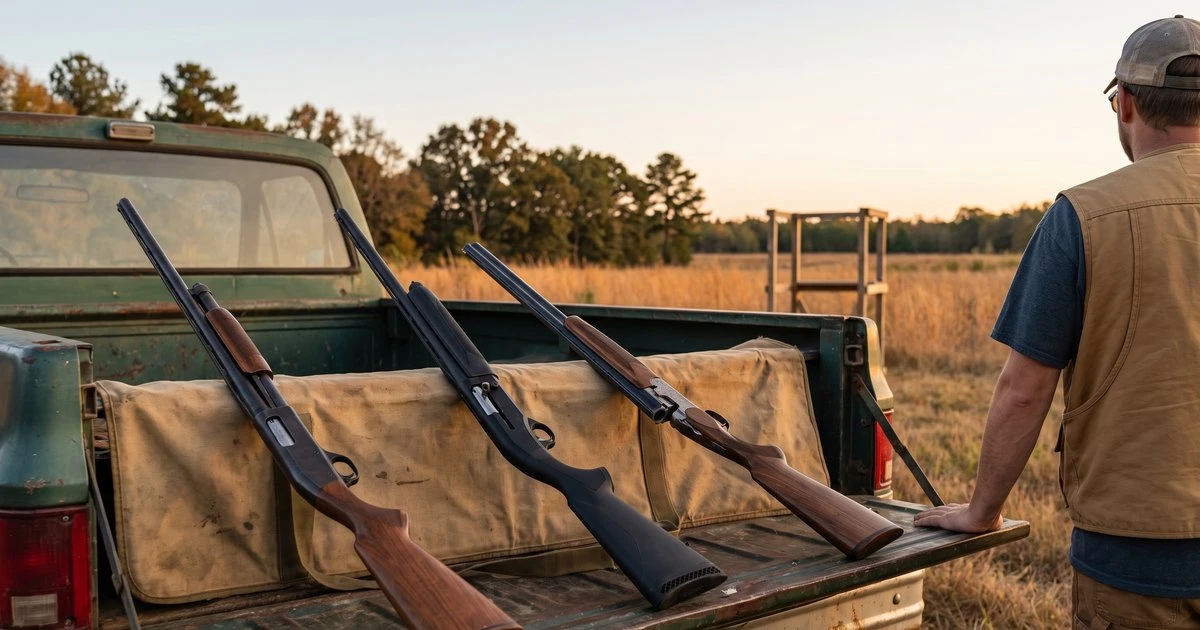
Shotguns fall into three main families: pump-action, semi-automatic, and break-action. Break-actions split again into over/under, side-by-side, and single-shot designs. Lever-action and bolt-action shotguns exist too, but they're niche, so this guide sticks to the big three. If you want another take on the basics, Hunter-Ed's overview of common actions on rifles and shotguns covers them.
Action isn't the only choice that narrows the field, though. Gauge does it just as fast. Gauge is the size of shell a shotgun is built to fire, and we lay out how shotgun gauges compare, from 10 gauge to .410 in a separate guide. Pick your action and your gauge, and most of the wall is ruled out for you.
Pump-action shotguns
A pump-action shotgun runs on your arm. Slide the forend (the grip under the barrel) back and the spent shell comes out. Push it forward and a fresh shell moves from the magazine tube into the chamber. That's the whole cycle, and you supply the power for every step.
Because your arm powers the action instead of recoil or gas, a pump cycles light target loads, heavy magnum loads, and specialty rounds without caring which one you fed it. A semi-auto can be picky about very light loads, but a pump isn't.
Pumps are easy on the budget, and one gun can do a lot. Many accept interchangeable barrels, so the same shotgun can cover hunting, clay shooting, and home defense with a barrel swap. For a first shotgun, or the only one you'll ever own, that's hard to beat.
The downsides mostly land on the shooter. Under stress it's easy to short-stroke a pump, which means not pulling the forend all the way back or pushing it all the way forward, so the shell doesn't eject or chamber and the gun stalls. A pump also kicks harder than a gas semi-auto because nothing in the action is soaking up recoil, and running one smoothly takes practice. Working the forend fast and correctly every time is a skill you build at the range.
You can see what we stock in our pump-action shotgun lineup.
Semi-automatic shotguns, inertia versus gas
A semi-automatic shotgun chambers the next shell for you every time you pull the trigger. There's no pumping between shots, so follow-ups come fast and you can keep your attention on the target instead of on working the gun.
What powers that cycle splits semi-autos into two camps. A gas-operated gun bleeds off some of the propellant gas from the barrel and uses it to run the action. That spreads the recoil out, which makes the gun softer to shoot. An inertia-driven gun skips the gas system altogether. Its recoil energy compresses a spring behind the bolt, and that spring does the cycling. With no gas parts, an inertia gun ends up lighter and slimmer, with fewer parts to foul. NRA Family's explainer on the difference between gas-operated and inertia-driven shotguns goes deeper on how each system works.
Gas guns favor recoil comfort and handle a wider range of loads. Inertia guns favor light weight, easier cleaning, and reliability when conditions are wet or dirty.
Semi-autos as a group come with a few drawbacks. They cost more than a comparable pump, they need more cleaning, and some are sensitive to very light loads. If a semi-auto is starting to sound right, browse our current semi-automatic lineup.
Over/under and side-by-side shotguns
Over/unders and side-by-sides are both double-barrel break-actions. The barrels hinge open at the breech, you drop a shell in each chamber, and you close the gun and shoot. You get two shots, a quick second one, and no magazine to manage.
Two barrels also means two chokes. A choke is the tightening at the muzzle that controls how much the shot spreads. Run a more open choke in one barrel and a tighter one in the other, and you can take a close first shot and a longer second shot, each with a different pattern.
The over/under stacks the barrels one on top of the other. That gives you a single narrow sighting plane, a low recoil line so the kick comes straight back into your shoulder, and a balance that many shooters find easier to aim. Those are the reasons the over/under dominates clay sports.
The side-by-side puts the barrels next to each other, and it's the traditional upland gun, the kind you carry while walking fields and woods for birds like pheasant and quail. It's lighter and quicker to open, though the wide sighting plane takes some shooters more practice to get used to. American Rifleman's look at side-by-side versus over/under shotguns lays out the tradeoffs in more detail.
Both designs share the same downsides. You have two shots before you have to open the gun and reload, prices run higher once you get into quality guns, and neither is a great fit for home defense.
They do have one safety benefit. With the action hinged open, anyone can see at a glance that the gun is unloaded, which matters on a clay field or in a hunting party.
Single-shot break-action shotguns
The single-shot is the simplest shotgun there is. It has one barrel, loads one shell at a time, and has the fewest moving parts of any shotgun. You break it open, drop in a shell, close it, and shoot.
That's why it's such a common starter gun. It costs little, it's easy to operate, and an open action shows at a glance that the gun is unloaded, which is a nice thing to have when you're teaching someone new.
Single-shots have some specialty jobs, too. Some are set up as dedicated turkey guns or slug guns, and they're good at teaching shot discipline. When every shell counts, you slow down and make the shot.
You only get one shot, reloads are slow, and single-shots are usually very light, so the recoil is sharper than you'd expect from such a simple gun.
Shotgun actions compared side by side
Here's how the six actions stack up on the traits that matter most when you're buying. The ratings are relative, so they show how one action compares with the rest and aren't exact figures.
| Action | Capacity | Follow-up speed | Felt recoil | Ammo flexibility | Maintenance needed | Relative price |
|---|---|---|---|---|---|---|
| Pump | High | Moderate | Moderate | High | Low | Low |
| Gas semi-auto | High | High | Low | Moderate to high | High | Moderate to high |
| Inertia semi-auto | High | High | Moderate | Moderate | Moderate | Moderate to high |
| Over/under | Low (2 shots) | Moderate | Low to moderate | High | Low | Moderate to high |
| Side-by-side | Low (2 shots) | Moderate | Moderate | High | Low | Moderate to high |
| Single-shot | Low (1 shot) | Low | High | High | Low | Low |
Pumps give you the best mix of value and flexibility, which is why they're the default all-rounder. Gas semi-autos are the softest shooters of the group, at the cost of more cleaning and a higher price. The break-actions trade capacity for simplicity and low upkeep, and the single-shot is the cheapest and simplest of them all, with the sharpest kick.
Which shotgun action fits how you shoot
Start with what you'll use the gun for, and the list gets short fast.
- Home defense. Pumps and semi-autos are the usual picks, because they hold more shells than a double-barrel. Whichever you choose, practice with it matters more than the action itself, and a pump you know cold beats a semi-auto you've barely shot. For specific models, see our picks for the best home-defense shotguns, and our home defense firearms guide covers how shotguns fit alongside handguns and rifles.
- Clay sports. Over/unders are the go-to for trap, skeet, and sporting clays, thanks to the single sighting plane and balance. Shooters who are sensitive to recoil and burn through a lot of shells in a day do well with a gas semi-auto, since the softer recoil is easier on the shoulder when the round count climbs.
- Hunting. For upland walking, over/unders, side-by-sides, and inertia semi-autos are the natural picks, because you carry the gun a long way and only shoot it now and then. Side-by-sides and inertia guns are also light, which helps on a long walk. For waterfowl and turkey, pumps and semi-autos are the usual picks, since capacity and heavy loads matter more there.
- New, young, and smaller-framed shooters. A single-shot keeps things simple and makes every shell count, but its light weight means it kicks. A soft-shooting gas semi-auto can make learning easier. Gauge shapes recoil as much as action does, so if the kick is the worry, look at the 12 gauge versus 20 gauge decision before you settle on anything.
How to choose your first shotgun action
Three questions get most people to an answer.
- What is the gun for? Home defense, clays, hunting, or a mix. The job alone usually narrows the field to one or two actions.
- How much recoil can you handle? Be honest about it, because you won't practice with a gun that punishes you. If recoil is a concern, lean toward a gas semi-auto or a smaller gauge.
- How much do you want to spend, and how much cleaning will you do? Pumps and single-shots keep the price and the upkeep down. Semi-autos cost more and need more cleaning, gas guns most of all.
Whatever the answers say, handle and shoot more than one action before you buy. How a gun mounts and cycles in your hands often settles the choice on its own. Our indoor range is attached to the shop, so you can try the difference in person. When you're ready to start looking, see our full shotgun selection.