
NICS Background Check Explained: What Happens at the Counter
Posted by Total Impact Guns & Range on Sep 30th 2026
TL;DR. The NICS background check is the FBI's national system for confirming a buyer can legally receive a firearm from a licensed dealer. The dealer runs it after you show a photo ID and fill out ATF Form 4473 at the counter. In 2025, about 92 percent of checks handled by the FBI's NICS Section got a final answer within minutes.
Every check ends one of three ways: proceed, delayed, or denied. A delay gives the FBI three business days to finish, after which federal law generally lets the dealer transfer the gun unless state law says otherwise.
If you've never bought a gun from a dealer, the background check is probably the part you're wondering about most. You hand over your name and address, answer some questions about your past, and wait while a government system gives the dealer a yes or no. It sounds heavier than it is, and for most buyers it's a few minutes standing at the counter.
Much of the nervousness comes from lumping three separate things together: the federal check, the paperwork that starts it, and any waiting period your state adds on top. They're different animals, and once you see which is which, none of it is complicated.
What NICS is and who runs it
NICS stands for the National Instant Criminal Background Check System. The FBI runs it, and every licensed dealer has to complete a check through it before transferring a firearm to you. It was created under the Brady Act of 1993 and has been running since November 30, 1998, according to the FBI's 2025 NICS Operational Report.
Where the check goes depends on your state. Some states act as their own point of contact, so the dealer sends the check to a state agency instead of the FBI. Others route checks straight to the FBI. Florida is a point-of-contact state, which means Florida dealers submit checks to the Florida Department of Law Enforcement (FDLE), and FDLE searches state records on top of the federal ones.
You don't need to work out which kind of state you live in, since your dealer already knows where the check goes.
What happens at the gun counter
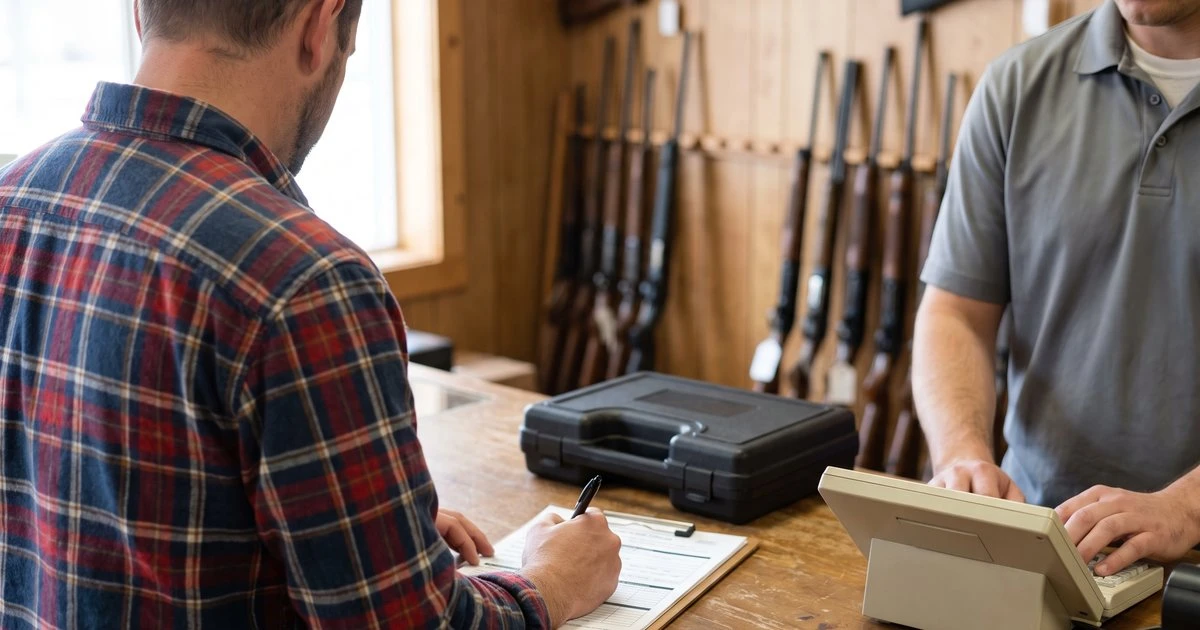
The order of events is the same almost every time. You pick out the gun. You show a valid government photo ID. You fill out Form 4473, the ATF's transaction record. Then you wait while the dealer submits the check.
The dealer does the contacting, not you. That contact goes to NICS or the state agency, most often online through the FBI's E-Check system, so you don't call anyone or file anything yourself.
The process is the same if you bought a gun online and had it shipped to a dealer for pickup. You still show ID and fill out the form, and the dealer still runs the check before handing the gun over. Our guide on how an FFL transfer works covers that route in more detail.
When everything's clean, the check usually wraps up while you're still standing at the counter.
The Form 4473 questions in plain English
Form 4473 is the ATF's Firearms Transaction Record. It captures your identity details, then runs through a series of yes-or-no questions about whether you're eligible to buy. The ATF keeps the current version on its Form 4473 revisions page.
The "actual buyer" question asks whether you're buying the gun for yourself. If you're buying it on behalf of someone else, that's an illegal straw purchase, even when you're the one paying for it. If you're not sure whether your situation counts, ask the dealer before you sign anything.
The rest of the form is a yes-or-no tour of the federal disqualifiers, covering things like your record, whether you're a fugitive, court orders against you, and drug use.
Whatever the question, answer it honestly. A false answer on the form is a federal crime in its own right, separate from whether the check clears. If a question is unclear, ask the dealer instead of guessing.
The drug-use question is changing in 2026, after a Supreme Court ruling and a proposed revision to the form. Go by the wording on the form in front of you, not what an older article says about it.
What the background check screens for
NICS searches three national databases. Between them they cover criminal history, wanted persons and protection orders, and other federal prohibiting records.
What the search is built to catch is the list of federal disqualifiers. In plain terms, that's a felony-level conviction, a domestic violence conviction, an active protection order, fugitive status, certain formal mental health adjudications, or a dishonorable discharge from the military. Checks also account for state-level prohibitions, which vary depending on where you live and where the sale happens.
The match runs on your name and descriptive details, not fingerprints. That's why a common name occasionally triggers a closer look. It comes down to the system sorting out which of several similar records is yours, and it says nothing bad about you.
If none of that applies to you, there's nothing to prepare beyond an accurate form and a valid ID.
Proceed, delayed, or denied: the three possible results
Every check comes back as one of three results.
- Proceed. This is the green light, and the dealer can complete the sale. It's by far the most common result.
- Delayed. The system needs more research before it can answer. A delay isn't a denial but a request for more time, and it usually traces back to an incomplete record or a look-alike one, meaning a file that resembles yours closely enough to need a second look.
- Denied. The sale stops. The check turned up a record that bars it, and sometimes that record turns out to belong to someone else. You have the right to learn the reason and challenge it.
Florida's state agency uses its own wording for the same three outcomes. Approved means proceed, decision pending means delayed, and non-approved means denied.
How long a NICS check takes
For most buyers, the answer comes back fast. In 2025, about 92 percent of checks handled by the FBI's NICS Section got a final answer within minutes, per the FBI's own 2025 numbers. That leaves a small share that need more research, and those are the checks that go into a delay.
When a check does go into delay, the FBI has three business days to finish it. If no denial has come back by the end of that window, federal law generally lets the dealer go ahead and transfer the gun.
That three-day default is permission, not an obligation. Some dealers choose to wait for a final answer instead, and state law can override the default.
Buyers under 21 can face an enhanced check of up to 10 business days, in states where state law lets them buy.
If the FBI still can't reach an answer, it keeps researching the check, then purges it after 90 days if there's still no answer.
State rules that can add time
The federal check is only one layer. Some states add waiting periods, permits to purchase, or their own record checks on top of NICS, so the total time from counter to carrying the gun home varies a lot by state. A waiting period isn't a delay. Your check can clear in minutes and the waiting period can still be running.
Florida makes a good worked example. The purchase age there is 21 and over, and there's a three-day waiting period on firearm purchases. That's three days not counting weekends and legal holidays, or until the background check is complete, whichever comes later. FDLE handles Florida's checks as the state's point of contact, and its Firearm Purchase Program FAQs explain how they're processed.
Some Florida buyers skip the waiting period altogether. Concealed weapon license holders are exempt, and so are trade-ins and rifle or shotgun buyers with a valid Florida hunting license or hunter safety certification. If you're weighing the license, skipping the waiting period is one practical perk, and our breakdown of whether a Florida concealed weapon license is worth getting goes through the rest.
If you're buying from out of state or ordering online, check your home state's rules before you order. Those rules follow you, not the shop. Our walkthrough of the full ship-to-FFL process for online orders covers how that route works.
What to do if your check is delayed or denied
If your check comes back delayed, keep the transaction number from the dealer and follow up on it. Most delays resolve within the three-business-day window anyway, so it's usually a short wait. If it runs longer, whether the dealer transfers or waits for a final answer depends on the dealer and your state's rules.
If you're denied, you can request the reason and file a challenge. Florida buyers appeal through FDLE rather than the FBI.
In 2025, 27 percent of challenged federal denials were overturned, most often because fingerprints proved a case of mistaken identity, according to the FBI's appeal figures for that year. The check itself matches on your name and descriptive details, so fingerprints are what settle whose record it is.
Buyers who keep getting delayed, or who share a name with someone else's record, can look into the FBI's Voluntary Appeal File. It gives you an ID number that speeds up future checks.
And if you have an old conviction, an expunged record, or a protection order that complicates whether you're eligible, talk to a qualified firearms attorney. They can tell you where you stand.
What happens to your information afterward
Some first-time buyers hold off because they don't want their information sitting in a government file. Federal law requires NICS to purge identifying details from an approved check within 24 hours of notifying the dealer.
The dealer does keep the completed Form 4473 in its own records, because the law requires it. That's a record kept at the shop, which is different from a government registry.
Buying your next firearm through Total Impact
When you buy here, we handle the check ourselves. Your only job is to bring valid ID and answer the form accurately, and if a question on it looks confusing, ask our team at the counter.
If you're still deciding what to buy, start with our handgun buying guide for first-time owners before you head to the counter. We run checks in-store and handle transfers for online orders, and if you're picking up locally, ordering directly through us is the simplest route. Total Impact is a certified FFL dealer, and running these checks is part of the job.
When you're ready, you can browse our online store.