
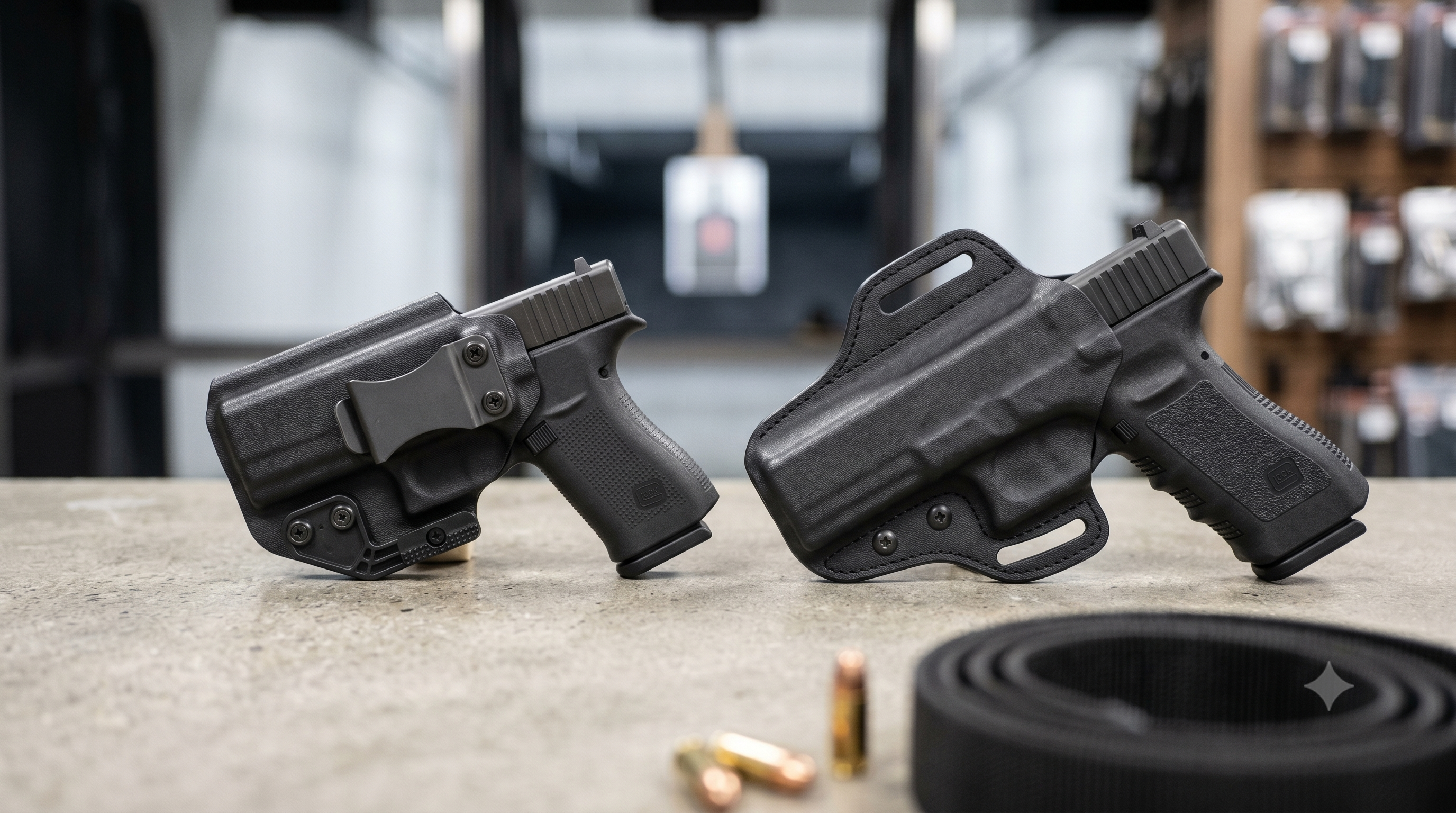
IWB vs OWB Holster: Which Carry Style Actually Fits Your Life
Posted by Joel Sheran on Jun 9th 2026
If you're carrying daily and trying to decide whether to stick with IWB or move to OWB, here's the short version. An IWB holster sits inside your pants for a discreet, concealed setup, and an OWB holster rides outside the waistband, attached to your belt. IWB wins on concealment. OWB wins on comfort and draw speed. Everything else comes down to how you live.
That last part is where most articles tap out. They run a pros and cons list and finish with "it's personal preference." So this IWB vs OWB holster post does it differently. We'll walk through five variables that decide for your body, your gun, and your week, then run four lifestyle scenarios. We covered the broader basics in our complete guide to concealed carry; this one zooms in on the holster decision.
IWB vs OWB at a Glance
There are four trade-offs you're weighing; every other consideration is a downstream version of one of them.
Concealment. IWB hides the gun inside your waistband, so the holster body and most of the grip live below your belt line. OWB rides outside the pants, so you need a longer or looser cover garment (the shirt, jacket, or untucked top doing the concealing) to keep the gun out of sight.
Comfort. OWB tends to be more comfortable for all-day wear because the belt isn't pulling the holster tight against your skin. IWB puts kydex or leather on your hip for ten-plus hours, and it takes a while for your body and the holster to broker a peace deal.
Draw speed. OWB is faster; the gun is already outside your clothing, so you grip and pull. With IWB, your hand has to clear the cover garment first. The difference is real but measured in tenths of a second.
Gun-size compatibility. Compact and mid-size pistols pair well with IWB. Full-size guns work better in OWB because larger handguns may be harder to conceal or may dig into the body when you tuck them inside your waistband.
The decision lives in the next four sections.
Inside-the-Waistband (IWB), Honestly
IWB earns its reputation because it conceals better than almost anything else. Slip a properly fit rig under a fitted t-shirt and you're carrying without anyone around you noticing. That's why most daily carriers start here.
The trade-offs are honest, though. IWB holsters are often more secure than OWB because they're harder to grab and less likely to snag, but you pay with comfort. The holster sits between your hip and your jeans all day. Spring metal clips can show at the belt line if your shirt rides up, which is something to watch for. The draw is slower too, because you have to clear your shirt before you can establish a grip.
A few terms worth defining inline. Cant is the angle the holster sits at relative to your belt; a forward cant (FBI cant) is most common for hip carry. Ride height is how high or low the gun sits; lower hides more grip but slows the draw a fraction. A tuckable holster is an IWB design that lets you tuck a button-down between the holster and the gun, with only the clips visible at the belt line.
One non-negotiable for either style, especially IWB: a real gun belt. USCCA notes IWB clips work best over a sturdy 1.5-inch belt. A gun belt is reinforced (leather core, kydex insert, or polymer stiffener) so it carries the weight of a holstered firearm without sagging. A dress belt is not the same thing, and it's the single most common upgrade new carriers skip.
AIWB: A Third Path Worth Naming
Appendix-inside-the-waistband carry, AIWB, is IWB worn at the front of the body, usually 12 to 1 o'clock for right-handed shooters. It behaves like a third option, not a flavor of hip IWB.
What AIWB does well: strongest concealment of any waistband position and the fastest draw, since your hand is already in front of you. What it does badly: comfort drops sharply when seated, especially driving or at a desk. There's also a long-running safety debate. Some trainers flag concerns about the muzzle pointing toward the femoral artery on reholstering; others argue that with proper holster fit and reholstering technique, AIWB is no more dangerous than any other waistband position. If you go AIWB, take a class with someone who teaches it well and buy a holster designed for it.
Outside-the-Waistband (OWB): Not Just for Cops and Competition
There's an old line that OWB isn't real concealed carry. That stereotype dies the first time you see someone carry a full-size 1911 under a sportcoat for ten years and nobody notices. OWB conceals fine when the cover garment cooperates: a flannel, vest, untucked button-down, or sportcoat over a t-shirt.
What OWB does well is the inverse of IWB. The gun rides outside your pants, so it isn't grinding against your waistband all day. The draw is faster because there's no cover-garment dig before the grip. And full-size guns sit comfortably; a 5-inch 1911 or duty-size striker that wouldn't work IWB rides cleanly in OWB.
The cons of OWB carry are worth naming clearly. Concealment depends on the cover garment, so a hot day in shorts and a t-shirt forces a wardrobe change or a different rig. The gun prints (the visible outline of the holster through clothing) more easily if your shirt is tight or thin. And in tight spaces, like getting in and out of a car, the exposed grip can snag.
Three OWB construction types are worth knowing. A pancake has two panels of material with the gun riding between them; pulls the firearm tight to your body for better concealment. A paddle uses a flat paddle that slides inside your waistband while the holster body sits outside; easier on and off but rides further off the body. A belt-slide threads onto your belt through built-in loops; lowest profile of the three. 5.11 notes OWB holsters can occupy the same positions IWB does and, like IWB, require a good gun belt. Same 1.5-inch reinforced belt rule. Don't OWB-carry a full-size gun on a dress belt; it sags and the rig prints.
The Five Variables That Decide for You
Here's the framework. Score yourself honestly on each variable, and the right answer tends to fall out.
Concealment Priority
How discreet do you need to be, every day? If your job or setting means nobody can ever see anything, IWB is your default and AIWB is a serious option. Printing (the visible outline of the gun through clothing) is the metric you're managing. If you can wear a cover garment most of the time without it standing out, OWB opens up.
Draw Priority
How much does access speed matter for your week? For most everyday carriers, the answer is "less than the internet would have you believe." If your daily life puts you in higher-risk environments (late-night cash-handling, certain transport jobs), the weight on draw speed shifts and OWB or AIWB looks more attractive.
Gun Size
Compact and mid-size guns (Glock 43X, Sig P365, M&P Shield, Glock 19) pair naturally with IWB. Full-size guns (Glock 17, 1911, full-frame striker pistols) work better in OWB. The Glock 19 is the crossover; it lives comfortably in either style depending on body type. If you're comparing two of the most common CCW guns, our Glock 19 versus Sig P320 head-to-head walks through the size and shootability differences.
Body Type
Body type is the variable nobody wants to talk about, so most articles don't. We will, with respect.
Slim builds get the most flexibility; most positions work in either style, but there's less to "hide" the holster against, so the cover garment does more work.
Average builds are the default the holster industry designs around, so most rigs feel decent at the 3 to 4 o'clock hip position.
Athletic builds (broad shoulders, narrower hips) often do well with kidney carry (4 to 5 o'clock) for IWB, or a pancake OWB pulled in tight against the lower back area.
Where Do You Carry If You Have a Gut?
This deserves a real answer. Vedder is honest about it: the 2 o'clock position works particularly well for big guys since this is typically the region that falls between the love handles and stomach, making it a natural hiding place for an IWB holster. Forward of the hip but not full appendix. The contour of the lower belly hides the grip better than a 3 o'clock straight-hip carry, where the gun pushes into the love handle and prints. For OWB carriers with similar build, a pancake holster at 3 to 4 o'clock with a slightly longer cover garment is usually the answer. Belly carry rigs exist as a separate category if waistband carry isn't working for your body.
Daily Activity and Climate
What does a normal Tuesday look like? A desk job is different from on-feet trades, is different from driving four hours a day, is different from gym-to-errands-to-coaching. Each has a default that fits, which is why we run scenarios next. Climate is the quiet partner to activity; a November carry day in Pittsburgh and a July carry day in Sarasota are not the same problem.
Lifestyle Scenarios
The framework is portable. Here's what it looks like applied.
The office worker who tucks shirts daily. IWB tuckable, hip carry at 3 to 4 o'clock, mid-size striker like a Glock 43X or Sig P365XL. Pair it with a real gun belt and a shirt that isn't paper-thin. You'll forget it's there by month two.
The sales rep or real-estate agent who drives four-plus hours a day. OWB pancake at 3 to 4 o'clock, or IWB at the same position with a slight forward cant. Skip AIWB; seated comfort drops sharply with a gun in front, and the r/CCW threads are full of carriers who switched off appendix for the driving. Cover garment is usually a sportcoat or untucked button-down, which the job already calls for.
On-feet trades, nurses, retail managers. IWB hip or AIWB with a micro or compact pistol. Constant movement makes a small rig disappear, and you're rarely seated long enough to notice the AIWB downside. A loose work shirt is usually all the cover garment you need. Avoid OWB here; the snag risk in tight spaces is a real consideration.
Weekend casual or outdoor. OWB pancake or belt-slide with a full-size gun under a flannel, fishing shirt, or light jacket. Comfort and draw-speed advantages pay off, and the cover-garment requirement is a non-issue. A lot of weekday-IWB carriers switch to OWB on weekends specifically for this.
The Florida Heat Reality
If you're carrying in Florida, the IWB vs OWB calculus shifts. Summer here is mid-90s and 80-plus percent humidity for months. IWB and AIWB both pay a comfort tax; the kydex or leather sits against skin that's already sweating, and the rig can corrode faster than carriers from drier climates expect. OWB shifts moisture off your skin but creates a cover-garment problem, since a lightweight moisture-wicking shirt prints more than carriers usually realize. Most year-round FL carriers we talk to run an IWB tuckable or AIWB rig with a moisture-wicking undershirt as a sweat barrier, plus an OWB pancake for cooler months and casual weekends. (Permitless carry has been Florida law since July 2023, but the Concealed Weapon License is still worth having for 38-state reciprocity if you cross state lines.)
Most Carriers End Up With Both
Here's the truth nobody selling a single holster wants to say out loud: a year or two into daily carry, most committed carriers own multiple rigs. Vedder puts it well: both styles are excellent, but the differences are significant enough that they can't be used interchangeably. They solve different problems.
This isn't a vendor cop-out. Work week is different from weekend, summer is different from winter, and the gun you started with might not be the one you carry in two years. Most carriers settle into a primary rig (IWB or AIWB for daily) and a secondary (OWB pancake for casual or full-size days). Buy one good rig, run it for a few months, and let your day-to-day tell you what the second one needs to be.
If you haven't picked your carry gun yet, our roundup of the best concealed-carry pistols for new shooters covers the same considerations from the gun side.
Where to Go from Here
The IWB vs OWB holster decision is concealment versus comfort and draw speed, weighted against your body, your gun, and what your week actually looks like. Score yourself on the five variables, run the scenarios, and you'll have your answer.
A holster decision also feels more committal on a website than in your hand. Come by the shop and feel the difference between an IWB hip rig and an OWB pancake on your own belt before you commit; the indoor range is right there if you want to draw from a few setups before deciding. Once you've sorted the carry style, the next question is what you'll carry; take a look at our concealed-carry handgun selection for daily-carry pistols, or browse the wider self-defense handgun lineup if you're also weighing a home-defense option.