
How to Choose Your First Concealed Carry Handgun in 2026
Posted by Joel Sheran on Jul 7th 2026
TL;DR. The best first concealed carry gun is whichever one you'll actually carry every day and can still shoot straight when it counts. Most first-timers land on a 9mm, since it balances recoil, capacity, cost, and stopping power better than anything else on the shelf. Compact and micro-compact pistols dominate the carry market for good reason, trading grip size and round count for a gun that disappears under a shirt.
Most modern micro-compact 9mms now hold 10 rounds or more while still staying slim enough to carry comfortably. None of that matters if the gun doesn't fit your hand, so plan to rent or test-fire before you buy.
Choosing a concealed carry gun for the first time feels overwhelming because the market throws a hundred options at you before you've even figured out what questions to ask. Caliber, size, capacity, sights, safeties, the list keeps growing the more you research. What actually determines whether you carry a gun every day and shoot it well comes down to a handful of things, and none of them are the brand name on the slide or how a spec sheet reads.
Start with how you'll carry, not the gun on the shelf
Before you pick a model, figure out how, where, and how often you're actually going to carry it. That answer matters more than any single spec on the gun. A pistol that feels great in a store's display case can turn into dead weight in your nightstand if it doesn't fit your wardrobe, your daily routine, or your body type.
The easiest guns to conceal are usually the hardest to shoot well, and the guns that are easiest to shoot well are usually the hardest to hide. That tradeoff shapes almost every decision that follows. A tiny micro-compact disappears under a t-shirt but kicks harder and has a shorter sight radius. A full-size duty pistol shoots flat and points naturally but prints through a light jacket. Every choice below is really a negotiation between those two ends.
That negotiation matters even more if you live somewhere like Florida, where permitless carry means anyone 21 or older can buy a handgun and carry it concealed without ever taking a class. No instructor is going to walk a lot of first-time buyers through fit, function, or safe handling before they leave the shop. That raises the stakes on getting your first gun right, because you may be carrying it and depending on it before you've had formal instruction.
Caliber, size class, capacity, sights, and safety features each narrow the field a bit further, and the hands-on fit check at the end ties all of it together. For a broader look at what carrying every day actually involves, beyond the gun itself, our complete guide to concealed carry for new carriers covers holsters, permits, and daily habits. As NRA Family points out, the gun you can actually carry and shoot well beats the gun that looks most impressive on paper, every time.
Caliber: matching defensive performance to recoil you can manage
Caliber gets argued about more than almost anything else in the gun world, and most of that argument misses the point for a first-time buyer. The right caliber isn't the one with the biggest number stamped on the box. It's the one you can shoot accurately, carry comfortably, and afford to practice with regularly.
9mm is the default recommendation for nearly every first-time carrier, and there's a reason nearly every police department in the country carries it too. USCCA recommends 9mm for new shooters because it hits the sweet spot: recoil you can control shot after shot, magazines that hold more rounds than a comparable revolver, and ammo cheap enough that you'll actually go to the range and train instead of leaving your carry gun in the safe.
.380 ACP earns its spot in the smallest guns on the market, the ones built for a pocket or an ankle holster where a 9mm frame simply won't fit. Don't assume small caliber means soft recoil, though. A micro .380 in a tiny, light frame can snap in your hand just as much as a compact 9mm, sometimes more, because there's less gun there to soak up the recoil.
If you're leaning toward a revolver instead of a semi-auto, .38 Special is the standard carry round for that path. It's controllable, it's been carried by generations of officers and civilians, and a good snub-nose revolver is about as simple a manual of arms as exists.
Whatever caliber you land on, pick the one you'll actually put rounds through at the range. A 9mm you shoot every month beats a bigger caliber that makes you flinch and skip practice.
Size class: the concealment versus shootability tradeoff
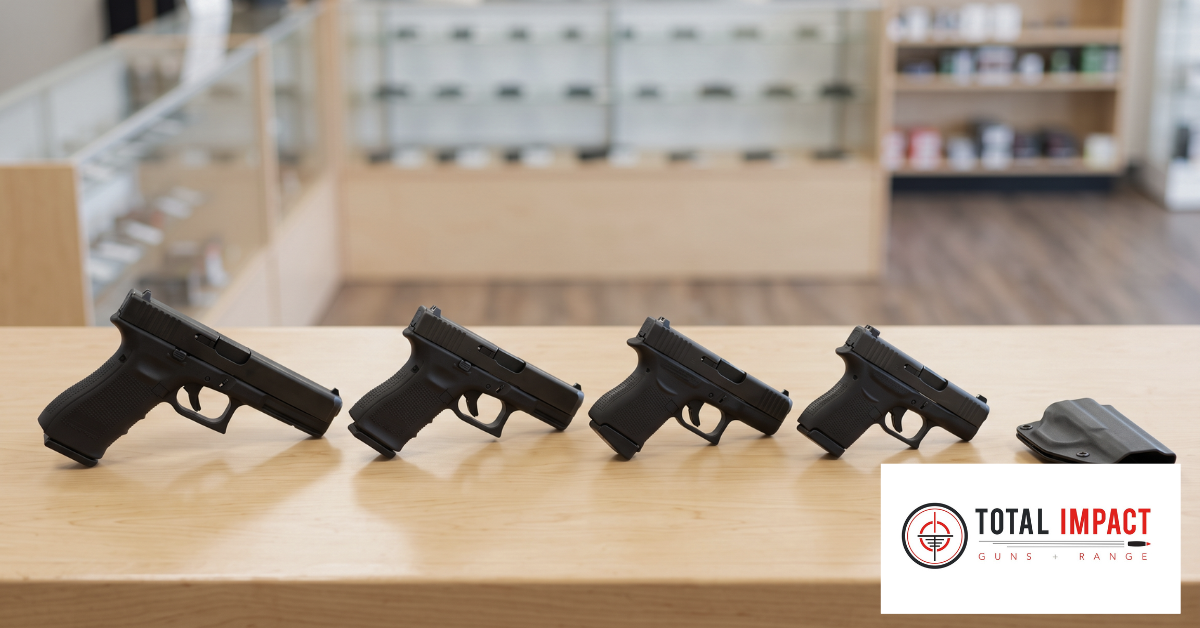
Once you've settled on caliber, the next decision is size class, and this is where most first-time buyers either get it right or end up with a gun they never carry. Handguns built for concealed carry generally fall into four practical categories:
- Full-size. The biggest grip, the longest sight radius, and the flattest recoil of the group. Easiest to shoot well, hardest to hide under normal clothes.
- Compact. A trimmed-down full-size, usually with a shorter grip and barrel. Still shoots comfortably for most people, and conceals reasonably well with the right holster and clothing.
- Subcompact. Noticeably smaller in every dimension. Easier to hide, but the shorter grip usually means only two or three fingers fit and recoil control gets harder.
- Micro-compact. Built specifically to disappear. Thin, light, and easy to carry all day, but the smallest sight radius and grip of the bunch, so shootability takes the biggest hit.
Frame size drives almost everything about how a gun handles. A bigger grip gives your hand more to hold onto, which means better recoil control and faster follow-up shots. A longer sight radius, the distance between your front and rear sight, makes it easier to shoot precisely. And a smaller frame is what actually lets the gun vanish under a t-shirt or a pair of jeans instead of printing a visible outline.
Plenty of first-timers walk in wanting the smallest gun on the shelf and walk out with something they can barely control. Concealability matters, but a gun you can't hit a target with isn't protecting anyone. If you're torn between two well-known options in this space, our Glock 19 vs Sig P320 comparison breaks down how a compact and a full-size-adjacent option compare on carry and shootability.
The good news is that the gap between concealability and shootability has narrowed a lot in the last several years. Today's best micro-compacts pack noticeably more capacity into a slim frame without adding much width, which is a shift worth understanding before you assume you have to choose between hiding the gun and shooting it well.
Capacity, sights, and safety features that matter
Once caliber and size class are settled, the remaining decisions separate two similar-looking guns that might otherwise seem interchangeable on paper.
Capacity used to mean a real tradeoff. A slim single-stack carry gun held six or seven rounds, full stop. That's changed. Double-stack magazines squeezed into micro-compact frames have made 10-plus rounds the new baseline for a serious carry gun, without adding the bulk that used to come with higher capacity. That extra capacity buys you margin in a defensive encounter without asking you to carry a bigger gun than you're comfortable with.
Sights range from basic factory irons all the way up to night sights that glow in low light and optics-ready slides that accept a red dot. Basic irons are fine to start with and what most new carriers train on first. Night sights are worth the upgrade if you're likely to need your gun in a dim room or a dark parking lot, since they let you find your sights without ambient light. "Optics-ready" just means the slide is cut to accept a red dot sight later. You don't need to add one on day one, but buying a gun that can take one later saves you from a costly swap down the road if you decide to upgrade.
The manual safety question doesn't have one right answer, and be wary of anyone who tells you it does. Some carry guns have a thumb safety you flip off before firing. Others rely only on a trigger safety, a small lever inside the trigger itself that has to be depressed for the gun to fire, with no separate switch to remember. Which one is right for you depends on your holster, how much you plan to train, and honestly how your hands work under stress. A thumb safety adds a step that some shooters forget in a real emergency; a gun without one demands more discipline about how you draw and holster.
None of these features matter in isolation. Pick capacity, sights, and safety type based on how much you'll actually train with the gun, not on which spec sheet looks most impressive in the store.
Fit and shootability: why you have to try before you buy
Everything up to this point has been about narrowing the field. Fit is what actually decides whether the gun you land on works for you.
Grip circumference determines whether your hand wraps around the gun naturally or fights it with every shot. Trigger reach determines whether your finger lands on the trigger at the right joint or has to stretch awkwardly to reach it. And whether you can rack the slide and hit the mag release and slide stop without shifting your grip determines whether you can actually run the gun under stress, not just hold it for a photo. None of that shows up on a spec sheet.
The only way to know for sure is to put rounds through the gun yourself. Plenty of ranges rent handguns specifically so buyers can compare a few models side by side before spending real money on one. That's not a luxury step, it's the step that catches problems no amount of online research will.
At Total Impact's attached indoor range, you can test-fire different carry models before you decide, so your choice comes down to how the gun actually feels and shoots in your hand, not just what the numbers say. Bring your top two or three candidates and shoot them back to back. The differences usually become obvious fast.
Fit doesn't stop at the gun, either. The holster and belt you carry it in shape your daily comfort just as much as the pistol itself, sometimes more. A great gun in a bad holster gets left at home. If you haven't settled on a carry method yet, our breakdown of choosing between IWB and OWB holster styles is worth reading before your range visit, since it'll change what you're testing for.
Putting your decision framework together
Here's the framework in the order it actually plays out:
- How you'll carry. Your wardrobe, your daily routine, and your body decide what's realistic before you look at a single gun.
- Caliber. Pick the round you'll control and actually practice with, most likely 9mm.
- Size class. Weigh concealability against shootability, and don't over-index on tiny just because it's tiny.
- Capacity, sights, and safety. Match these features to how you'll actually train, not to the longest spec list.
- Fit. Confirm everything above by putting your hands and rounds on the actual gun.
There's no single perfect concealed carry gun. There's only the right gun for your body, your wardrobe, and how much you're willing to train with it. Two people can walk away from this exact framework with two completely different pistols, and both can be right choices.
If you've worked through the framework and want a shortlist of specific models to start with, our roundup of the best concealed carry pistols for new shooters picks up where this guide leaves off. And when you're ready to put hands on a few candidates, our team can help you compare options in person and test-fire before you commit. Browse our concealed carry handguns to see what's in stock.