
How to Buy a Gun Online: The Ship-to-FFL Process Explained
Posted by Joel Sheran on May 9th 2026
Buying a gun online sounds like it should be easier than walking into a shop, and in a lot of ways it is. The part that throws people is the federal-law detour. Your gun doesn't ship to your house. It ships to a local dealer who finishes the paperwork.
Yes, you can buy a gun online legally from any FFL-licensed retailer. The firearm ships to a local Federal Firearms License (FFL) holder, not to your home. You complete ATF Form 4473 and a NICS background check at the FFL counter, pay a transfer fee ($25 to $50), and take possession. Total timeline: 2 to 7 business days.
This guide walks through the full process step by step, plus what to ask your receiving FFL before checkout, the state quirks that trip people up, and what to do when something goes sideways.
How the Online Buying Process Works (5 Steps)
The process is the same whether you're buying a $400 carry pistol or a $2,500 precision rifle. Five steps, in order.
1. Pick your receiving FFL FIRST
Most explainers tell you to find an FFL after you've bought the gun. That's backwards. Pick the receiving FFL before checkout so you know the transfer fee, the hours they accept inbound shipments, and whether they take transfers from your seller of choice. The full diligence checklist is in the next section.
A Federal Firearms License (FFL) is a federal license issued by the ATF that authorizes a business to sell, manufacture, or transfer firearms. The receiving FFL is the local dealer who accepts your shipment, runs your background check, and hands the gun across the counter.
2. Buy the gun and provide the FFL info at checkout
Most online retailers maintain dealer-network databases, so you can pick your receiving FFL from a dropdown at checkout. If your shop isn't in their database, your FFL will email a signed copy of their license to the seller directly. You generally don't have to handle the FFL paperwork yourself; the two dealers coordinate. (Shopping the catalog now? You can browse our firearm catalog before you head to the FFL step.)
3. The seller ships the gun to your FFL, not to you
Federal law requires that any modern firearm shipped across state lines be sent to a holder of a valid Federal Firearms License. It's not a retailer policy; it's the rule under 18 U.S.C. 922 and 27 CFR 478. Even if you live next door to the seller, the gun goes to a licensed dealer first.
4. Receive the call from your FFL when it arrives
The receiving FFL will call or email once your gun has been logged in. Plan a trip to their counter and bring valid government-issued photo ID with your current address. Some states require additional documentation; we'll get to those in the State Rules section below.
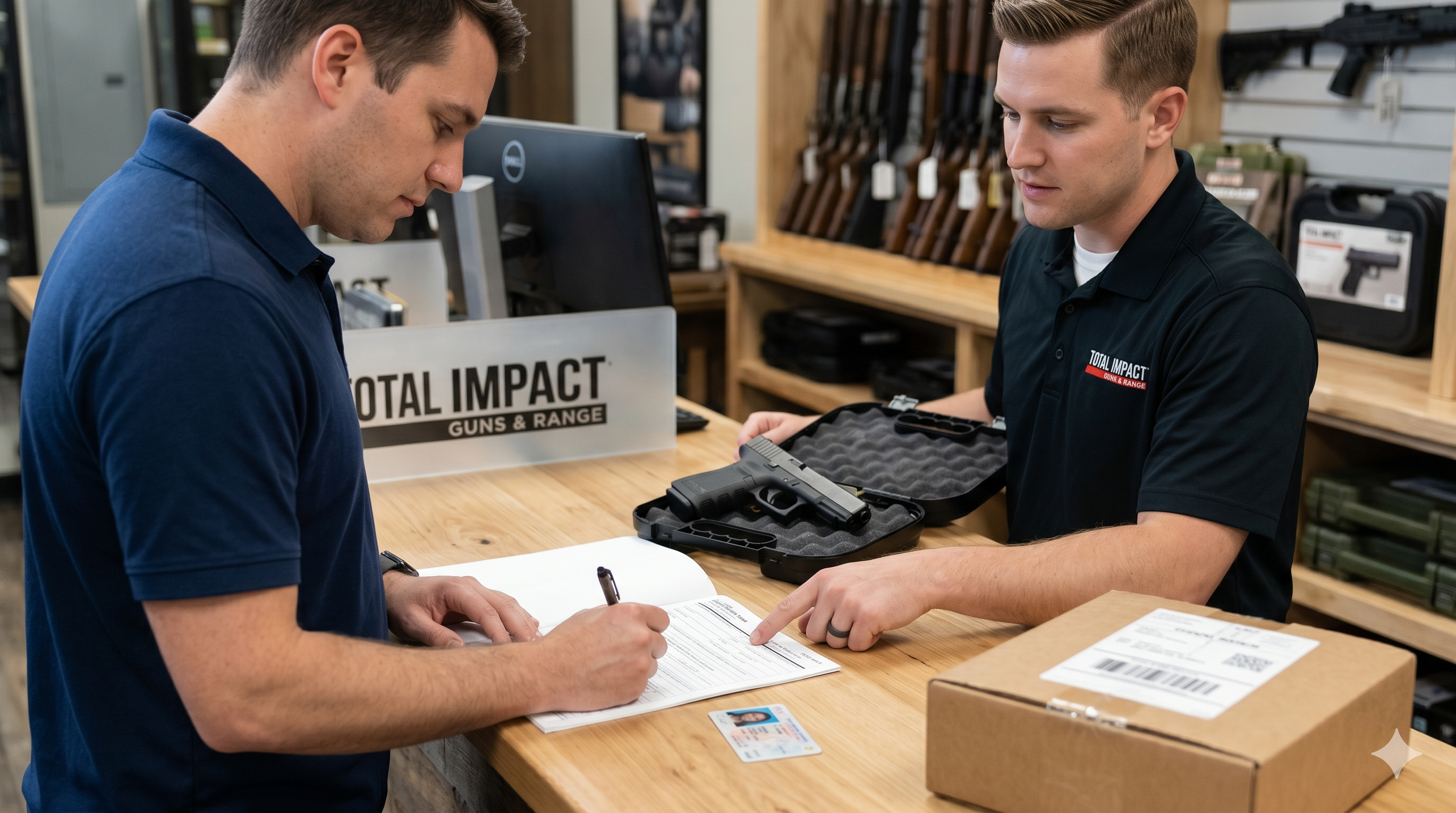
5. Complete ATF Form 4473 and NICS at the counter
At pickup, you fill out ATF Form 4473, the federal Firearms Transaction Record that captures your identity and confirms you're not a prohibited person under federal law. The dealer runs a NICS check (the FBI's National Instant Criminal Background Check System) to verify your eligibility. Most NICS results come back as "proceed" within minutes; a "delayed" return can extend up to 3 business days, but most resolve much faster.
You pay the transfer fee (the receiving FFL's charge for handling the inbound paperwork and NICS check, typically $25 to $50 for a non-NFA transfer per the rates observed across dealers like Texas Gun Experience and similar shops), pay any applicable state sales tax, and take possession.
That's the whole flow. The mechanics are the same in every state. What changes is the paperwork and timeline at the receiving end, which is what the rest of this post covers.
What to Ask Your Receiving FFL Before You Hit Checkout
The single most-skipped step in every "how to buy a gun online" guide. You should call (or email) the receiving FFL with these questions before you order anything. Five minutes on the phone saves you from the most common rookie mistakes.
- "What's your transfer fee per item?" The going range is $25 to $50 for standard transfers, with $40 to $45 most common. Expedited transfers and NFA items run higher. Get the number in writing if you can; surprise fees at pickup are the most common complaint.
- "What hours and days do you accept inbound shipments?" Some shops only accept inbound shipments during regular business hours. If the carrier shows up while they're closed, the package may bounce back to a sort facility, and your timeline slips by a day or two.
- "What ID do I need to bring?" Government-issued photo ID with your current address is the federal floor. Some states (we'll cover them below) require additional documents like a state-issued permit, license, or proof of residency.
- "Do you accept transfers from any retailer, or only certain ones?" Some FFLs limit inbound transfers to specific dealer networks. Confirm before you check out so you don't end up with a gun in transit to a dealer who won't receive it.
- "How long can I leave the gun here after it arrives before storage fees kick in?" A common policy is a 30-day pickup window with daily or monthly fees after that. Some shops will return the gun to the original shipper after 90+ days unclaimed, at your cost. Plan to pick up promptly.
- "Do you handle NFA transfers?" Only relevant if you're ordering a suppressor, short-barreled rifle, or other NFA item (firearms regulated under the 1934 National Firearms Act, including silencers, SBRs, SBSs, and machine guns). NFA transfers require an FFL with a Special Occupational Tax (SOT) endorsement, which not every dealer holds.
If you're a recent transplant or a first-time buyer, this is the part to take seriously. You're building your relationship with a local dealer from scratch, and the dealer who gives crisp, friendly answers is the one worth repeat business. If you're still picking the handgun itself, our handgun buying guide walks through the decision.
Handgun vs Long Gun: How Shipping Timelines Differ
Handguns and long guns ship under different carrier rules, which drives a real difference in delivery windows.
Handguns must ship by air. UPS requires Next Day Air for handgun shipments from licensed dealers, and FedEx imposes equivalent expedited service. USPS only accepts handgun shipments from licensed dealers and manufacturers, never from unlicensed individuals, per Publication 52 Section 432. Long guns (rifles and shotguns) can ship UPS Ground, which is slower but cheaper.
In practical terms:
- Handgun: 2 to 3 business days in transit once shipped.
- Long gun: 3 to 7 business days in transit.
- Plus: 1 to 2 business days at the receiving FFL before they call you.
Total order-to-pickup timeline is roughly 3 to 5 business days for a handgun and 4 to 9 for a long gun. Holiday seasons, big sale events, and the seller's own fulfillment speed can push these windows further. If you're shopping handguns specifically the air-freight requirement is built into the shipping cost. AR-15 and other long-gun shoppers should expect the longer ground window; our home-defense AR roundup covers the categories worth considering.
Federal Rules vs State Rules: What's the Same Everywhere and What Changes Where You Live
The federal layer is the same in all 50 states. The state layer is where most of the friction lives for buyers who recently moved or are buying for the first time.
Federal rules that apply everywhere
- The gun ships to an FFL, never to your home, for any interstate purchase.
- You complete ATF Form 4473 and a NICS background check at the receiving FFL's counter before the gun leaves the shop.
- Federal age minimums at an FFL: 21 for handguns, 18 for long guns.
- No transfers to prohibited persons, including felons, fugitives, certain mental-health adjudications, and others listed under 18 U.S.C. § 922(g).
- Private sales between residents of the same state can sometimes happen without an FFL under federal law, but that doesn't apply to the online interstate purchases this post is about. If you're buying online, your gun is shipping across state lines, and an FFL is involved either way.
Florida-specific callouts
Florida's purchase rules layer onto the federal floor. Per FDLE, Florida requires:
- Minimum age 21 for ALL firearms purchased from an FFL (handguns and long guns alike, raised to 21 statewide in 2018).
- NICS background check at every FFL purchase.
- A 3-business-day waiting period (excluding weekends and holidays) between purchase and delivery.
- A waiting-period exemption for holders of a Florida Concealed Weapon License (CWL), the state's concealed-carry permit issued by FDACS.
The mechanic that catches out-of-state movers and online buyers: the 3-day clock starts when the receiving FFL initiates the NICS check at their counter, not when you place the order online and not when the gun arrives at the FFL. Florida Statute 790.0655 ties the waiting period to the FFL's NICS initiation. So an FL buyer ordering online still sits a minimum of 3 business days between paperwork and pickup. The exception is a Florida CWL holder, who can take same-day delivery. For the deeper story on the CWL itself, our concealed carry guide covers FL CWL and the 38-state reciprocity in depth.
For out-of-state movers: use your current Florida ID with your current Florida address. The receiving FFL has to be in your new state of residence, and your ID has to match. If your license still shows your previous state, the transfer can stall.
Restrictive-state landmines worth a flag
These states layer significant additional requirements on top of the federal floor. One sentence each, no deep dive; confirm with your receiving FFL before ordering:
- California: the firearm must be on the state Roster of Handguns Certified for Sale (the Roster is California's and Massachusetts' state-maintained list of handguns approved for civilian sale; an off-roster gun cannot be transferred regardless of where it was purchased online), plus DROS paperwork and a 10-day wait at the receiving FFL.
- New York and New Jersey: you must already hold a permit (a NY pistol permit, or NJ FID and handgun permit) before the receiving FFL can complete the transfer.
- Massachusetts: the firearm must comply with the state Approved Firearms Roster.
- Illinois: you need an active FOID card to receive a firearm.
Buyers in any of these states should treat their receiving FFL as the local rules expert. Confirm model legality before you order, not after the gun is sitting in the shop.
Should I Call My FFL Before I Order?
Short answer: yes. A two-minute call before you check out prevents the three most common headaches.
- Confirm they'll accept the transfer. Some shops only accept inbound transfers from specific dealer networks.
- Confirm the transfer fee in writing. Email it to yourself if needed. Surprise fees at pickup are the most common complaint.
- Confirm hours and inbound-receiving policy. If the carrier needs a signature and the shop is closed at delivery, the package bounces back to the sort facility and your timeline slips.
The receiving FFL appreciates the heads-up. A call costs you two minutes and earns goodwill that's worth its weight in transfer fees the next time around.
What Can Go Wrong (And How to Avoid It)
The workflow is straightforward, but the failure modes are predictable. Here's what trips people up.
- NICS delay or denial. A "delayed" return isn't a denial. Federal law gives the FBI 3 business days to resolve, and most delays clear faster. If you have a name-match issue or share a name with someone in the database, file the FBI's Voluntary Appeal File ahead of time to reduce future delays.
- Receiving FFL refuses the transfer because the gun isn't roster-legal in your state. The California and Massachusetts trap. Verify model legality with your receiving FFL before ordering, especially for handguns and AR-pattern rifles.
- Wrong FFL address shipping. Confirm the FFL's shipping address matches the address on their license. The ATF FFL eZ Check tool verifies a dealer's license. Packages sent to the wrong location can't legally be re-routed without a dealer-to-dealer transfer.
- Storage-fee accrual. Most receiving FFLs allow a 30-day pickup window. Travel, work, or hospitalization can blow past that fast. Call the FFL the moment you know you'll be late; most are reasonable if you communicate early. After 90 days, some shops return the gun to the original shipper at your expense.
- The "skip the FFL via a friend" idea. You'll see this on Reddit and YouTube, and it's wrong. Federal law requires the transfer go through a licensed FFL using ATF Form 4473 and NICS regardless of personal relationship. No friends-and-family loophole for interstate purchases. Pay the transfer fee; it's the cost of doing it right.
Conclusion
The online buying process is straightforward once you understand the receiving-FFL handoff. Most of the "hard parts" are avoidable if you pick the receiving FFL first and ask the right questions before checkout. A good shop will walk you through pickup paperwork in 10 to 15 minutes, and a national-shipping retailer plus a vetted local FFL covers the same ground as your old hometown gun store, often at better prices on hard-to-find models.
Total Impact ships firearms nationally and handles FFL transfers in both directions. If you're in the Sarasota area, pick up in store; if you're not, we can ship to your local FFL. Our price-match guarantee covers any firearm you find for less elsewhere. Browse our national-shipping store to get started.