
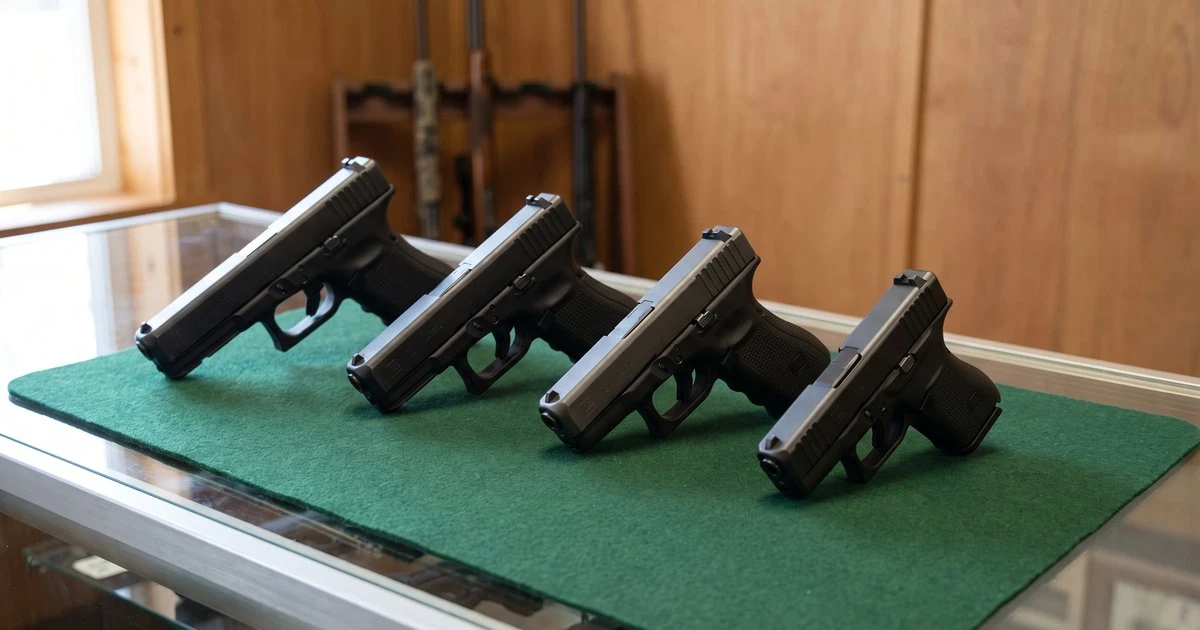
Handgun Sizes: Full-Size, Compact, Subcompact & Micro Guide
Posted by Total Impact Guns & Range on Sep 30th 2026
TL;DR. Handgun sizes fall into four loose classes (full-size, compact, subcompact, and micro-compact), and no industry standard defines them, so labels vary by maker. Full-size pistols run barrels around 4.5 to 5 inches and hold 15 to 17 or more rounds of 9mm. Compacts sit near a 4-inch barrel and are the most versatile size for carry, home defense, and range use.
Subcompacts shorten the barrel to roughly 3 to 3.5 inches and the grip enough that many shooters' pinky finger hangs off. Micro-compacts, a class the SIG P365 kicked off in 2018, fit 10 or more rounds into a grip about 1 inch wide.
Walk up to any gun counter and you'll hear the same four words over and over: full-size, compact, subcompact, micro. They sound like they should mean something exact, the way shoe sizes do. They don't, so it pays to know what's behind the words.
Size is the first thing most people ask about, and it's the thing you feel every time you pick the gun up. It's one piece of the bigger decision we lay out in our full guide to buying a first handgun, and it's worth a close look on its own.
What handgun size classes actually mean
Full-size, compact, subcompact, and micro-compact are marketing categories. No industry standard decides where one ends and the next begins, so every manufacturer draws its own lines, and the same gun can land in different classes depending on who's describing it. NRA Women's firearm terminology guide covers the general size terms and lists typical barrel and height ranges for each class.
Numbers tell you more than labels do. Five measurements show what a handgun really is, whatever the box calls it: barrel length, overall height, width, weight, and magazine capacity. Height and width tell you how the gun will sit in a holster and under a shirt, and weight has as much to do with how it shoots as how it carries. Compare those five between two models and the size question mostly answers itself.
Here's a rough map of the four classes. Treat the numbers as typical rather than exact, since any one model can land a little on either side.
| Size class | Typical barrel | Typical 9mm capacity | Example models | Built for |
|---|---|---|---|---|
| Full-size | 4.5 to 5 inches | 15 to 17 or more | Glock 17, S&W M&P9 2.0 | Home defense, range, competition, duty |
| Compact | About 4 inches | A bit under full-size | Glock 19, SIG P320 Compact | One gun for home, carry, and range |
| Subcompact | 3 to 3.5 inches | Fewer than a compact | Glock 26, slim single-stacks | Carry |
| Micro-compact | Short, like a subcompact's | 10 or more | SIG P365, Springfield Hellcat | Daily and deep-concealment carry |
This guide sticks to semi-automatic pistols. Revolvers have their own size names, from short snubnose models up to full-size service revolvers, and they make for a different comparison. If you're weighing one against a semi-auto, here's how revolvers compare to semi-autos for a first gun.
How size changes grip, capacity, recoil, and accuracy
Every step down in size makes a handgun easier to hide and harder to shoot well. Once you've got that in your head, each class below is just a different spot on the same slope.
A heavier gun soaks up more of the kick before it reaches your hand, and a longer grip gives you more hand on the gun to hold it steady. Shrink both and the same load feels sharper, with less of your hand there to control it.
Sight radius is the distance between your front and rear sights, and a longer slide and barrel stretch it out. A longer barrel also adds a little bullet velocity, but the bigger deal is the sights, since more distance between them makes them easier to line up and makes a small error easier to spot. On a small gun that distance shrinks, so a bit of slop in your trigger pull turns into a bigger miss downrange.
Grip height and magazine design set how many rounds you get and how thick the gun feels in your hand. A taller grip fits a longer magazine. A single-stack magazine holds its rounds in one column, which keeps the grip slim but limits capacity. A double-stack magazine staggers them two across, which holds more and makes the grip thicker. The newer stack-and-a-half designs sit in between, squeezing in more rounds than a single-stack without the full thickness of a double-stack.
Caliber plays into it too. The same cartridge feels noticeably snappier in a small, light pistol than in a full-size one, so a 9mm that's mild in a big gun can feel sharp in a little one. If you're comparing calibers as well as sizes, how 9mm and .45 ACP differ in recoil and capacity is worth a read.
Full-size handguns
Think Glock 17, Smith & Wesson M&P9 2.0, or a 5-inch Government-pattern 1911. That's a full-size pistol: a barrel around 4.5 to 5 inches, a grip that fills your whole hand, and on the 9mm models a magazine that holds 15 to 17 rounds or more.
These are the easiest handguns to shoot accurately. The long sight radius, the weight, and the full grip all work for you, and you get the most capacity and the softest felt recoil you can find in a given caliber. If you're learning to shoot, or just shooting a lot at the range, this is the size that makes it easiest.
That makes full-size the natural fit anywhere concealment doesn't matter, which means home defense, range practice, competition, and duty use. A gun that lives on a nightstand or in a range bag doesn't need to be small. If home defense is what you're buying for, take a look at the handguns we recommend for home defense.
The catch is that most body types and most clothes can't hide a gun this size, so it rarely works as an everyday carry gun.
Compact handguns
A compact is a full-size pistol trimmed down a bit. The barrel runs about 4 inches, and the slide and grip are shorter than on the full-size version. The Glock 19, the SIG P320 Compact, and the M&P9 2.0 Compact are the ones most people know.
Most shooters still get a full firing grip on a compact, so you keep most of the control a full-size gives you. At the same time, the gun is small enough to carry comfortably with a good holster and a shirt or jacket over it.
That's why the compact is the best single-gun answer for someone who wants one handgun to cover home defense, occasional carry, and range time. It won't out-shoot a full-size or out-hide a micro-compact, but it handles all three jobs without giving up much on any of them.
The tradeoff is that a compact is still wide and tall enough that some body types and wardrobes find daily carry a challenge. If the outline of the gun shows through your shirt (folks call that printing), or the grip digs in by the end of the day, a smaller size might suit you better.
Subcompact handguns
A subcompact cuts the barrel to roughly 3 to 3.5 inches and shortens the grip even more than that. The Glock 26 is the classic double-stack example, and slim single-stack pistols are the other common type.
The grip is where you feel it, since on many subcompacts there isn't enough of it for all your fingers and your pinky hangs off the bottom. That's why extended magazines and grip extensions are so common in this class; they give that last finger something to hold. The trade is that an extension adds back a little of the length you bought the smaller gun to avoid.
Shooting one costs you something too. The shorter barrel and lighter weight mean sharper recoil, and the shorter sight radius is less forgiving, which is hard on newer shooters still working on their trigger control. A subcompact can make a fine carry gun, but it asks more of you than a compact does.
Micro-compacts have also squeezed this class. Many now match or beat traditional subcompacts on capacity while being thinner, which leaves the subcompact sitting between a compact that shoots better and a micro-compact that's slimmer to carry.
Micro-compact handguns
Micro-compacts are the newest size and the most popular one for carry. The SIG P365 launched in 2018 and created the class by fitting 10 or more rounds into a grip about an inch wide, according to the USCCA's write-up on compact handgun frame sizes. Other makers followed with their own versions. The Springfield Hellcat, the Smith & Wesson M&P Shield Plus, and the Glock 43X are the ones you'll see on the shelf next to the P365.
These guns are built for carrying. If you want something you'll actually wear every day, one that stays comfortable and doesn't print under a shirt, this is the class designed for it. It's also the best fit when you need deep concealment, where the gun has to disappear under everyday clothes. What you give up is range-day shootability, because comfort and concealment come first.
The honest limit is that micro-compacts are harder to master than larger guns. Small size, light weight, and a short sight radius leave less room for sloppy fundamentals, so it usually pays to build yours on a bigger pistol first. If you're newer to shooting, carry pistols that suit new shooters will help you sort out whether to start bigger or pick a forgiving micro. When you're ready to look at options, you can browse our concealed carry handguns in stock.
Don't confuse micro-compacts with pocket pistols. Those are smaller still, often chambered in .380 ACP, and they trade capacity and control for size.
Crossover pistols and modular grips
A lot of today's market doesn't sit neatly in one class. Crossover pistols pair a full-size grip with a compact-length slide, and the Glock 19X and Glock 45 are the clearest examples. You get the hand fit and magazine capacity of a full-size gun with a slide the length of a compact's.
Grip length, not slide length, usually decides how well a gun conceals. The grip is what prints through a shirt, so a short slide on a full-size grip doesn't hide much.
Modular guns blur the lines even more. The SIG P320 and P365 families let you swap the grip module or the slide, so one serialized chassis (the part that carries the serial number) can move between size classes depending on which pieces you put on it.
All of this is why the label on the box shouldn't be your guide. A crossover can straddle two classes, a modular gun can be several, and manufacturers use the terms differently anyway. Put the real dimensions side by side (barrel length, height, width, weight, and capacity) and decide from those.
Matching handgun size to how you'll use it
Start with what you'll mostly use the gun for. A gun that tries to do everything is a compromise somewhere, and it's a lot easier to pick the compromise you can live with once you know the job.
Here's how the sizes line up:
- Full-size fits home defense and range days, where concealment doesn't matter and shootability does.
- Compact is the do-everything choice, one gun that covers home defense, occasional carry, and range time.
- Subcompact and micro-compact are the daily-carry sizes, with the micro-compact being the slimmer of the two.
If the gun will mostly live at home or at the range, go bigger. If it'll ride on your belt most days, go smaller and plan on more practice time to shoot it well.
Class isn't the whole story, though. Your hand size, grip strength, and how much recoil you're comfortable with matter as much as the label on the gun, and the only reliable test is holding it and shooting it. A pistol that looks perfect on paper can feel wrong in your hand.
So rent two or three sizes at an indoor range and shoot them back to back. Notice which one you can hold steady, which one you hit with, and which one you'd want to keep shooting. If you've never been to an indoor range, what to expect on your first indoor range visit walks you through the whole thing.
When you know what fits, you can shop handguns across every size class right here, and if the one you want isn't on the shelf, we can get it for you.