
First Time at an Indoor Shooting Range: A Step-by-Step Walkthrough
Posted by Joel Sheran on Jun 9th 2026
Walking into an indoor range for the first time is mostly anticipation. You haven't done it before, you're not sure where to stand, and you don't want to ask a dumb question. The good news is that almost every range in the country runs the same basic sequence, and the staff are used to first-timers.
Here's what happens, in order: sign in at the front desk, fill out a waiver, get a quick safety briefing, gear up with eye and ear protection, take your assigned lane, set up your target, load and fire at your own pace, then clean up and head out. Total time is about an hour, give or take.
If you're new to a gun range, beginners always have the same questions, and they're almost never as embarrassing as they feel. This is a calm, sequenced walkthrough of what actually happens from the parking lot to walking out the door, plus what to bring, what to wear, what to do if something goes sideways, and one short note for older first-timers who get overlooked in most of these guides.
What to Expect on Your First Visit (Quick Overview)
Before the deep dive, here's the shape of the visit so you can orient.
- You walk in and tell the front desk you're new.
- You show ID, sign a waiver, and pay your lane fee (plus rental and house ammo if you don't own a gun).
- You watch or read a short safety briefing.
- You put on eye and ear protection before you cross onto the range floor.
- You take your assigned lane, set up a paper target, and shoot at your own pace.
- When you're done, you unload, clean up your spot, wash your hands, and leave.
That's the whole arc. Two things worth saying up front. First, a Range Safety Officer, or RSO, is the staff member on the range floor whose job is to enforce safety and help shooters. They are positively happy to help an obvious newbie. What they're watching for is unsafe behavior, not inexperience. Second, every range tells you the same thing in their own first-timer guide, and Gritr Range puts it best: "Don't be shy about telling the staff that you're new. They are there to help you and will explain everything you need to know. People around you will also be more patient if they know you're still learning." That one sentence dissolves about 80% of the anxiety.
Before You Go: What to Bring
You don't actually need to bring much. Most ranges rent or sell everything you'd otherwise pack.
- Government-issued ID. Driver's license or passport. Required everywhere. No exceptions.
- Your firearm, in a case, unloaded. If you own one, transport it unloaded in at least a soft case. Range staff will usually inspect it at check-in. If you don't own a gun yet, skip this and rent at the range. (Most ranges require renters to be 21 or older regardless of state purchase age, so bring ID that shows it.)
- Ammunition. Correct caliber for your gun if you're shooting your own. If you're shooting a rental, almost every range requires you to use their house ammo (the in-house brand the range stocks for use through their own rental firearms). Don't fight this rule. It's how they keep their guns from blowing up.
- Eye and ear protection. Often called "eyes and ears." Most ranges rent muffs and hand out free foam plugs at the counter, so if you don't own protection, you're covered. NRR, or Noise Reduction Rating, is the dB attenuation number printed on hearing protection. Higher is more protection. For indoor handgun shooting, NRR 25 or higher is the floor, and doubling up (foam plugs under earmuffs) is the safer choice indoors specifically. The peak noise from a handgun in an enclosed range easily clears the level at which a single exposure can cause permanent hearing damage, per NIOSH guidance on noise exposure, so this is the one piece of gear not worth being casual about.
- Spare magazines if you have them. Saves reload time. Not required.
- Cash or card. Lane fees at US commercial indoor ranges typically run $10 to $50 per hour, with rental firearms commonly $10 to $20 each on top, plus targets and house ammo. Bring more than you think you'll need.
A quick note for true solo first-timers. Some range policies require renters to bring a second person, mostly as a safety policy against single-person incidents. If you don't own a gun and don't have a friend to come with, call the range ahead of time, or book a paid intro lesson. Instructors are exempt from the buddy requirement, and the lesson covers your range time too. It's the cleanest path in.
One more thing on hot brass. Hot brass is the spent cartridge case ejected from a semi-automatic firearm after each shot. Freshly fired cases are hot enough to give you a quick burn if they land on bare skin, which sets up the next section.
What to Wear (and What Not To)
Range wardrobe rules feel arbitrary until you've had a piece of hot brass go down your shirt. Then they feel obvious.
- Closed-toe shoes. Sneakers, boots, anything that fully covers the top of your foot. No flip-flops, no Crocs, no sandals. Falling brass can roll under an open-toed foot mid-shot, which is exactly when you don't want a surprise.
- A high-collar or crew-neck shirt. Crewneck T-shirts, polos, button-downs buttoned up. The point is to keep ejected brass from dropping into the gap between your collarbones. Avoid V-necks, scoop necks, low-cut tops, and loose tank tops.
- Long hair tied back. Same reason, plus it stays out of the way of your sight picture.
- A hat with a brim. Helps deflect brass that ejects upward and sideways. Optional but useful.
If a piece of brass does land on your skin, the move is not to dance, swat, or twist around. The Range 702 publishes the cleanest version of the response script: "If brass lands against your skin, don't panic. Keep the weapon pointed in a safe direction and carefully put it on the shooting platform. Take a step back and remove the round." Memorize that. The whole post is pointed at you having that script ready before you ever need it.
At the Range: A Step-by-Step Walkthrough
This is the actual sequence. Each step is short on purpose. Read it once before you go and you'll know what's about to happen at every counter and door.
-
Walk in and tell them you're new. Front desk, first thing. Staff are noticeably nicer to people who flag it up front, and they'll customize the rest of your visit around it. This is the single highest-leverage thing you do all visit.
-
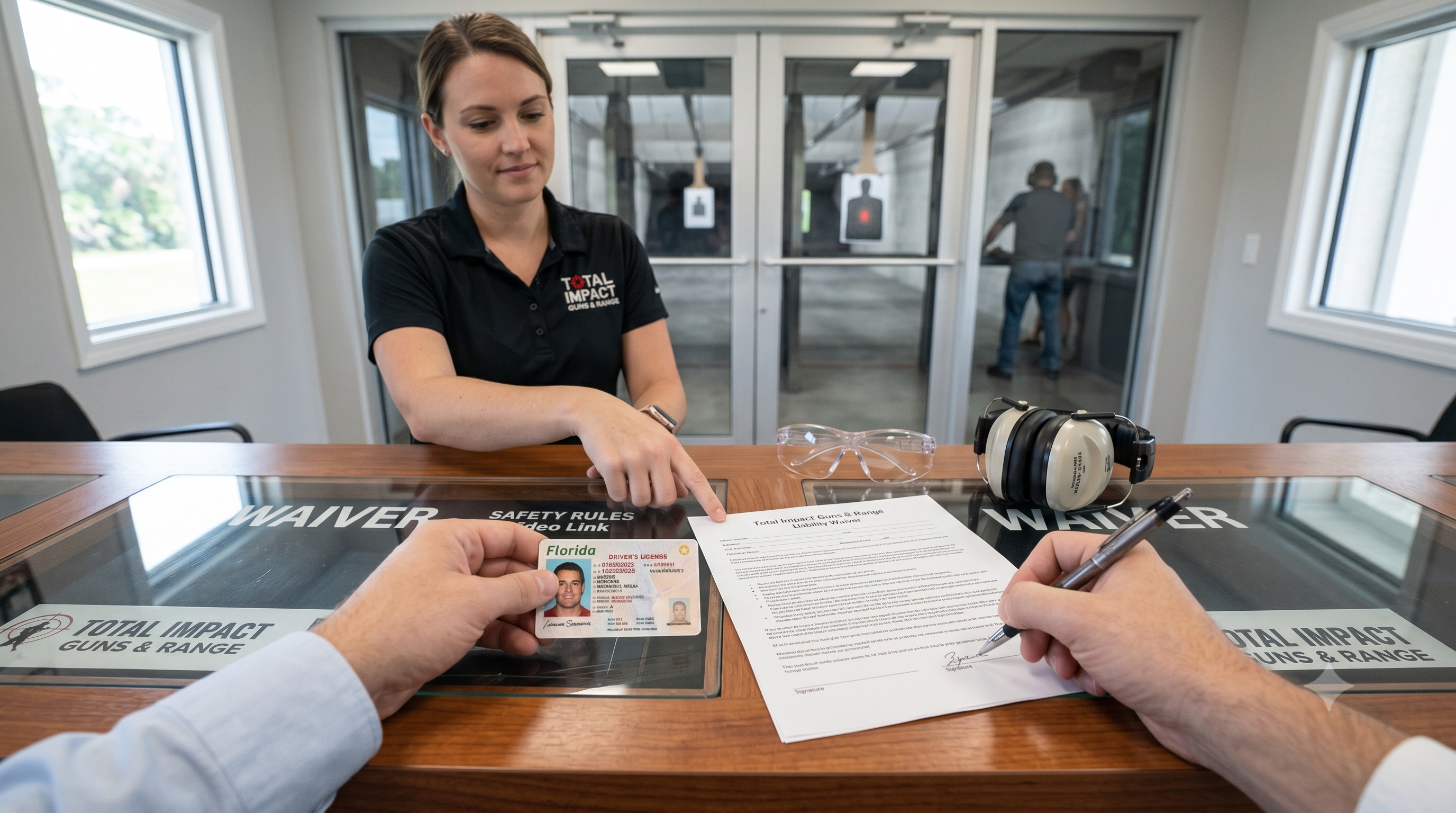
Sign the waiver and present your ID. Some ranges let you complete the waiver online before you arrive, which trims the front-counter time. Otherwise expect 5 to 10 minutes of paperwork. Most ranges also require renters to be 21 or older, even where state law allows 18+ purchase of long guns. Have ID ready that proves it.
-
Pay your lane fee, rental fee, and pick up house ammo if you're shooting a rental. All in one transaction at the counter. If you're new and don't own a gun, this is also where you choose your rental. Ask the counter staff to recommend something forgiving for a new shooter. They know which rentals in their case are easy starters and which ones aren't. (Our new gun owner's guide covers what "forgiving" actually means if you want context before you walk in.)
-
Get your safety briefing. Could be a 5-minute video, an iPad form, or a one-on-one walk-through with an RSO. Don't tune out, even if you've watched a similar video on YouTube. Every range has its own commands, lane layout, and house rules, and the briefing is where you learn the local versions.
-
Gear up before you cross onto the range floor. Eyes and ears on, fully seated, before you cross the threshold. Many ranges mark it with a painted line or a second door, and the rule is enforced. Get in the habit of doing it at the line, not after you've taken a few steps onto the floor.
-
Walk to your assigned lane. A lane is the partitioned shooting station, separated from your neighbors by side baffles. The bench (sometimes called the shelf) is the platform inside the lane where the firearm rests when you're not actively shooting. Place your range bag on the bench, not the floor. The floor is where falling brass lands, and you don't want it bouncing into an open bag.
-
Set up your target. Most modern indoor ranges have a motorized target carrier. Clip the paper target to the carrier, push the button, and send it downrange. Downrange is the direction the firearms point, toward the targets and backstop (the structure at the back of the lane that captures fired rounds). Start at 7 yards if you're new. Not 25, not 15, not "all the way back to look cool." Seven yards is where almost every defensive-handgun training program starts, and you'll hit enough to actually enjoy yourself. Older ranges may require you to walk downrange yourself during a cold range break. A cold range means all firearms are unloaded with actions open and resting on the bench, and it's safe to cross the firing line. The opposite is a hot range, when live fire is happening and nobody crosses the firing line. The RSO will tell you which kind of range you're in and when transitions happen.
-
Load. Magazine seated, slide forward, finger off the trigger and resting along the frame above the trigger guard. If you're new, ask the RSO to walk you through this on the bench before you start. They will. That's literally the job.
-
Shoot at your own pace. Square stance, sights aligned with the target, smooth trigger press. This isn't a shooting lesson, and we're not going to try to make it one. (Our handgun buying guide for first-time owners covers grip and stance fundamentals if you want to read up before you go.) Hot brass will eject as you shoot. Let it. Don't follow it with your eyes, don't reach for it, don't flinch toward where it lands. The wardrobe rules above are doing their job.
-
When you're done shooting, unload, action open, gun on the bench muzzle-downrange. Step back. The RSO can confirm you're safe before you handle the gun anywhere outside the lane. Some ranges hand out an action indicator (a brightly colored plastic rod inserted into the chamber to visually confirm the gun is unloaded). Use it if offered.
-
Pack out and clean up. Spent brass on the floor. Most ranges have a brass broom in the lane; sweep your brass forward into a pile inside your own lane. Used targets in the trash. Wipe down the bench if there's gun oil residue. Carry your range bag out, eyes and ears off only after you've crossed back through the door.
That's it. Eleven steps, about an hour, and once you've done it once you'll never have to read this list again.
What If Something Goes Wrong?
Here's the part nobody writes about. New shooters carry one quiet question that the top-five guides don't answer: what do I do if something happens that I don't have a script for? Three scenarios cover almost everything you're actually worried about.
Hot brass down the shirt. This is the one. Your instinct will be to swat at it, twist around, or set the gun down fast. Don't. Use The Range 702 script: keep the gun pointed downrange, finger off the trigger, carefully place the gun on the bench muzzle-downrange, take a step back, and then fish out the brass. The burn is brief and mild. The danger is what your body does in the half-second of surprise, not the brass itself.
The gun won't fire. A click instead of a bang, or nothing at all. This is a malfunction, not an emergency. Don't twist around, don't tilt the gun toward yourself to look at it, don't try to clear it on instinct. Keep the muzzle pointed downrange, finger off the trigger, set the gun on the bench muzzle-downrange, and wave for the RSO. They are paid to handle this, and most of them genuinely enjoy it. It's a teaching moment for them as much as for you.
You drop a loaded magazine on the floor. Don't dive for it. Leave it where it landed. The gun in your hand is still safe as long as the muzzle stays pointed downrange and your finger stays off the trigger. When you're ready, bend at the knees, keep the muzzle direction stable, pick the magazine up, and place it on the bench. Slow is smooth.
The pattern across all three is the same: the gun doesn't move from muzzle-downrange, the trigger finger stays off the trigger, you step back instead of leaning forward, and you ask for help if you need it. That's the calm script. It works for almost any surprise the range can hand you.
Common First-Timer Mistakes (Looking New vs. Being Unsafe)
The underlying anxiety most new shooters carry is "I'll look stupid." The right reframe is that looking new is fine, and being unsafe is not. Two different things, two different reactions from the staff.
Looking new (totally fine, RSOs help):
- Asking the same question twice.
- Loading slowly.
- Closing the slide weirdly or fumbling the magazine release.
- Taking five minutes between shots to reset.
- Hitting low and to the left because you're jerking the trigger. (Everyone does this. It's the most common new-shooter pattern in the world.)
- Asking what a command means after the briefing.
None of those will get you corrected. Most of them won't even get a second look from your neighbors.
Being unsafe (will get you corrected, possibly loudly):
- Sweeping the muzzle past another person. This usually happens when a new shooter turns around with the gun still in hand instead of placing it on the bench muzzle-downrange first. Don't pivot with the gun. Set it down, then turn.
- Finger on the trigger when you're not actively about to fire. The cardinal habit. RSOs watch for this constantly. Trigger finger lives along the frame above the trigger guard until you're on target and ready to shoot.
- Crossing the firing line during a hot range.
- Carrying a loaded magazine into the lobby or a loaded gun off the range floor.
The rules feel strict because the consequences of getting them wrong are permanent. But they're not subtle, and you don't have to guess at them. If an RSO corrects you, the right move is to nod, fix the behavior, and keep going. Nobody holds it against you.
A Note for Older Shooters
If you're picking up a firearm for the first time later in life, or coming back to it after a 30-year gap, this section is for you. Three accommodations worth knowing about.
First, most modern striker-fired pistols (the dominant style sold today) have stiff slides that require a fair amount of grip strength to rack. If your hands aren't what they were at 30, you can ask for a hammer-fired pistol or a revolver as a rental. Both are easier on the hands and just as accurate at 7 yards. The counter staff won't blink.
Second, electronic muffs work over hearing aids significantly better than passive muffs because they amplify ambient sound and only clamp down on the gunshot itself. Flag at check-in that you wear hearing aids. Most ranges either rent electronics or can recommend a model.
Third, asking for a one-on-one paid intro lesson is normal, common, and exactly what the lesson is for. RSOs and instructors love teaching this segment because the questions are good and the focus is real. If you want a calmer, slower first visit, book the lesson. Don't try to figure it out from the back of the briefing video.
Lead Hygiene Before You Leave
This one almost nobody writes about. Indoor ranges concentrate airborne lead from primer combustion, and a small amount lands on your hands, face, and clothes by the end of a session. It's not dramatic, but it is real, and it's worth a 30-second routine on the way out.
Wash your hands with cold water (warm water opens skin pores), and use a lead-removal soap if the range has it at the sink. D-Lead is the common brand. Do this before you eat, drink, or touch your face. If you wear range-specific clothes, change out of them before you get in the car or, at minimum, don't snack on the drive home in the same shirt. CDC guidance on indoor lead exposure backs this up; it's the part of every range visit that's easy to skip and worth not skipping. (NIOSH publishes the relevant workplace guidance for indoor range exposure.)
What Are the Universal Firearm Safety Rules?
Different programs teach different counts, which is where the "is it 4 rules, 5, or 6?" confusion comes from. The four universal rules, often called the Cooper rules, are taught in nearly identical form by the NRA, USCCA, and essentially every commercial range training program:
- Treat every firearm as if it is loaded.
- Never point the muzzle at anything you are not willing to destroy.
- Keep your finger off the trigger until your sights are on the target and you've decided to fire.
- Know your target and what is beyond it.
Some programs teach 5 or 6 by adding rules about safe storage, sobriety, and knowing how your specific firearm works. Those are good rules, and worth following, but they're additions on top of the four. If you internalize the four above, you will not have a bad day at the range.
Conclusion
The whole visit is calmer than you're picturing right now. You walk in, you say you're new, you pay, you watch a video, you put on protection, you shoot, you clean up, you leave. The staff want you to come back. The shooters around you remember being where you are. The rules are strict but they're not subtle, and the script for surprises is the same every time: muzzle stays downrange, finger stays off the trigger, gun goes on the bench, then you handle whatever it is. If you plan to carry concealed eventually, (our concealed carry complete guide covers the next stretch of the journey, but range competence comes first either way.)
If you're in the Sarasota or Nokomis area and want a calm, walk-you-through-it first visit, stop by Total Impact Guns & Range. Our indoor range and counter staff handle a lot of first-timers and we'll run you through the same sequence above without rushing or making it weird. If you're somewhere else in the country, any reputable indoor range will do the same. Tell them you're new, and the rest of the visit will take care of itself.