
Concealed Carry: A Complete Guide for New Carriers
Posted by Joel Sheran on May 9th 2026
Concealed carry means legally carrying a loaded handgun on your person in a way that keeps it out of public view. To learn how to conceal carry well, you make four core decisions: which handgun fits your hand, which holster and gun belt hold it safely and comfortably, which ammo you train with versus which you carry, and how often you practice. Your state's legal landscape (permit, permitless, reciprocity) is the thread woven through all four.
If you live in Florida, Tennessee, South Carolina, or any of the other states that have gone permitless in the last few years, the question isn't really "do I need a permit" anymore. As of 2026, 29 states allow some form of permitless concealed carry, and Florida joined that group on July 1, 2023. The real question, and what this guide answers, is how to conceal carry well day in and day out when nothing on paper is forcing you to take it seriously.
It's written for the carrier who's already started, or who's about to. If this is your first day thinking about concealed carry, you're in the right place too. We'll walk through every decision in order, with enough context that you can make calls that fit your actual life.
Get Your Mindset Right Before You Get the Gear
The hardest part of concealed carry isn't picking a gun. It's the mental shift to "I am responsible for a loaded firearm on my body, every time I leave the house." That commitment runs 24/7. There's no off switch when you stop at the gas station, hit the grocery store, or run into a friend at the coffee shop.
A useful framework here is the Cooper color code, popularized by Jeff Cooper and still taught at Gunsite Academy. It maps mental state to four colors:
- White is unaware. Phone in hand, head down, oblivious to your surroundings.
- Yellow is relaxed alert. You're not paranoid, but you're scanning. This is the baseline state for anyone carrying.
- Orange is something specific has caught your attention. The guy in the parking lot is acting off, the room emptied out faster than it should have.
- Red is you're acting on a real threat.
Most of carrying responsibly is just living in Yellow. It's a habit, not a martial-arts stance.
The other piece of the mindset reset is honest. A handgun isn't a magic talisman. Carrying one doesn't make you safer if you're inattentive, untrained, or carrying it in a way you can't access under stress. Plinking at paper on a square range, while fun, is not a defensive encounter. We'll come back to that in the training section.
Concealed carry is a system: gun, holster, belt, ammo, position, wardrobe, training, legal prep. The gun is one variable, and often not the most important one. Get the mindset right and the rest of the decisions get easier.
What's the Best Beginner Concealed Carry Gun?
The honest answer is: a reliable handgun that fits your hand, that you can shoot accurately, and that you'll actually carry every day. That third clause does most of the work.
For most new carriers, that points to a compact or subcompact 9mm semi-auto. Compact frames (Glock 19, Sig P320 Compact, S&W M&P 2.0 Compact) are big enough to shoot well at the range and small enough to conceal under a normal shirt. Subcompacts (Sig P365, Glock 43X, Hellcat) hide more easily but are harder to shoot fast and accurately because there's less gun to hold onto. Full-size duty pistols are wonderful at the range and brutal to conceal under Florida summer clothes.
On caliber, 9mm is the dominant modern choice for good reasons (modern defensive ammo performs well, recoil is manageable, capacity is solid, ammo is affordable enough that you'll actually train). That said, .380 ACP makes sense for recoil-sensitive shooters, .38 Special remains defensible in a small revolver, and larger calibers come down to preference. We're not going to relitigate the caliber wars. Pick what you can shoot well and feed regularly.
There's a popular shortcut: "just buy a Glock 19 and stop overthinking it." For a lot of people, it's not bad advice. The Glock 19 is reliable, has massive aftermarket support, holds 15+1, and conceals fine for most builds. Where it falls down is small hands (the grip feels like a 2x4), heavy recoil sensitivity, or a wardrobe that won't accommodate a compact 9mm at 3 o'clock. If you want to weigh the decision in detail, our Glock 19 vs Sig P320 comparison breaks down the trade-offs between the two most popular options.
The single best thing you can do before buying is shoot what you're considering. Hand fit is real. Recoil tolerance is real. The gun everyone on Reddit loves might feel terrible in your hand. Most ranges, ours included, stock rentals exactly so you can try before you commit.
A reasonable budget for the gun itself runs $400 to $700, which lands you in the modern striker-fired 9mm category. Spend on quality, not on tactical accessories you don't yet know you need. When you're ready to compare models, browse our concealed carry handguns lineup for current pricing and inventory.
Holster, Belt, and Carry Position
If the gun is the headliner, the holster and belt are the rhythm section. They're the difference between a system that gets carried daily and one that lives in a drawer because it's uncomfortable. In our experience, this is where most new carriers quietly give up.
A good concealed-carry holster meets three requirements:
- Full trigger-guard coverage. No part of the trigger is exposed when the gun is holstered. Non-negotiable.
- Secure retention. The gun stays put when you bend over, run, sit in a car, or stumble. Kydex (or Boltaron) molded to your specific gun model is the proven baseline; soft nylon "universal" holsters fail this test routinely.
- A smooth, repeatable draw. The holster mouth stays open when the gun comes out so you can reholster one-handed, without looking, without sweeping yourself.
A rigid gun belt is not optional. Your standard work or dress belt sags under the weight of a loaded handgun, the gun rocks around, and you spend your day adjusting. A proper gun belt (reinforced leather or nylon, 1.5 inches wide, designed for the load) holds the rig in one place all day. Plan on $50 to $120 for a belt and another $50 to $120 for a holster. Don't put a $500 gun in a $5 holster.
What's the best carry position for a beginner?
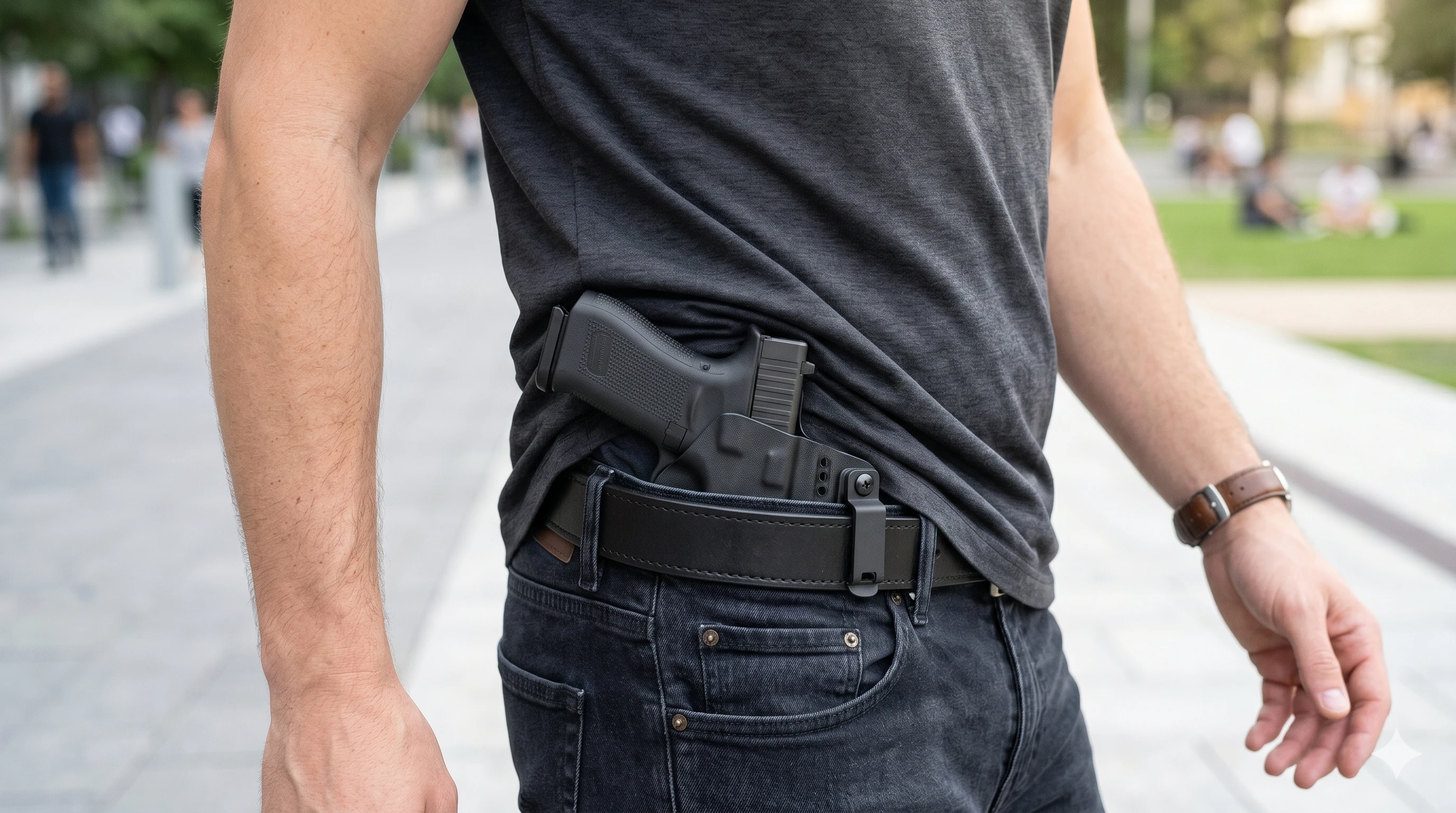
For most new carriers, the answer is IWB carry at the 3 to 4 o'clock position. IWB stands for inside the waistband, meaning the holster sits between your body and your pants, with only the grip riding above the belt line. The 3 to 4 o'clock position puts the gun on your strong-side hip, just behind the seam of your pants. This is the proven baseline that Gunsite Academy and most credible CCW instructors recommend for a reason: it conceals well under a normal untucked shirt, the draw stroke is intuitive, and the muzzle is pointed at the ground when you reholster.
A quick tour of the alternatives:
- AIWB (appendix inside the waistband) sits at 1 o'clock, in front of the hip. Faster to draw and conceals very well, but the muzzle points at your femoral artery during reholstering. Trained carriers use it safely; new carriers usually shouldn't start there.
- OWB (outside the waistband) sits on the outside of your belt under a cover garment like a vest or untucked button-down. Comfortable for range training, harder to conceal in summer.
- Pocket carry with a pocket-specific holster works for small revolvers and subcompacts as a backup. The pocket has to be dedicated; nothing else goes in it.
- Ankle carry is backup-only. Slow draw, awkward access.
- Small-of-back carry is a bad idea. Fall on your back and you can damage your spine on the gun.
About printing, the term for when the outline of your gun shows through your shirt. New carriers worry about this constantly and almost nobody else notices. People are looking at their phones, not your waistband. A slightly darker, slightly looser shirt usually solves it. The bigger tell is fidgeting; constantly adjusting the holster in public broadcasts "armed person" louder than printing ever will.
A safety note on Mexican carry, slang for tucking a handgun into your waistband without a holster. Don't do it. Nothing covers the trigger, the gun shifts, and reholstering is essentially impossible without pointing the muzzle at yourself or others. Get a real holster.
One climate callout for Florida readers and anyone else carrying in year-round heat: synthetic athletic shirts pair well with a Kydex IWB rig; cotton tees soak through fast. A leather-backed Kydex hybrid (sometimes called a "comfort" hybrid) trades a little draw speed for a more comfortable contact surface against sweaty skin. It's a real factor in whether the gun gets carried in July.
Ammo: Train With FMJ, Carry HP
Ammo splits into two roles: training rounds and defensive rounds.
FMJ stands for full metal jacket. The bullet is a lead core wrapped in a copper jacket, and it's designed for accuracy, reliability, and cost. This is what you train with. Cheap, plentiful, easy on the gun.
HP stands for hollow point. The bullet has a hollow cavity in the tip designed to expand when it hits soft tissue. Expansion does two useful things in a defensive context: it transfers more energy into the threat, and it reduces the odds the round will pass through and keep going. That second part matters more than people realize, especially for home defense in a typical residential setting where over-penetration can put a family member behind drywall at risk. Match the grain weight of your training FMJ to your defensive HP (so 124-grain FMJ paired with 124-grain HP, for example) to keep recoil and point of impact consistent between practice and carry.
Defensive ammo runs roughly $25 to $40 for a box of 20, which means budgeting around $75 to $120 to load three magazines with hollow points and rotate them out twice a year. Avoid exotic, gimmicky rounds with marketing names. They're often less reliable than mainstream defensive loads (Federal HST, Speer Gold Dot, Hornady Critical Defense, Winchester Ranger T) and they read poorly if a round ever ends up in a courtroom.
Training: What "Practice Regularly" Actually Means
Every CCW guide on the internet tells you to "train regularly" and then bails on what that actually looks like. Here's a concrete floor for a working adult who can't live at the range:
- Dry fire, 10 minutes, 3 to 4 times a week. No live ammo in the room. Practice your draw from concealment, sight alignment, trigger press, reholstering. This is where you build mechanical fluency that holds up under stress. It's free.
- Live fire, 50 to 100 rounds, once a month. Burn a box or two through your carry gun. Don't just stand at 7 yards and slow-fire bullseyes. Work drawing from concealment under a shot timer, shooting from cover, target transitions, strong-hand and weak-hand only.
- Formal training, once or twice a year. A defensive pistol course with a competent instructor exposes more holes in your skill set in one weekend than a year of square-range practice.
- Trauma first aid. The part most carriers skip. If you're carrying a tool that can put holes in people, knowing how to plug a hole is part of the job. A basic Stop the Bleed or TCCC-aligned course teaches tourniquet use and wound packing in a few hours. A pocket tourniquet costs $30. Carry it.
Our in-store training calendar covers most of the above, and the indoor range is open seven days a week if you'd rather work on your own program. Either way, the floor is dry fire plus monthly live fire. Anything less and the gun is decoration.
Florida and the National Legal Picture
Concealed carry law in the United States is a layer cake. Federal law sets the floor. State law sets the rules where you live. Other states' laws apply the moment you cross a state line. Here's the structure that matters.
Federal floor
Every commercial firearm purchase in the U.S. goes through a federally licensed dealer (FFL) and runs through the NICS background check (the FBI's National Instant Criminal Background Check System). You fill out Form 4473, the dealer runs the check, and you either walk out with the gun or, if your state imposes one, you wait out the state's waiting period. Federal minimum age to buy a handgun from an FFL is 21.
Two federal no-carry rules apply nationwide regardless of permit status. The Gun-Free School Zones Act generally prohibits firearms within 1,000 feet of K-12 school grounds, with a narrow exception for permit holders carrying in their permit-issuing state. And federal facilities are off-limits, including post offices, federal courthouses, and most federal buildings, regardless of any state permit. Your CWL doesn't get you into the post office with a gun in your pocket.
Permitless carry as the modern baseline
As of 2026, 29 states allow some form of permitless concealed carry (sometimes called Constitutional carry) of a handgun by adults 21+. That's the current count from NRA-ILA's Florida summary, which tracks the national rollup. (You'll still find guides quoting 27 states, including Liberty Safe's "Concealed Carry 101"; it's a stale number that hasn't been updated for the most recent additions.) Florida joined the group on July 1, 2023.
Permitless carry means no state-issued permit is required to carry concealed in the state where you live, assuming you're legally able to possess a firearm. It does not mean no rules. Off-limits locations (schools, courthouses, bars, polling places, etc.) still apply. Federal restrictions still apply. And the moment you cross into a state that doesn't recognize permitless carry, you're carrying illegally unless you have a permit that state recognizes.
Why a CWL still matters in a permitless state
Florida is permitless, and the Florida Concealed Weapon License (CWL) is still issued for two practical reasons.
Reciprocity, which is one state recognizing another state's permit, is the big one. The FL CWL provides reciprocity with 38 other states, the broadest reciprocity footprint of any state-issued permit. If you ever drive across a state line with a gun, that matters a lot. Without a recognized permit, your legal carry in Florida becomes a felony in a state that hasn't gone permitless and doesn't recognize FL.
The second reason is the 3-day waiting period on firearm purchases in Florida. Most buyers wait 3 business days (excluding weekends and holidays) between purchase and pickup. CWL holders are statutorily exempt and can take same-day delivery. If you buy guns regularly, that adds up.
Reciprocity in practice
Reciprocity rules change. Verify before every trip rather than going off what you remembered last year. A few things commonly change at state lines:
- Magazine capacity limits. Some states cap magazines at 10 or 15 rounds.
- No-carry locations. What's legal in your home state may be off-limits two states over (state buildings, restaurants serving alcohol, etc.).
- Duty to inform. Some states require you to immediately tell a law enforcement officer you're armed during any official contact. Some don't.
- Carrier rules for transport. Air travel with a firearm has its own checked-baggage protocol; train and bus rules vary by carrier.
Florida specifics worth knowing
For FL buyers, minimum age to purchase any firearm from an FFL in Florida is 21 (raised post-Parkland in 2018), and the 3-day waiting period applies to handguns and long guns. Florida's Stand Your Ground law eliminates the duty to retreat in places where you have a legal right to be; a full Castle Doctrine deep-dive is its own topic.
If you're rebuilding habits after moving to Florida from a state with stricter rules, the legal floor here is lower than what you're used to. The personal floor doesn't have to drop with it. For browsing, our self-defense handgun options page covers the broader category if you're still working out whether a dedicated CCW pistol is your path.
After a Self-Defense Incident: The Honest Picture
Most CCW guides pivot here into a sales pitch for a self-defense legal plan. We're going to skip the pitch and tell you what realistically happens after a justified use of force, because you should know it before you carry, not after.
If you fire your gun at another person in self-defense and they're hit, expect to be detained, possibly arrested, and held pending investigation. That's true even when the shoot is clean. Police don't sort out facts on the curb; they sort them out at the station and in front of a prosecutor over days or weeks.
Expect significant legal fees regardless of outcome. Defending a self-defense case through a grand jury alone often runs into five figures. A full criminal defense through trial can run six figures and up. A no-bill or acquittal in the criminal case doesn't end your exposure either; the surviving family or the wounded party can sue you civilly under a lower standard of proof. Your employer may also have strong opinions; some employment contracts include morality clauses or firearms policies that result in termination after any use-of-force incident.
Self-defense legal plans (sometimes called CCW insurance, though most are pre-paid legal coverage rather than true insurance) exist as a category of risk-management product worth researching as part of carrying responsibly. We're not going to recommend a specific vendor; the right choice depends on your situation and you should compare offerings yourself. Look at what's covered (criminal defense fees, civil defense, expert witnesses, bail), what triggers coverage, and what the per-incident and lifetime caps look like.
The point isn't to scare you out of carrying. The point is that "just call my lawyer" isn't a plan. Have an actual one.
Common Concealed Carry Mistakes to Avoid
A short list of patterns we see derail new carriers most often:
- Switching guns and holsters constantly. Muscle memory comes from repetition. A new gun every six months means you never get past the awkward stage. Pick a setup, run it for a year before you change anything material.
- Spending all your money on the gun, none on the belt and holster. A $700 pistol in a $20 holster on a $25 work belt will not get carried. Spend proportionally.
- Treating the gun as a talisman. The gun doesn't make you safer if you don't train. Training is most of the value.
- Dressing tactical. 5.11 pants, photographer's vest, gun-brand t-shirt. You're advertising. Dress like a normal adult and the gun disappears.
- Constantly adjusting the holster in public. Fidgeting with your waistband is the loudest tell there is. Get the rig dialed in before you leave the house.
- Carrying only "in dangerous places." Crime is opportunistic. Either commit to carrying every day or don't bother; the half-measure leaves the gun at home on the day you'd want it.
Conclusion
So how do you conceal carry well? Make four decisions, in this order: a handgun that fits your hand and that you'll actually carry; a holster and gun belt that hold it safely and comfortably enough that the rig stays on your body all day; defensive ammo you've test-fired in your gun, with training ammo that matches grain weight; and a real training cadence that includes weekly dry fire and monthly live fire. Then add the legal layer for where you live and where you travel.
Concealed carry isn't a single answer. It's a system you build and maintain. The carriers who do it well aren't the ones with the most expensive gear; they're the ones who made deliberate choices, train consistently, and treat the responsibility as the long-term commitment it is.
If you want to handle and shoot what you're considering before you buy, come into the shop and use the range. We have rentals across the major compact and subcompact 9mms, and the team can talk you through the trade-offs without trying to upsell you. If you'd rather start by browsing, see our selection of concealed carry pistols online and get in touch with questions.