
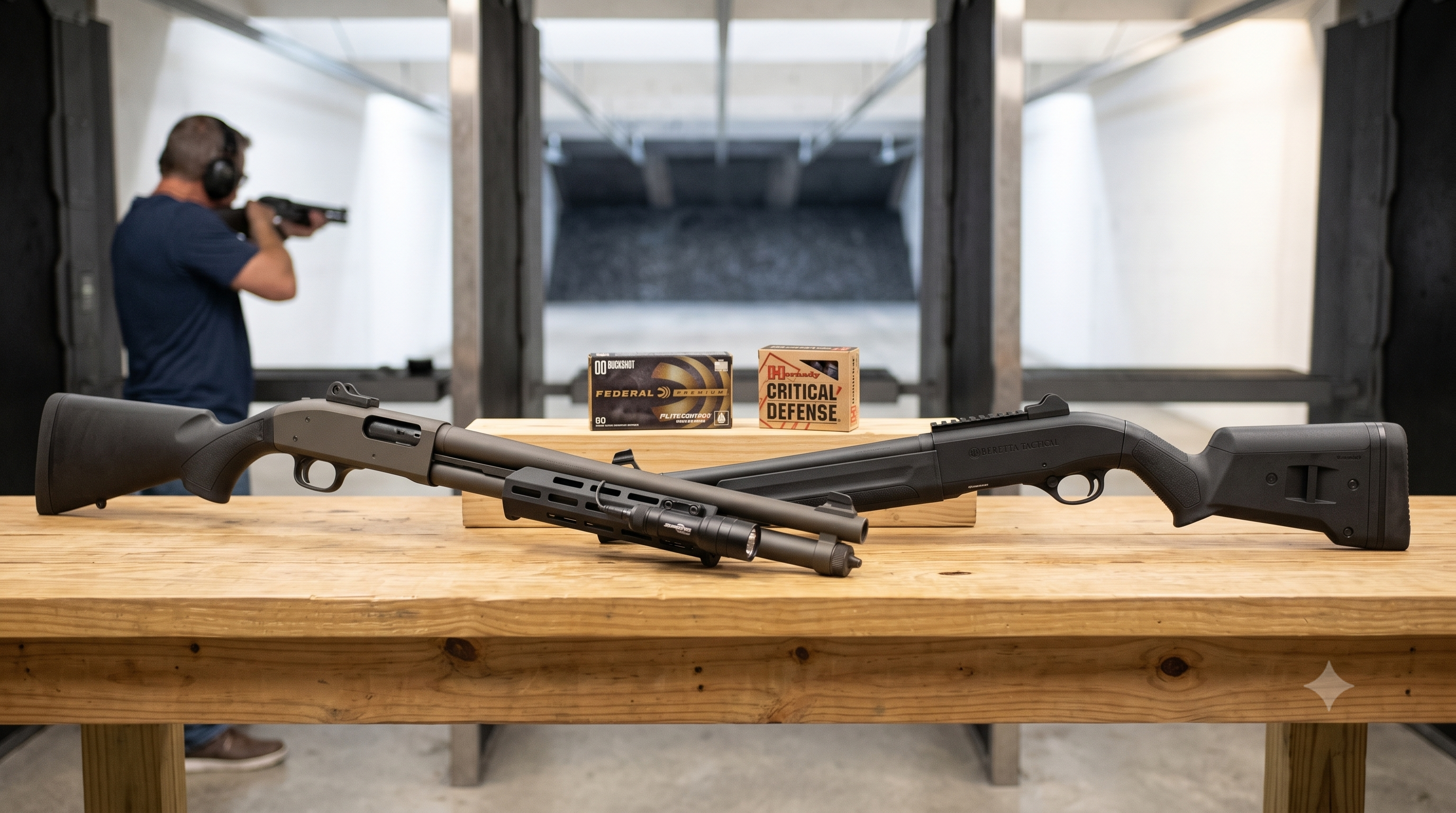
Best Shotgun for Home Defense: 2026 Buyer's Guide
Posted by Joel Sheran on Jun 9th 2026
If you want the short answer: the Mossberg 590A1 is the consensus pump-action pick at around $576, the Beretta A300 Ultima Patrol is the value semi-auto at $949, and the Benelli M4 is the most reliable semi-auto at about $1,952. Stick with 12-gauge in most cases, an 18 to 19-inch barrel, 5+1 capacity or higher, and a weapon-mounted light. That covers 90% of buyers.
The longer answer is what most people actually need, because the "best shotgun for home defense" depends on how much you'll shoot, what you can spend, and whether you want to rack a pump under stress or let the gun cycle itself. Below are six picks across pump-action and semi-auto, plus a 20-gauge sidebar. Every one of these is something you can rent and shoot at our indoor range in Nokomis before you put money down.
How We Picked These Shotguns
A real home-defense shotgun isn't a duck gun with a shorter barrel. The picks here all clear the same bar:
- Gauge. 12-gauge default; 20-gauge is legitimate for recoil-sensitive shooters (more below).
- Barrel length. 18 to 19.1 inches. Federal minimum legal barrel is 18 inches. Sub-18" guns like the Mossberg 590 Shockwave are classified as a "firearm" under federal law because of the 14-inch barrel and birdshead grip, per Mossberg's documentation. Different tool, different technique, not what we're recommending here.
- Capacity. 5+1 minimum (five in the tube, one in the chamber). Mainstream HD shotguns run 4+1 up to 8+1.
- Light-ready. Ships with M-LOK or Picatinny for a weapon-mounted light, or accepts an aftermarket forend that does.
- Reliable across loads. Cycles reduced-recoil tactical, full-power buckshot, and slugs without choking.
- Price ceiling. Sub-$2,000.
For testing standards, PewPewTactical's home-defense shotgun roundup ran every gun through 250-plus rounds (most exceeding 1,000) across 7-, 15-, and 25-yard pattern distances. That's the industry benchmark, plus what we see at our indoor range with customers pulling triggers on these guns before they buy.
A note on action types, since we'll use the terms throughout:
- Pump-action — manually-cycled. You slide the forend rearward and forward to extract the spent shell and chamber a fresh one. Cheapest, most reliable across ammo types.
- Semi-automatic (gas) — gas-driven. The gun taps off propellant gas to cycle the action for you. Beretta A300, Beretta 1301, Mossberg 940, and Benelli M4 are gas-operated.
- Semi-automatic (inertia) — recoil-driven. Benelli M2 is the classic inertia gun. Lighter, pickier about reduced-recoil loads.
At-a-Glance Comparison
Here are all six picks side by side, plus the Mossberg 940 Pro Tactical as a seventh contender for shooters who want a factory-included optic-ready setup.
| Pick | Action | Gauge | Capacity | Barrel | Weight | Price | Best For |
|---|---|---|---|---|---|---|---|
| Mossberg 590A1 | Pump | 12ga | 5+1 / 6+1 / 8+1 | 14" / 18.5" / 20" | ~7.25 lbs | ~$576 | Best pump overall |
| Mossberg Maverick 88 | Pump | 12ga / 20ga | 5+1 / 7+1 | 18.5" / 20" | ~6.75 lbs | ~$234 | Best budget pick |
| Remington 870 Tactical | Pump | 12ga | 4+1 / 6+1 | 18.5" | ~7.5 lbs | ~$449 | Best for first-time HD buyers |
| Beretta A300 Ultima Patrol | Semi-auto (gas) | 12ga | 7+1 | 19.1" | ~7.1 lbs | ~$949 | Best value semi-auto |
| Beretta 1301 Tactical | Semi-auto (gas) | 12ga | 7+1 | 18.5" | ~6.4 lbs | ~$1,549 | Best premium semi-auto |
| Benelli M4 | Semi-auto (gas) | 12ga | 5+1 | 18.5" | ~7.8 lbs | ~$1,952 | Most reliable semi-auto |
| Mossberg 940 Pro Tactical | Semi-auto (gas) | 12ga | 7+1 | 18.5" | ~7.8 lbs | ~$1,120 | Best red-dot-ready semi-auto |
If you'd rather just browse the lineup we keep on the shelf, take a look at our full 12-gauge shotgun selection.
Best Pump-Action Shotgun for Home Defense — Mossberg 590A1
Specs: 12-gauge, pump-action, 5+1 / 6+1 / 8+1, 14" / 18.5" / 20" barrel options, ~7.25 lbs, ~$576.
There's a drift on the SERP toward semi-auto editor's picks, and we get why; the A300 Ultima Patrol and Beretta 1301 Tactical are excellent guns. But the 590A1 is still the right answer for the buyer who'll fire 50 rounds a year, keep one in the bedroom, and needs it to work in five years when they pick it up again.
It's the gun the U.S. military and law enforcement have leaned on for decades. Heavy-walled barrel, metal trigger guard, metal safety, parkerized finish. The 8+1 configuration gives you nine rounds before reload, which is more than most shooters will ever need defensively. Sighting options include a simple bead, a rifle-style front sight, or ghost-ring sights (a large aperture rear with a post front, faster to acquire than a bead at HD distances).
The standard forend doesn't have a light mount, but Mossberg's M-LOK forend or aftermarket replacements bolt right on. Run Federal Premium Personal Defense 00 buckshot with FliteControl wad as your primary load.
The case against it: 7.25 pounds is heavier than the polymer-stock semi-autos, and it kicks. For the buyer this gun is for, that's a non-issue.
Best Budget Shotgun for Home Defense — Mossberg Maverick 88
Specs: 12-gauge or 20-gauge, pump-action, 5+1 / 7+1, 18.5" or 20" barrel, ~6.75 lbs, ~$234.
The Maverick 88 is essentially a Mossberg 500 with a cheaper finish and the safety moved from the tang (top of the receiver, where your thumb naturally lands) down to the front of the trigger guard. That's the only meaningful difference. It accepts 500-pattern barrels and most 500 accessories, so the upgrade path is real. Longer mag tube, ghost-ring sights, M-LOK forend all bolt on the same way they would on a more expensive Mossberg.
At ~$234, per PewPewTactical's pricing roundup, this is the entry point for a serious 12-gauge HD pump. We're not going to oversell it; it's not a 590A1. For the buyer with $300 total to spend who wants a shotgun in the closet for one specific job, this is the right tool. The 20-gauge version is worth knowing about; we'll come back to it below.
Best Beginner Shotgun — Remington 870 Tactical
Specs: 12-gauge, pump-action, 4+1 or 6+1, 18.5" barrel, ~7.5 lbs, ~$449.
The 870 has been around since 1950, and there are millions in service. That matters for a first-time HD shotgun buyer in two ways. The action is smooth and the manual of arms is simple enough that our staff can walk a brand-new shooter through field-stripping in about five minutes. And the aftermarket is enormous; if you decide in two years you want a different stock, sight saddle, extended mag tube, or forend, the part exists and it's probably under $80.
Hardwood or synthetic stock at the same price. Rifle-style front sight on the Tactical model, faster to pick up than a bead in a hallway. The slide cycles like butter out of the box.
If you're new to shotguns and want a gun you'll grow into rather than out of, the 870 Tactical is the one we hand most first-time HD buyers. Not the cheapest pick and not the highest capacity, but the most forgiving to learn on.
Best Value Semi-Auto — Beretta A300 Ultima Patrol
Specs: 12-gauge, gas-operated semi-automatic, 7+1, 19.1" barrel, ~7.1 lbs, ~$949.
This is the gun that flipped the SERP. Two years ago, you could not get a serious semi-auto home-defense shotgun for under $1,500 without buying used. The A300 Ultima Patrol changed that, and PewPewTactical now ranks it as their Editor's Pick across the entire category at $949 (per the PewPew roundup).
What you get for the money: an extended seven-round magazine tube, a Picatinny rail for a red dot, oversized controls (bolt release, safety, charging handle) that you can find with gloves on or in the dark, and a gas-operated action that meaningfully reduces felt recoil compared to a pump. It ships ready for accessories, which is unusual at this price point. Most sub-$1,000 semi-autos make you spend another $200 in upgrades before they're really HD-ready. The A300 doesn't.
For the buyer with $900 to $1,000 to spend who wants softer recoil and faster follow-ups than a pump can give, this is the pick. The only meaningful tradeoff versus the 1301 Tactical above it is cycling speed; the A300 is fast, the 1301 is faster.
Best Premium Semi-Auto — Beretta 1301 Tactical
Specs: 12-gauge, gas-operated semi-automatic (B-Link), 7+1, 18.5" barrel, ~6.4 lbs, ~$1,549.
Beretta markets the 1301's B-Link gas system as cycling 36% faster than any other semi-auto shotgun, and the PewPewTactical hands-on review confirms ultra-fast cycling and minimal muzzle rise. This is competition-grade glass on a defensive platform.
Length-of-pull is adjustable via included spacers, which matters more than most buyers realize. A shotgun stock that's the wrong length for your build is one you don't shoot well, especially with a heavy jacket on at 2 a.m. The 1301 lets you tune it to fit.
This is the gun we tell people to actually shoot at the range before they spend the money. The cycling speed is something you have to feel; it doesn't come through on YouTube. If you can spend $1,500, you'll know within 25 rounds whether the 1301 is worth $600 more than the A300 to you.
Most Reliable Semi-Auto — Benelli M4
Specs: 12-gauge, gas-operated semi-automatic (ARGO), 5+1, 18.5" barrel, ~7.8 lbs, ~$1,952.
The U.S. Marine Corps adopted the M4 in 1999 and still issues it. That's the credential. The gun runs a proprietary auto-regulating gas-operated (ARGO) system that uses two short-stroke pistons to cycle reliably with everything from light tactical loads to full-power magnum shells. It does not care what you feed it.
The case for the M4: it's the buy-once-cry-once pick. The case against: it's 7.8 pounds, $1,952, and the standard tube is 5+1. PewPew's editor leaned toward the 1301 Tactical as the better all-around defensive semi-auto for most shooters, and we mostly agree. The M4 is the pick when reliability under any conditions, including humid Florida storage, is the only thing that matters. The NRA's America's 1st Freedom guide puts the M4 alongside the Benelli M2, M3, and Beretta 1301 as primary semi-auto recommendations; we'd bracket all four in the same "you cannot make a wrong call here" tier.
Is 12-Gauge or 20-Gauge Better for Home Defense?
Twelve-gauge is the default, and it's what every pick above is chambered in. But 20-gauge is not a toy load, and it's the right answer for a meaningful subset of buyers.
The case: meaningfully reduced recoil with adequate buckshot performance at indoor distances (typical HD engagement is under 10 yards). For a smaller-framed shooter, an older shooter, or anyone who has tried a 12-gauge and decided the recoil is going to keep them from training, a 20-gauge HD pump is a serious tool, not a compromise.
Our recommendation is the same Mossberg Maverick 88 in 20-gauge, or a Mossberg 500 in 20-gauge. Same controls as the 12-gauge versions; you're just shooting a smaller shell. Load it with 20-gauge #3 buck (the equivalent buckshot load to 12-gauge 00) and you've got a defensive shotgun the recoil-sensitive shooter will actually practice with. A gun you train with beats a gun you flinch through every time. Browse our 20-gauge shotguns if you'd like to see what we keep on the shelf.
Gauge is a comfort and confidence question at HD distances, not a stopping-power question. Pick the one you'll actually shoot well.
Pump-Action vs Semi-Auto: Which Should You Buy?
This is the actual fork in the road:
Pump-action. $234 to $700. Unbeatable reliability across every load type, including mini-shells, light target loads, slugs, and reduced-recoil tactical buckshot. Manual of arms is simple. Downsides: human error matters (short-stroking under stress causes jams), follow-ups are slower, and recoil is heavier because the gun isn't using gas to soak up the impulse.
Semi-automatic. $949 to $2,000+. Faster follow-ups, softer felt recoil, simpler manual of arms in the moment (no need to cycle between shots). Downsides: more expensive, can be picky about reduced-recoil loads, more parts to maintain.
Decision rule. If you're going to fire fewer than 100 rounds a year and want a defensive tool that lives in the closet, buy a pump. The 870 Tactical, 590A1, or Maverick 88 will all serve you for life. If you're going to train regularly, want softer recoil for that training, and have $900+ to spend, step up to the A300 Ultima Patrol or the 1301 Tactical.
A few quick myths to clear out:
"Just rack the action — the sound alone scares the intruder away." Don't plan on this. Racking gives away your position, leaves the gun in a different state than you trained on, and a determined intruder isn't deterred by sound. Train as if you'll have to fire.
"Pump shotguns are obsolete." They aren't. The drift toward editor's-pick semi-autos on every gun-content site since 2024 is real, but it's written for the buyer who's going to shoot a lot. The buyer who'll shoot 50 rounds a year does not need to spend $1,500.
"A handgun is a better answer than a shotgun." Real argument from pistol-first instructors. A handgun is one-handed, easier to operate while holding a flashlight, easier to maneuver in tight spaces. The shotgun's counter-argument is pattern forgiveness on a 2 a.m. wake-up plus raw stopping power that a 9mm cannot match. If you haven't decided whether shotgun is the right platform, read our complete home defense firearms guide. For the rifle alternative, our breakdown of the best AR-15s for home defense covers it. For the pistol option, our complete handgun buying guide walks through the platform.
What to Load: Ammo Notes for Home Defense
What you put in the gun matters as much as the gun itself:
- Federal Premium Personal Defense 00 Buckshot (FliteControl wad). Industry consensus pick for defensive 12-gauge. The FliteControl wad keeps the pattern tight at the actual HD distance band, roughly 7 to 10 yards. A tighter pattern means more pellets stay on target and fewer leave the room.
- Hornady Critical Defense 00 Buck. The other consensus pick. Similar tight-pattern design, slightly different recoil impulse. Whichever your gun cycles best is the right one for you.
- #4 buck if you specifically want a less-penetration load. Smaller pellets (~21 per shell instead of 8 to 9), denser pattern, less likely to drive through interior partitions.
- Birdshot is not a serious HD load. This was conventional wisdom 30 years ago and it has not aged well. Industry consensus is that birdshot underpenetrates for stopping power. Skip it.
A note for Florida buyers: if your house is newer construction, your interior walls are likely sheetrock over wood or metal stud, which 00 buck will pass through. The answer isn't birdshot; it's knowing your home's layout, knowing what's on the other side of the walls, and patterning your gun at HD distances so you know what your specific load combination does.
Setup Essentials: Light, Sights, and Storage
Three things every home-defense shotgun needs:
A weapon-mounted light. Non-negotiable. You cannot shoot what you cannot identify, and at 2 a.m. in your hallway you have to identify your target before you fire. Most of the picks above either ship with an M-LOK rail (Beretta A300, 1301, Mossberg 940) or accept an aftermarket forend that adds one (590A1, 870 Tactical, Maverick 88). A Streamlight TLR-1 HL or Surefire Scout is the standard.
Decent sights. Bead sights work, but ghost-ring or a red dot is meaningfully faster at HD distances. The 590A1 ships with ghost-ring as an option; the Mossberg 940 Pro Tactical ships red-dot ready. A red dot lets you shoot with both eyes open, which matters more than most shooters expect.
Quick-access storage near the bedroom. This is the persona's biggest concern, and it's a fair one: how do you keep the shotgun ready without making it accessible to kids or grandkids? The answer is a quick-access safe that opens with a fingerprint or button code in two seconds, mounted within arm's reach of where you sleep. Vaultek, Hornady, and Stack-On all make solid options in the $200 to $400 range. Whatever you buy, practice opening it in the dark before you assume you can.
If you're also looking at a concealed-carry pistol for the broader self-defense picture, that's a separate conversation worth having with our staff in person.
Skip These Picks for Home Defense
A few categories worth knowing about so you can ignore them at the gun shop:
- Bullpup shotguns (KelTec KS7, IWI Tavor TS12, KelTec KSG). Compact and interesting, but the manual of arms is unfamiliar, the controls are awkward to find under stress, and they're heavier than a comparable conventional shotgun.
- Multi-barrel shotguns (Charles Daly Triple Threat, Standard DP-12). Two or three barrels, double the rounds before reload. Also double the weight, double the complexity, and a manual of arms no one trains on.
- Magazine-fed shotguns (Mossberg 590M, Smith & Wesson M&P12). Detachable box mags sound like a feature until you realize the mags are oddball, expensive, and prone to feeding issues with anything other than the specific load they were designed around. Tube-fed magazines aren't a limitation; they're a reliability advantage.
The pattern across all three is the same: novelty over reliability, complexity under stress, slow reloads. None of these are bad guns. They're just not HD guns.
Bottom Line
The decision tree is short. Buy a pump if you'll fire fewer than 100 rounds a year and want a tool that works in a decade with no maintenance: the Mossberg 590A1 at $576 for the best pump in class, the Remington 870 Tactical at $449 if you're new to shotguns, or the Mossberg Maverick 88 at $234 if budget is the constraint. Step up to a semi-auto if you'll train regularly: the Beretta A300 Ultima Patrol at $949 (value), the Beretta 1301 Tactical at $1,549 (premium), or the Benelli M4 at $1,952 (buy-once-cry-once).
What we'd actually like you to do is come into the shop. Every gun on this list is something you can rent and shoot at our indoor range in Nokomis before you commit. The differences between a 590A1 and an 870, or between a 1301 and an M4, do not come through on a spec sheet; they come through after 10 rounds. And if you find a better price on any of these somewhere else, we'll match it. See our curated home defense shotgun lineup or stop by the counter.