
Best First Handgun: A Complete Buying Guide for New Florida Owners
Posted by Joel Sheran on May 9th 2026
You've decided you want a handgun. Now you're staring at a wall of pistols and revolvers with no idea where to start. Good news: it's easier than the internet makes it sound.
For most new buyers, the best first handgun is a compact 9mm striker-fired polymer pistol with a 3.5" to 4" barrel, priced between $400 and $700, and tested at a range before purchase. That's the consensus across nearly every credible buyer's guide. The rest is how to know if that consensus is right for you.
This guide covers the decision (not a single SKU recommendation), the Florida-specific buying rules you'll run into at the counter, and what to do during your first 30 days as an owner.
What Should You Know Before Buying a Handgun?
Five things to sort out before you walk into a shop.
1. Why are you buying it? Concealed carry, home defense, range fun, or some mix? Your answer drives almost every other decision. A nightstand gun and a daily carry gun aren't usually the same gun.
2. What's your real budget? Plan on $400 to $700 for the firearm, plus $100 to $200 for the basics (a quick-access safe, a holster if you're carrying, eye and ear protection, a couple boxes of practice ammo). Going below $400 narrows your options to brands without much support behind them.
3. Where will you store it? If you have kids in the house or visitors with kids, a quick-access safe isn't optional. Build the cost in now.
4. Will you actually train with it? A gun you shoot four times a year is a paperweight in an emergency. If you can't see yourself going to the range every couple of months, scale your expectations down.
5. It's okay not to know yet. Nobody is born knowing the difference between a striker-fired pistol and a hammer-fired one. That's why ranges with rentals exist. If you want a fuller framework before narrowing the format, our first firearms broken down by purpose guide is a good companion read.
A quick vocabulary primer:
- Caliber is the diameter of the bullet, expressed in inches (.22, .380, .38, .45) or millimeters (9mm, 10mm).
- Semi-auto uses the energy of each fired round to load the next one. Most modern pistols.
- Revolver uses a rotating cylinder of 5 to 7 rounds. Mechanically simpler.
- Striker-fired means a spring-loaded firing pin gets cocked by the slide cycling. No external hammer. Glock, Sig P320, S&W M&P. The default beginner platform today.
- Hammer-fired uses an external or internal hammer that drops to fire. 1911s, CZs, Berettas, the Sig P226.
The number-one rule borrowed from most well-respected instructors: reliability beats features. The best first handgun is one that goes bang every single time you pull the trigger. Boring is good.
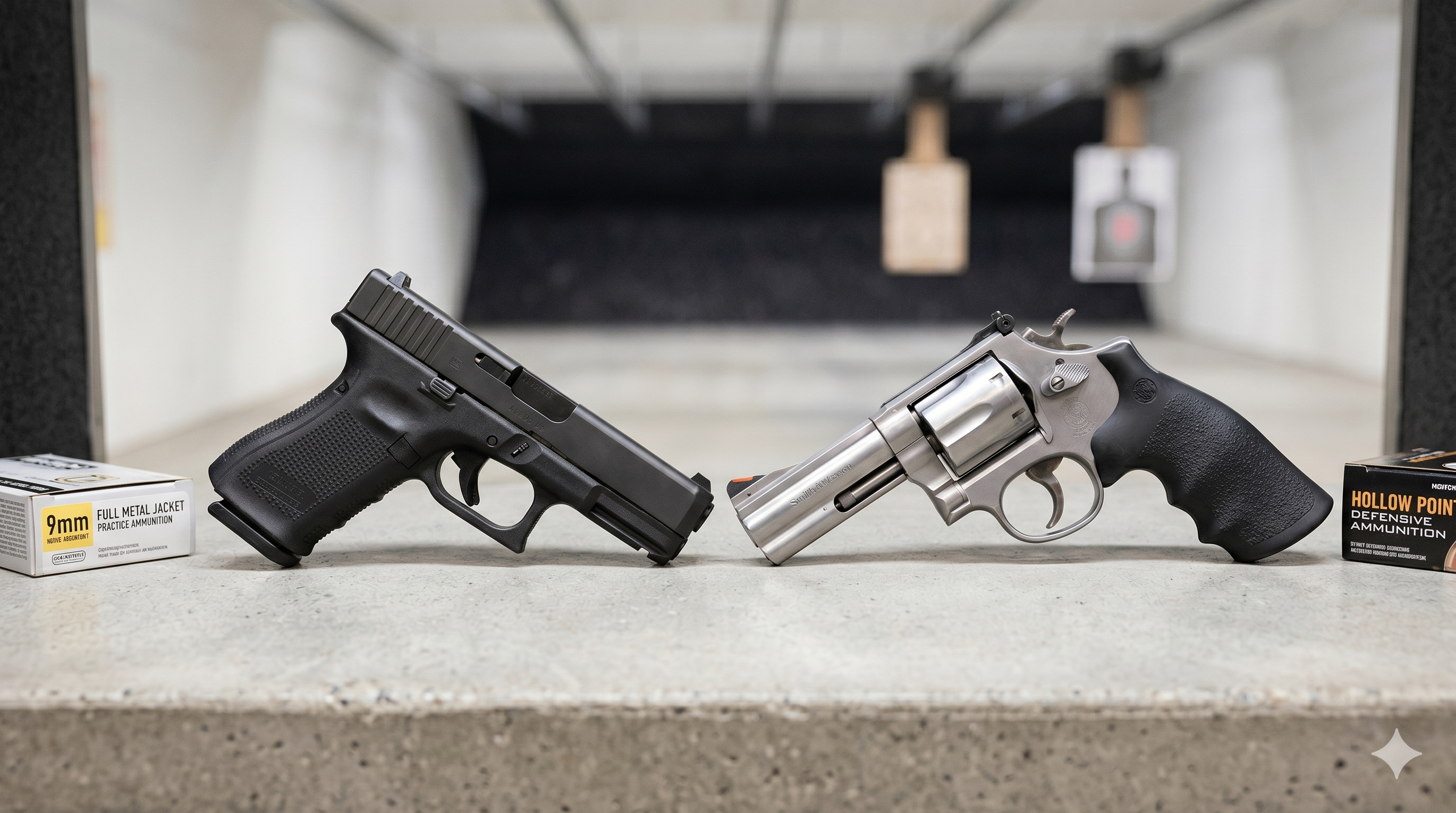
Semi-Auto vs Revolver: Which Is Right for Your First Handgun?
This is the foundational fork in the road. The internet will tell you revolvers are obsolete. The internet is wrong, or at least overconfident.
Semi-autos dominate the modern market for real reasons. Capacity in the 10 to 17 round range, faster reloads with a magazine swap, broad accessory and holster support, and the ability to add a red dot down the road. The trade-off is a slightly more complex manual of arms (slide manipulation, magazine release) and the requirement that you can rack a stiff slide reliably under stress.
Revolvers keep showing up on serious best-of lists for a reason. Pew Pew Tactical's roundup, for instance, includes the Smith & Wesson Model 686, a six-shot .357 Magnum revolver, alongside its semi-auto picks. The case for a revolver as a first handgun:
- You want maximum simplicity. Pull the trigger, it fires. No slide to rack, no magazine to load, no safety to check.
- You struggle to rack a slide. Hand-strength issues, arthritis, smaller hands, or a stiff factory recoil spring. A revolver eliminates the problem.
- You're buying a dedicated nightstand gun and don't need 15 rounds. Five or six rounds of .38 Special covers most home-defense scenarios.
- You like the format. Some people just shoot revolvers better.
Where revolvers struggle: capacity (5 to 7 rounds versus 10 to 17), slower reloads, and a heavier trigger pull that can affect accuracy until you train through it.
If you want to see the format in person, the revolvers we stock range from compact snubnose models for backup carry to full-size service revolvers like the 686. And if you're thinking past a single handgun toward a complete home-defense setup, our broader home-defense guide covering shotguns and rifles too walks through whether a handgun is even the right primary tool for your situation.
Most first-time buyers will land on a semi-auto. But "most" isn't "all," and a revolver is a real choice, not a consolation prize.
Caliber Choice: Why Most Beginners Land on 9mm
Of every decision in this guide, caliber has the strongest consensus. Across every major buyer's guide we reviewed, 9mm is the recommended starting caliber. The reasons line up cleanly:
- Manageable recoil for most adult shooters, which means you can train longer without flinching.
- Cheaper ammunition than .40 S&W, .45 ACP, 10mm, or .357 Magnum. Practice cost matters when you're building a habit.
- Higher capacity in the same frame size compared to larger calibers.
- Modern hollow-point performance has closed most of the gap between 9mm and the larger service calibers in defensive ballistics. The FBI moved back to 9mm for issued duty pistols in the mid-2010s after extensive ballistic testing, and most major law-enforcement agencies followed. If 9mm is enough for federal agents, it's enough for a homeowner.
A note on the counter-position: a vocal minority of older instructors and some training schools argue .22 LR is the right first handgun. Their case is fundamentals first, no recoil-induced flinch, very cheap practice. It's not a bad position. If you're highly recoil-sensitive, planning to shoot thousands of rounds a month, or buying a teaching gun for a smaller-framed family member, .22 LR is a legitimate path. The modern instructor consensus pushes back though: training under realistic defensive recoil produces better outcomes, so most new owners should start on the caliber they'll actually carry or keep loaded at home.
What about .380? Reasonable for deep-concealment backup, but the recoil in the small pistols .380 lives in is often worse than 9mm in a slightly larger frame. Don't pick .380 because you think it'll be gentler. Shoot both first.
What about .40 and .45? Still good defensive rounds, both have shrunk in market share for new buyers, and neither offers a meaningful real-world advantage over 9mm with modern ammunition. Skip them on round one.
A couple terms while we're here:
- Hollow point (JHP) is defensive ammunition designed to expand on impact. Reduces over-penetration. What you load for home defense or carry.
- FMJ (full metal jacket) is practice ammunition. Cheaper, doesn't expand. What you shoot at the range.
If you'd like to browse the format most first-time buyers end up with, see our 9mm pistols selection.
Size: Full Size, Compact, or Subcompact?
Handgun size tiers, in plain language:
- Full size: duty-pistol footprint. Glock 17 territory, around a 5.5" slide. Easiest to shoot well, hardest to conceal. Great as a nightstand or range-only gun.
- Compact: the do-everything tier. Glock 19, S&W M&P 2.0 Compact, Sig P320 Compact. Around a 4" barrel. Big enough to shoot accurately, small enough to carry with the right holster and cover garment. Where most new owners should land if they're buying one gun to do everything.
- Subcompact: Glock 26, Springfield Hellcat. Around a 3" to 3.5" barrel. Built for concealed carry, harder to shoot well, less forgiving recoil.
- Micro-compact: Sig P365, S&W Bodyguard 2.0. Around a 3" barrel and very thin. Designed for deep concealment. Capacity has gotten genuinely good in this tier (10 to 13 rounds in some), but recoil is sharper and the shorter sight radius makes accuracy harder.
If you're buying one gun to cover home defense, occasional carry, and range practice, default to a compact. The classic answer is the Glock 19 because it's been refined across five generations and aftermarket support is unmatched, but the M&P 2.0 Compact and the Sig P320 Compact are equally credible. None is a wrong answer.
If you're buying purely for daily concealed carry and you've already proven you can shoot a small gun well, a micro-compact makes sense. Most new owners regret jumping straight to a micro-compact as their first gun though, because the platform punishes shooting fundamentals that are still being built.
Action Type, Optics, and Safety Features
Three quick decisions that paralyze new buyers more than they should.
Striker-fired vs hammer-fired. Default to striker-fired polymer. Simpler manual of arms, no decocker to learn, usually no manual safety to fumble under stress. This is why the modern beginner-recommendation pool is dominated by Glocks, Sigs, S&W M&Ps, and Walthers, not by hammer-fired guns like the 1911 or the Beretta 92. Hammer-fired guns have their fans for good reason; they're just not the path of least resistance for a first handgun.
Manual safety, yes or no? A manual safety is a small lever you flip down before the gun will fire. Some new owners feel safer with one. Others find it adds a step they might forget under stress. The current dominant view: a properly holstered striker-fired pistol with a good trigger doesn't need a manual safety, and skipping it removes one thing to think about. If a manual safety helps you carry confidently, get one (the M&P 2.0 and several Walthers offer the option). Otherwise, you don't need it.
Optics-ready, MOS, RMR cut. All of these mean the slide is milled to mount a red-dot sight directly. You don't need a red dot on day one. But spending the small premium for an optics-ready slide gives you the option later. Adding a red dot down the road is far easier than retrofitting one onto a non-optics-ready pistol. If you're picking between two otherwise similar guns, take the optics-ready version.
For a deeper head-to-head between the Glock 19 and Sig P320, two of the most common first-handgun candidates in this category, that comparison walks through the trade-offs in detail.
Florida-Specific Buying Rules You Need to Know
If you're buying in Florida, the state adds a few wrinkles the national guides skip. The short version:
You must be 21+ to buy any handgun or long gun. Florida raised the minimum age to 21 for all firearm purchases in 2018. No FFL workarounds; this applies to private sales too. The NRA-ILA's Florida summary covers the statute in detail.
3-day waiting period on every FFL purchase. Three business days, excluding weekends and legal holidays, between paperwork and pickup. The FDLE's firearm purchase FAQ is the authoritative source. A Friday afternoon purchase usually means picking up the following Wednesday.
The CWL waives the wait. If you hold a valid Florida Concealed Weapon License, the 3-day waiting period doesn't apply. You can take same-day delivery. Florida has been a permitless concealed-carry state for residents 21+ since July 2023, so you don't need a CWL to carry. But the FDACS Concealed Weapon License is still issued because it gives you reciprocity in 38 other states and removes the waiting period at home. Worth considering if you plan to buy multiple firearms.
NICS background check at the counter. Every FFL purchase runs through the federal National Instant Criminal Background Check System. You'll fill out an ATF Form 4473 (the federal firearms transaction record) at the counter; the dealer submits it to NICS for a near-instant decision.
No FL pistol registration. Florida doesn't maintain a state firearms registry. Once your purchase clears, the state has no ongoing record of your ownership.
Private sales. Federal law doesn't require a NICS check on private sales between Florida residents. The 21+ age requirement still applies. Private sales are legal in FL but most new owners are better off going through an FFL the first time around so the paperwork is on record.
One terminology note: FFL stands for Federal Firearms Licensee, the dealer license required to sell firearms. When someone says "the FFL" they usually just mean the gun shop.
Try Before You Buy: Use a Range to Pick the Right Handgun
Reading specs online will only get you so far. The grip angle that looks great on YouTube might feel wrong in your actual hand. Range time before purchase is the single most useful thing you can do.
How to actually do it:
- Narrow to 3 or 4 candidates that survived the previous sections. Probably all 9mm, probably mostly compacts, probably mostly striker-fired. If you're seriously considering a revolver, include one.
- Rent each one. Most ranges with retail attached (ours included) rent the same models they sell.
- Fire 50 rounds of practice ammo through each. One magazine slow-fire for a feel of the trigger and grip. One at moderate pace. One at a target placed at realistic home-defense distance (about 7 yards).
- Save your targets. A phone photo works if you don't want to carry paper out.
- Pick the gun you shot best with that also felt right in your hand. Not the one with the best reviews. Not the one your buddy shoots. Yours.
- If you're between two, sleep on it. A first-handgun decision shouldn't be made in 90 minutes of adrenaline at the range counter.
One honest counter-perspective: rentals don't perfectly match what you'll own. Range guns are often well-used and the recoil spring may have softened over thousands of rounds. Fair point. Even imperfect range time still beats buying based on YouTube and forum opinions alone.
What to Do in the First 30 Days After You Buy
The top buyer's guides usually stop at the purchase. Here's what we tell first-time owners to do once they get the case home.
Set up storage on day one. A quick-access handgun safe runs $150 to $300 for a single pistol. If you have kids in the house or any chance of visitors with kids, this isn't optional. Pick one with a backup key in case the keypad battery dies at the worst possible moment. In Florida, look for humidity protection or add a silica desiccant pack (Gulf Coast humidity gets to everything).
Buy two kinds of ammo. Practice ammo (FMJ) for the range, defensive ammo (JHP) for whatever the gun is loaded with at home. Run at least a box of your chosen defensive load through the gun before you trust it. Some defensive rounds don't feed reliably in every pistol, and you want to know that before you actually need it.
Schedule your first range session inside two weeks. The longer the gun sits in the case unfired, the more you'll second-guess everything. 100 rounds at slow pace, focused on grip and trigger press, will teach you more than any YouTube video.
Build a dry-fire habit. Ten minutes a week with the gun fully unloaded and ammunition in another room beats most live-fire practice for trigger control. Triple-check the gun is empty before each session. Then triple-check again.
Consider a basic handgun safety course. Especially if this is your first firearm of any kind. A two- to four-hour course with a qualified instructor in your first 60 days will save you years of bad habits.
The Short Version
The best first handgun for most new buyers is a compact 9mm striker-fired polymer pistol, in the $400 to $700 range, that you've personally fired before purchase. That's the consensus. The way to confirm it's right for you is to put rounds through three or four candidates at a range, then pick the one you shot best with.
Not knowing the terminology on day one is normal. Nobody at a good shop will judge you for asking what striker-fired means or whether the 9mm in the case is the same one on the wall. If anyone does, walk out and find a different shop.
When you're ready to narrow it down, browse our curated handgun selection or come into the shop in Nokomis to handle a few in person. Rentals are available at the indoor range so you can shoot before you commit. We'll price-match if you find a better deal somewhere else, and we run in-store training courses if you'd rather start with a structured lesson before the first purchase. No pressure either way.