
Best Concealed Carry Pistol Picks for New Shooters in Florida (2026)
Posted by Joel Sheran on May 9th 2026
At 21 in Florida, you can legally carry concealed without a permit, you'll wait 3 days to take delivery unless you hold a CWL, and you're about to make a $400-$700 decision you'll live with for years. That's a lot riding on a first pistol, and the wrong pick is a gun that sits in a safe instead of on your hip. This guide narrows the field to the handful of carry pistols that genuinely work for new shooters, scores them against the learning curve instead of dropping pros/cons soup on you, and tells you which one to rent first.
The best concealed carry pistol for a new shooter is one that's easy to rack, manageable to shoot, simple to operate, and priced in the $400-$700 sweet spot. The most-recommended picks for first-time carriers are the Sig Sauer P365, Springfield Hellcat, Glock 43X, Smith & Wesson M&P9 Shield EZ or Shield Plus, and Smith & Wesson Bodyguard 2.0 in .380 ACP. We also include the Glock 19 as the explicit "step-up" option for buyers who'd rather start with a slightly larger gun that's easier to shoot well.
Each pick below gets a one-paragraph "who this is for" rationale, a clean spec line, and a short note on who should pass. If you're earlier in the buying process and not even sure pistol versus revolver, our broader handgun buying guide is a better starting point. If you haven't decided pistol versus shotgun versus rifle for your first firearm at all, start with our best first firearms by purpose overview.
Quick Comparison: 7 Concealed Carry Pistols for New Shooters
| Pick | Caliber | Capacity | Barrel | Weight (unloaded) | MSRP | Manual Safety Option |
|---|---|---|---|---|---|---|
| Sig Sauer P365 X-Macro Comp | 9mm | 17+1 | 3.7" | 21.5 oz | ~$800 | Yes (variant) |
| Springfield Hellcat | 9mm | 11+1 / 13+1 | 3.0" | 18.3 oz | $599-$1,050 | Yes (variant) |
| Glock 43X (MOS) | 9mm | 10+1 | 3.41" | 18.7 oz | $448-$582 | No |
| S&W M&P9 Shield EZ | 9mm | 8+1 | 3.675" | 23.2 oz | ~$549 | Yes (variant) |
| S&W Bodyguard 2.0 | .380 ACP | 10/12+1 | 2.75" | 9.8 oz | $449 | Yes (variant) |
| Glock 19 Gen 5 MOS | 9mm | 15+1 | 4.0" | 23.6 oz | ~$650 | No |
| Ruger MAX-9 | 9mm | 10/12+1 | 3.2" | 18.4 oz | $439-$489 | Yes (variant) |
What Makes a Pistol Right for a New Concealed Carry Shooter
Industry-standard reviews like Pew Pew Tactical's testing protocol score carry pistols across three pillars: reliability and accuracy, ergonomics, and value. Those still apply, but new shooters have a few extra criteria that get glossed over on most "top 10" listicles. Here's the lens this guide uses.
Slide-rack effort. This is the unspoken make-or-break for a lot of first-time buyers. Modern micro-9s have stiff recoil springs, and not everyone can comfortably rack the slide on a brand-new P365 or Hellcat. If you can't easily lock the slide back at the rental counter, that pistol is giving you its answer. The Smith & Wesson Shield EZ family was specifically built around a lighter-effort slide for this reason.
Recoil management for a first hand. Caliber matters less than grip geometry and frame size. A 9mm in a longer-barreled compact like a Glock 19 feels softer than the same 9mm in a 1-inch-wide micro, because there's more gun to absorb the impulse. If your first range session leaves your wrists sore, you'll shoot less and carry less.
Simple, consistent controls. This is the gun's manual of arms, the operational sequence to load, fire, reload, clear, and unload. Fewer levers and decisions are better when adrenaline is up. A striker-fired pistol (where the trigger releases an internal striker instead of an external hammer) with a basic slide stop, magazine release, and no decocker is the default new-shooter design for a reason.
Reliability over fancy features. Your first carry gun does not need a compensator, a flared mag well, or a custom trigger. It needs to go bang every time. Buy from a manufacturer with a long track record at the price point: Sig, Glock, Smith & Wesson, Springfield, Ruger.
Optics-ready as future-proofing. A red dot sight earns its place once you've put a few hundred rounds through iron sights. Buy a slide that's cut for a micro red dot ("optics-ready" or "MOS") so you can add one later without paying for aftermarket milling. Don't buy the red dot on day one.
Budget anchor: $400-$700 on the gun itself. Spend the rest of your first-thousand-dollar budget on a quality holster, a real gun belt, two spare magazines, 500 rounds of practice ammo, a box of defensive hollow-points, and a CWL or defensive-pistol class. A $1,200 high-end pistol is not a better starter than a $550 Glock 43X paired with $450 of holster, ammo, and training. If you're shopping inside the broader 9mm market, our 9mm pistols category is filtered to the chamberings that fit this new-shooter lens.
Try Before You Buy, Always
Range rentals are not optional for a first carry gun. Before you put money down, rent the two or three pistols at the top of your shortlist and shoot at least 25-50 rounds through each. Expect to pay roughly $20-$40 per gun in rental fees plus ammo, and ask the range staff which of their rentals shoots most like the pistols you're cross-shopping.
If a pistol's slide is too stiff to comfortably rack at the rental counter, that's the gun's answer. It is not a personal failing, and it does not get easier after you've owned it for three months. Move on.
Outdoor Life's beginner-handgun guide puts it bluntly about the Glock 19: "any gun range that offers rentals will have one, so take one for a spin before you buy." That logic applies to every pick on this list. Florida's 3-day waiting period gives you time to think after purchase, but it does not give you time to fix the wrong pick.
The Best Concealed Carry Pistols for New Shooters
Six core picks plus one optional budget pick, in the order most new shooters should consider them. We've capped the list at seven on purpose. Anything longer turns into the same paralysis you came here to avoid.
Sig Sauer P365 (or P365 X-Macro Comp) — Best Overall for New Carriers
Best for: new carriers who want the most-recommended starting point and don't have a strong preference yet.
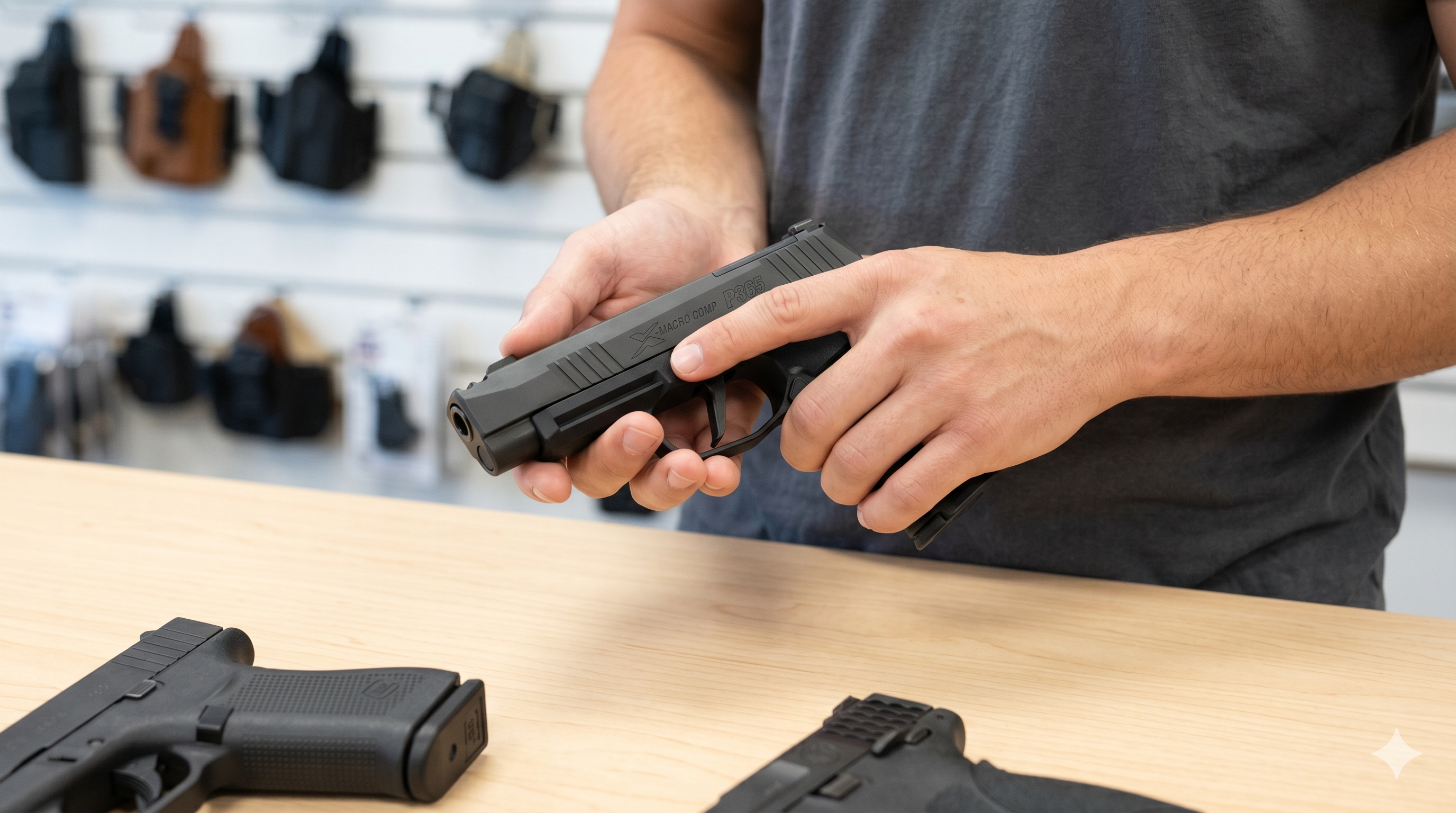
The P365 defined the modern micro-compact category, and for most new carriers it's still the right default. Capacity for the size is excellent, trigger feel out of the box is better than its peers, and the X-Macro Comp variant adds an integrated compensator that flattens recoil without making the gun bigger to carry. Pew Pew Tactical's editor pick for "Best Overall CCW" is the P365 X-Macro Comp for the same reasons.
- Caliber: 9mm
- Capacity: 10+1 to 17+1 depending on variant
- Barrel: 3.1" to 3.7"
- Weight: 17.8 to 21.5 oz unloaded
- MSRP: roughly $600-$800
- Optics-ready: yes (most current variants)
- Manual safety: available on select variants
Pick this if you want the broadest mix of capacity, concealability, and aftermarket support, and your hand size is small to medium. Pass on this if grip strength is weak (the slide is on the stiffer end of the micro-9 category) or stretching past $600 is a real strain.
Springfield Hellcat (or Hellcat Pro) — Best Micro-9 Alternative to the P365
Best for: buyers who want a P365-class pistol with a different grip texture, or who want a factory manual-safety option.
The Hellcat is the closest direct competitor to the P365 and beats it on a few specifics: aggressive grip texture that locks into your hand, widely available optics-ready variants, and a factory manual-safety configuration. Per Speer's roundup, capacity is 11+1 flush or 13+1 extended at 18.3 ounces.
- Caliber: 9mm
- Capacity: 11+1 or 13+1
- Barrel: 3.0"
- Weight: 18.3 oz unloaded
- MSRP: $599-$1,050 depending on variant
- Optics-ready: yes (OSP variants)
- Manual safety: available on select variants
Pick this if the P365 doesn't feel right at the rental counter and you want a near-equivalent alternative, especially with a manual safety. Pass on this if the P365 grip already works for you; there's no reason to pay extra for the alternative when the default pick fits.
Glock 43X (MOS optional) — Best for Glock-Family Familiarity
Best for: buyers who already shoot a Glock 19 at the range and want a slimmer, more concealable version of the same manual of arms.
The 43X is the slim micro-9 in the Glock lineup, and its biggest advantage for a new shooter is that the controls are identical to every other Glock. Train on a Glock 19 rental, then carry a 43X, and the manual of arms is the same. The MOS variant is optics-ready for a future micro red dot.
- Caliber: 9mm
- Capacity: 10+1 (15+1 with aftermarket magazines)
- Barrel: 3.41"
- Weight: 18.7 oz unloaded
- MSRP: $448-$582
- Optics-ready: yes (MOS variant)
- Manual safety: no
Pick this if Glock is the brand you've already spent time around, or you want the cheapest path into the micro-9 category from a Tier 1 manufacturer. Pass on this if capacity is your top priority (10+1 is the lowest in this micro-9 group) or you specifically want a manual safety; Glock doesn't make a 43X with one.
Smith & Wesson M&P9 Shield EZ (or Shield Plus with Manual Safety) — Best for Limited Hand Strength or Manual-Safety Buyers
Best for: buyers who can't comfortably rack the slide on a P365 or Hellcat, and buyers who specifically want a manual safety on a single-stack design.
The Shield EZ is the headline low-effort-slide pistol, and Smith & Wesson built the entire model around shooters with limited hand strength. The slide is designed to be racked without fighting a typical micro-9 recoil spring. The Shield Plus is the higher-capacity micro variant in the same family and offers a factory manual-safety configuration.
- Caliber: 9mm (also offered in 30 Super Carry)
- Capacity: 8+1 (Shield EZ) / 10+1 / 13+1 (Shield Plus)
- Barrel: 3.675" (Shield EZ) / 3.1" (Shield Plus)
- Weight: 23.2 oz (Shield EZ) / 19.3 oz (Shield Plus)
- MSRP: ~$549
- Optics-ready: yes on most current variants
- Manual safety: yes (factory variants on both)
Pick this if slide-rack force is a real obstacle, or if a manual safety is the difference between actually carrying every day and leaving the gun in a safe. Pass on this if you can operate a P365 or Hellcat; the Shield EZ trades capacity for the easier slide, and that trade only makes sense if you need it.
Smith & Wesson Bodyguard 2.0 (.380 ACP) — Best for Buyers Who Genuinely Need a Smaller, Lighter Pistol
Best for: buyers who can't manage 9mm recoil even after honest range time and need the lightest, smallest carry option.
The Bodyguard 2.0 is the only non-9mm pick on this list, and that's a deliberate fallback rather than a default. .380 ACP has historically been considered the floor of viable defensive calibers, but modern loads like Speer Gold Dot 90gr close most of the performance gap with 9mm in a properly designed pocket pistol. The Bodyguard 2.0 weighs under 10 ounces unloaded, runs about 0.88" wide, and ships with a tritium front sight standard.
- Caliber: .380 ACP
- Capacity: 10+1 or 12+1
- Barrel: 2.75"
- Weight: 9.8 oz unloaded
- MSRP: $449
- Optics-ready: yes (current variants)
- Manual safety: available on select variants
Pick this if a 9mm micro genuinely doesn't work after honest range time, you need true pocket-carry, or you'll mostly carry in lighter clothing where a thicker gun won't conceal. Pass on this if you can manage 9mm; you'll get more capacity in a similar footprint and easier ammo selection. .380 is the answer when 9mm isn't, not the default.
Glock 19 (Gen 5 MOS) — Best Compact 9mm for Buyers Who Can Conceal a Slightly Larger Gun
Best for: buyers who'd rather start on a gun that's genuinely easy to shoot well and figure out concealment second.
There's a meaningful camp in the concealed-carry community that says everyone's first carry gun should be a Glock 19, and they're not wrong. The G19 is bigger than every other pick on this list (4-inch barrel, 15+1 capacity), and that extra size is exactly why it's easier to shoot accurately under stress. Outdoor Life calls it the "Best All-Around 9mm" specifically for beginners because the recoil is mild and the controls are simple.
The trade-off is concealment. A G19 prints under a t-shirt in ways a 43X won't, so you need a real holster, a real gun belt, and clothing that accommodates the gun. If you live in shorts and tucked-in shirts year-round, this pick gets harder.
- Caliber: 9mm
- Capacity: 15+1
- Barrel: 4.0"
- Weight: 23.6 oz unloaded
- MSRP: ~$650
- Optics-ready: yes (MOS variant)
- Manual safety: no
Pick this if you want the easiest-shooting gun in this guide and you're willing to dress around it, or if the same pistol will double as a home-defense and range gun. Pass on this if you live in lightweight summer clothing year-round; a micro-9 conceals more reliably under a tucked t-shirt. For a deeper compact-9 comparison, our Glock 19 vs Sig P320 breakdown walks through how the G19 stacks up against its closest Sig competitor.
Ruger MAX-9 (with Manual Safety) — Best Budget Pick Under $500
Best for: buyers stretching to make this purchase work and who want a manual-safety striker-fired option.
The MAX-9 is the budget pick that doesn't compromise the things that matter. Capacity is competitive, fiber-optic sights come standard, and Ruger offers a factory manual-safety variant. MSRP under $500 leaves more budget for a holster, ammo, and a class.
- Caliber: 9mm
- Capacity: 10+1 or 12+1
- Barrel: 3.2" (a 4-inch variant exists)
- Weight: 18.4 oz unloaded
- MSRP: $439-$489
- Optics-ready: yes (current variants)
- Manual safety: available on select variants
Pick this if budget is real and you'd otherwise wait months to save up for a P365, or if a manual safety on a budget micro-9 is your specific requirement. Pass on this if you can stretch to a Glock 43X or Shield Plus; aftermarket support and resale value on the bigger names is better.
How to Choose Between These Picks
If you've read all seven and still aren't sure, run yourself through three forks.
Fork 1: Hand size and grip strength. If you can comfortably rack a P365 or Hellcat at the rental counter, you're in the micro-9 lane (P365, Hellcat, 43X, Shield Plus, MAX-9). If the slide is a struggle, you're in the Shield EZ lane. If 9mm recoil is genuinely too much for your hand even after a few rental sessions, you're in the .380 lane (Bodyguard 2.0).
Fork 2: Manual safety preference. If you specifically want a manual safety, your shortlist is Shield Plus, Hellcat with safety, MAX-9, or Bodyguard 2.0. If you don't want one or don't care, you've got the Glock 43X, the standard P365, and the Glock 19 added to the menu.
Fork 3: Carry style and clothing. If you live in lightweight Florida clothing year-round and want the gun to disappear under a t-shirt, you're in the micro-9 or .380 lane. If you're willing to wear an over-shirt, jacket, or looser fit and you'd rather have the easier-shooting compact, the Glock 19 wins.
If you can't pick after the three forks, rent the top three from your shortlist at your local indoor range and let the gun pick you.
Should a New Shooter Pick a Pistol With a Manual Safety?
Yes, if it's the difference between actually carrying the gun and leaving it in a safe. Only commit to that choice if you also commit to training the disengagement.
Defensive-shooting trainer consensus has shifted away from manual safeties on striker-fired carry guns. The argument is that under fight-or-flight stress, you'll forget to disengage and the safety becomes a footgun rather than a feature. That's why the Glock 43X, the Glock 19, and the standard P365 don't offer a manual safety in the configuration most carriers buy.
The counter-argument from new buyers is that the redundancy is psychologically necessary for them to actually carry. A gun in a holster is safer than a gun in a safe. So if the manual-safety variant is what gets you carrying every day, get the manual-safety variant (Shield Plus, MAX-9, Hellcat with safety, Bodyguard 2.0 with safety).
The trade is that you owe yourself the training. A CWL class or basic defensive pistol course will let you practice disengaging the safety as part of your draw stroke until it's a trained motion. If you can commit to that, the manual-safety pick is a legitimate choice. If you won't put the practice time in, the no-safety striker-fired pick is the trainer-consensus answer.
A Quick Word on Florida CCW Law for New Carriers
Florida became a permitless concealed carry state on July 1, 2023. Adults 21 and older who are not legally prohibited can carry concealed without a state-issued permit, per NRA-ILA's Florida summary. The federal minimum age for handgun purchase from a licensed dealer is also 21, and Florida raised the minimum age for all firearm purchases to 21 after 2018.
Florida still imposes a 3-day waiting period (excluding weekends and holidays) on firearm purchases, per FDLE. CWL holders are exempt and can take same-day delivery. The Concealed Weapon License is also worth applying for even if you don't need it in-state, because it provides reciprocity with 38 other states per FDACS, the widest of any state's permit.
This is the 30-second version. For the full breakdown of FL carry law, training options, and what to do at a traffic stop, see our complete guide to concealed carry in Florida.
The Bottom Line
For most new carriers in Florida, the shortlist comes down to four pistols: the Sig P365 if you want the best-selling default, the Springfield Hellcat if the P365 doesn't fit your hand, the Glock 43X if you want the simplest manual of arms in the family that everybody else carries, and the S&W Shield EZ if slide-rack force is a real obstacle. The Glock 19 is the right answer for buyers who'd rather start with the easiest-shooting gun and figure out concealment second. The Bodyguard 2.0 is the answer when 9mm genuinely doesn't work.
Whichever way you lean, rent two or three of these at your local indoor range before you put money down. Our indoor range carries most of the picks above on the rental wall.
When you're ready to buy, browse our concealed carry handguns category for the full lineup, or stop by the shop and our team will walk through your shortlist with you. If you find the same pistol cheaper somewhere else, we'll match the price.