
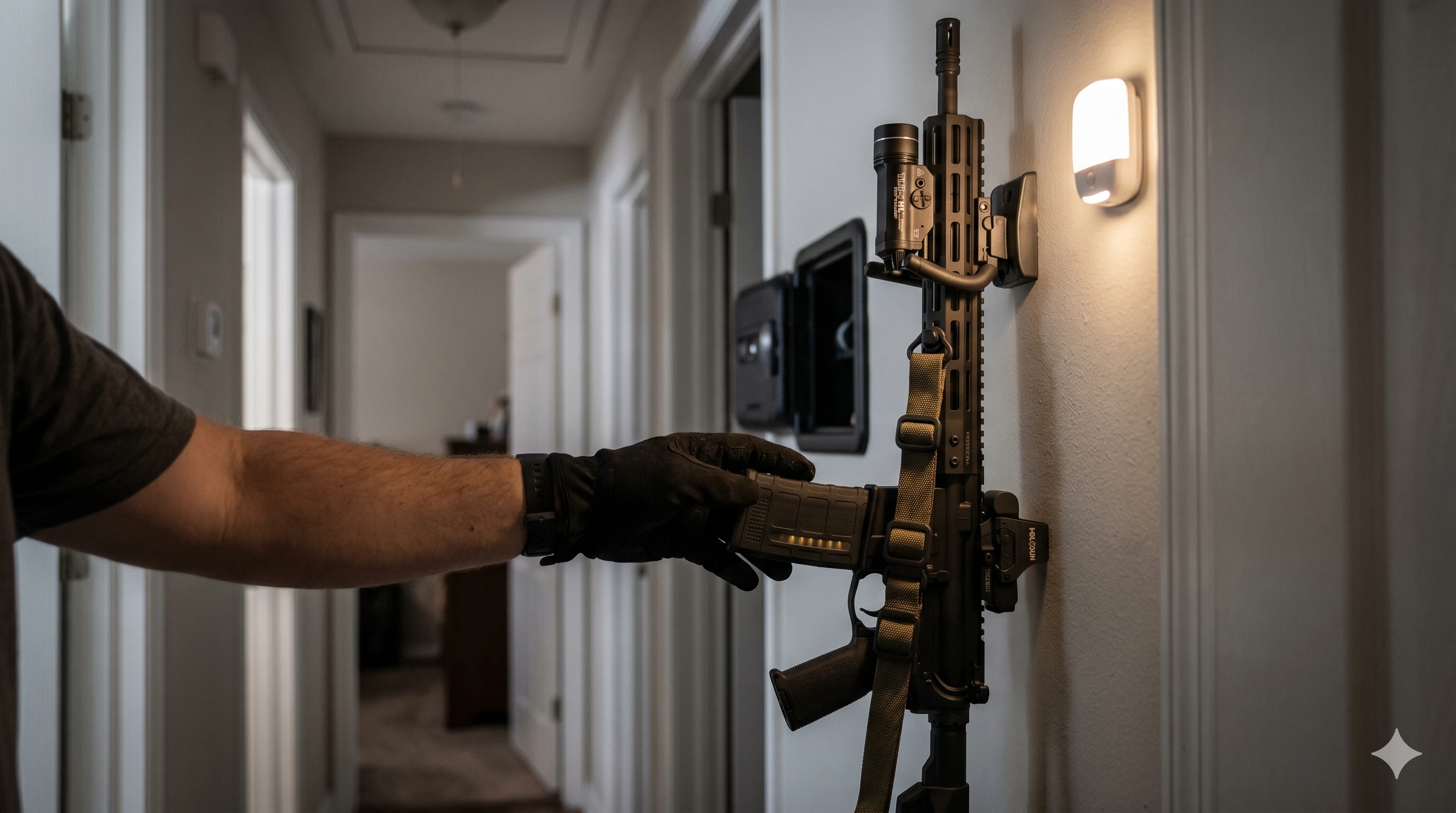
Best AR-15 for Home Defense: 6 Mid-Tier Picks That Actually Make Sense
Posted by Joel Sheran on May 9th 2026
If you're shopping for the best AR-15 for home defense, the honest short answer is the Springfield Saint Victor 2.0 (around $1,100) or the Smith & Wesson M&P15 Sport III (around $650 to $800). Both are mid-length-gas 5.56 NATO rifles that run common defensive ammo, accept a weapon light and red dot without modification, and sit in the $800 to $1,500 sweet spot where reliability is solid and you're not paying for hobbyist-grade extras.
You're a homeowner picking a tool, not a builder optimizing for the most rifle you can afford. That changes everything about which AR-15 you should actually buy. The good guides on the internet either cover every AR ever made, or they cover home-defense guns in general (shotguns, pistols, rifles all together). What's missing is a tight, honest list of AR-15s scoped specifically to the home-defense use case at a realistic price point. That's what this is. We're going to walk through what makes an AR right for this job, name six picks at the mid-tier sweet spot, talk caliber and ammo, cover barrel length, and touch on the Florida-specific stuff (castle doctrine, hurricane prep) that the national gun blogs never mention. None of this is legal advice, by the way. Florida is a stand-your-ground state with no duty to retreat in your own home, but you should still talk to a Florida attorney for anything case-specific.
What Makes an AR-15 "Right" for Home Defense
A home-defense AR-15 is a different rifle than a hunting AR, a long-range precision build, or a competition gun. The job is narrow: at 2 a.m., half-asleep, possibly in the dark, you need it to come up, point where you're looking, and work. Every time.
That means a few non-negotiables.
Reliability over features. A defensive rifle needs to run a few hundred rounds of practice ammo plus your chosen defensive load with zero malfunctions before you trust it. PewPewTactical's review protocol puts the threshold at 1,000+ rounds with no failures before they'll recommend a rifle for defensive use. That's the bar.
Standard 5.56 NATO chambering. The AR-15 is the civilian semi-automatic version of the M16/M4 platform, and 5.56 NATO is the round it was designed around. Skip the boutique calibers for this use case. 5.56 has the widest defensive-ammo selection, the cheapest practice ammo, and the deepest community knowledge base. (More on caliber below.)
A 16-inch or pinned 14.5-inch barrel with a mid-length gas system. The mid-length gas system (where the rifle taps gas from the barrel to cycle the bolt) gives a softer recoil impulse and less wear than the older carbine-length system. It's the standard setup for 16-inch barrels and the right call for nearly every home-defense AR.
Free-float MLOK handguard. A free-float handguard doesn't touch the barrel, which means whatever you clamp on it (light, sling mount, pressure switch) doesn't shift your point of impact. MLOK is the current dominant accessory-mounting standard. If a rifle ships with a plastic dropped-in handguard, you'll want to replace it before mounting a light, which adds cost.
Accepts a weapon-mounted light and red dot without further work. A weapon-mounted light (WML) lets you identify what you're pointing at before you pull the trigger. A red dot lets you put rounds where you're looking under stress without lining up iron sights. Both are baseline equipment for a defensive rifle, not optional upgrades. If a pick can't take both without a parts shopping spree, it's not actually home-defense ready.
Cycles common defensive ammo. That means 55 to 77 grain projectiles in the 1:8 or 1:7 twist barrels these rifles ship with. Hornady 75gr TAP, Federal 62gr Tactical Bonded, and Black Hills 50gr TSX are the loads to plan around.
If this is your first AR-15 ever, before you go any further, our walkthrough on buying your first AR-15 is a good upstream read. It covers the platform basics this post assumes you're already comfortable with.
The Mid-Tier Sweet Spot ($800-$1,500): Why You Probably Don't Need a $2,500 Tier-1 Build
Here's the part the tactical-influencer crowd won't tell you: for home defense, you're almost certainly fine in the $800 to $1,500 range.
The premium tier-1 builds (Daniel Defense, BCM, Geissele, Knight's Armament) are excellent rifles. They're built to harder tolerances, with components that survive abuse most civilian rifles will never see. If you want one, buy one. They're worth it for what they are. But the marginal benefit of a $2,500 build over a $1,100 build does not translate into a meaningfully better outcome in a home-defense scenario, where engagement distances are short, the rifle's job is straightforward, and round counts are minimal.
Below $800, things get looser. You start running into chrome-moly barrels with shorter service lives, looser tolerances on bolt-to-barrel fitment, and components you're more likely to want to replace within the first year. That's fine if you're building a range gun and learning the platform, but for a defensive rifle you trust your family's safety to, the $800 floor is reasonable.
If your budget is tighter than the mid-tier band, that's its own conversation. Our entry-level AR-15 roundup covers the picks worth buying under the $800 line so you don't waste money on a rifle that won't hold up.
The Picks: 6 AR-15s for Home Defense, Mid-Tier to Premium
We've kept this list to six rifles that actually fit the home-defense use case at a realistic price point. Each comes from a manufacturer with a real warranty program and a parts-and-service network. You can browse our curated AR-15 selection for current in-stock options, and if a specific model on this list isn't on the shelf, ask the counter about ordering it in or pulling something equivalent.
| Rifle | Barrel | Gas System | Twist | Weight | MSRP | Best For |
|---|---|---|---|---|---|---|
| Springfield Saint Victor 2.0 | 14" pinned/welded to 16" | Mid-length | 1:8 | 6.6 lbs | ~$1,100 | Mid-tier sweet spot |
| Smith & Wesson M&P15 Sport III | 16" | Mid-length | 1:8 | ~6.5 lbs | $650-$800 | Best value with brand backing |
| Ruger AR-556 MPR | 18" | Mid-length | 1:8 | 6.8 lbs | ~$750 | Sub-$800 brand trust |
| Aero Precision M4E1 | 16" | Mid-length | 1:8 | ~6.5 lbs | ~$999 | Ammo flexibility (.223 Wylde) |
| BCM RECCE-16 KMR-A | 16" | Mid-length | 1:7 | 6.1 lbs | ~$1,443 | Buy-once premium |
| Daniel Defense DDM4 V7 | 16" | Mid-length | 1:7 | ~6.5 lbs | ~$2,024 | If budget allows tier-1 |
Springfield Saint Victor 2.0 — Best Mid-Tier Pick (~$1,100)
The Springfield Saint Victor 2.0 is the rifle we'd hand to most home-defense buyers without a long conversation. It runs a 14-inch barrel with a pinned-and-welded flash hider that brings the overall length to the federal 16-inch minimum, which gives you a slightly shorter, more manageable rifle for indoor maneuvering without any NFA paperwork. The free-float MLOK handguard takes a light and accessories without modification. The nickel-boron trigger is genuinely good out of the box. Both the barrel and bolt carrier group are Melonite-coated for corrosion resistance, which matters more than you'd think on the Gulf Coast.
PewPewTactical specifically calls it "ideal for home defense, range sessions, or building skills," and we agree. The 1:8 twist runs everything from 55-grain practice ammo to 77-grain match and defensive loads.
Pick rationale: right size, right ammo compatibility, right ergonomics for someone buying this as a tool, and right price. If you're not sure what to buy, buy this.
Smith & Wesson M&P15 Sport III — Best Value Mid-Tier (~$650-$800)
The Sport III is the replacement for the discontinued Sport II, which was Smith & Wesson's long-running budget AR. The new version moves to a free-float MLOK handguard, mid-length gas system, and 1:8 twist 5R rifling. The Firearm Blog calls it "well worth the investment for the best entry-level AR-15," and at the $650 to $800 price point it's the value play that doesn't feel like a compromise.
The pitch here is brand-name backing at the bottom of the mid-tier band. S&W has a deep dealer network, a real warranty program, and a parts pipeline you can count on. For a buyer who's value-conscious but wants a name they recognize on the receiver, this is the pick.
Ruger AR-556 MPR — Best Sub-$800 Pick With Brand Trust (~$750)
Ruger does reliability quietly. The AR-556 MPR (Multi-Purpose Rifle) runs an 18-inch cold hammer-forged 4140 chrome-moly steel barrel, mid-length gas, 1:8 twist, and weighs 6.8 pounds. Cold hammer-forging is a barrel manufacturing process that produces tighter tolerances and longer service life than button-rifled barrels at this price point.
One caveat: the 18-inch barrel is on the long side for indoor maneuvering. It's not a dealbreaker, especially if you've already laid out your home-defense plan around fixed positions rather than clearing rooms (which you should not be doing solo anyway, but that's a different blog). Just know going in that this is the longest of the picks here. Ruger announced a new model called the Ruger Harrier at SHOT Show 2026 to eventually replace the AR-556 MPR line, so depending on when you're reading this, the MPR may still be in stock or you may be looking at the Harrier.
Pick rationale: trusted brand, hammer-forged barrel, mid-length gas, and a price point that punches above its weight. Reliability is what defensive use demands, and Ruger nails reliability.
Aero Precision M4E1 — Best Ammo Flexibility Pick (~$999)
The Aero Precision M4E1 is the pick if you've already got .223 Remington on hand or expect to. It's chambered in .223 Wylde, a chamber spec that safely runs both 5.56 NATO and .223 Remington. Most ARs are chambered in 5.56 (which can also fire .223 safely, though not the other way around), but if you're transitioning from a .223 bolt-action or have inherited a .223 stash, the M4E1 lets you shoot what you have without worrying about chamber pressure.
Build quality is strong for the price. Aero machines their own receivers and barrels, and the M4E1 has earned a reputation as a no-nonsense, no-drama mid-tier pick.
BCM RECCE-16 KMR-A — Best "Buy Once" Pick (~$1,443)
Bravo Company Manufacturing builds rifles that ride the line between mid-tier price and tier-1 quality. The RECCE-16 KMR-A runs a 16-inch cold hammer-forged barrel, 1:7 twist, weighs just 6.1 pounds, and BCM-USA explicitly designs the rifle for "home defense or shooting range" use. The KMR-A handguard is lightweight aluminum, the barrel is chrome-lined, and the BCG is one of the better mil-spec offerings on the market.
Pick rationale: this is for the buyer who'd rather spend once and never think about it again. You're not getting tier-1 reliability gains over a Saint Victor 2.0 in a defensive context. You are getting a rifle with components you won't replace and a brand reputation that holds resale value if you ever decide to sell it. Not necessary. Worth it if budget is there.
Daniel Defense DDM4 V7 — Premium Pick If Budget Allows (~$2,024)
The DDM4 V7 is genuinely a tier-1 rifle. 16-inch cold hammer-forged chrome-lined barrel, mid-length gas, the kind of fit-and-finish that makes the cheaper rifles on this list feel like the price-point compromises they are.
Here's the honest framing: if you've already decided you want a premium AR, this is the one to buy. Daniel Defense earned their reputation with military and law-enforcement contracts, and the consumer-grade DDM4 V7 inherits that lineage. But you don't need it for home defense to work. The Saint Victor 2.0 will do everything the DDM4 V7 will do in your hallway at 2 a.m. The DDM4 V7 just feels nicer doing it. If that's worth the extra $900 to you, buy it. If it's not, don't let anyone tell you you've under-armed yourself by going mid-tier.
Caliber and Defensive Ammo: The Decision That Actually Matters
Here's the thing about AR-15s for home defense: every reliable AR will go bang. The harder question, the one most buyers never think about until later, is what loaded ammo is actually in the rifle when it matters.
Is 5.56 or .223 Better for Self Defense?
For nearly every home-defense buyer, the answer is 5.56 NATO. Same external dimensions as .223 Remington, but with a different chamber pressure spec. A 5.56-chambered rifle can safely fire .223 ammunition. A .223-chambered rifle should NOT fire 5.56 (the higher pressure can damage the rifle and is unsafe). The .223 Wylde chamber accepts both safely, which is why the Aero Precision M4E1 is the ammo-flexibility pick on the list above.
The defensive ammo recommendation for 5.56 is bonded soft-point or expanding hollow-point loads designed for terminal performance. The standard picks are:
- Hornady 75gr TAP — heavy-for-caliber bonded load, good for the 1:8 and 1:7 twist barrels on the picks above.
- Federal 62gr Tactical Bonded — federal law enforcement load, widely available.
- Black Hills 50gr TSX — Barnes solid-copper expanding bullet, lighter and faster.
What you should NOT load for home defense is military-surplus FMJ (full metal jacket) ammo like M193 or M855. FMJ rounds are designed to penetrate, not to expand, and they're cheap practice ammo for a reason. Save them for the range. For home defense, run the bonded or expanding loads above.
"But Won't Rifle Ammo Go Through Every Wall in My House?"
This is the most common objection to AR-15s for home defense, and it's mostly wrong. With proper defensive ammunition, 5.56 actually penetrates fewer interior walls than common pistol ammo or 12-gauge buckshot, because lightweight bonded or expanding bullets fragment and yaw on impact instead of punching straight through.
A Pew Pew Tactical over-penetration study tested multiple calibers through ballistic gel and drywall layers. With Remington 62-grain Ultimate Defense, the 5.56 round expanded into a five-leaf clover and stopped after 12 inches of penetration in the first interior drywall layer behind the gel. Quality defensive 9mm loads behaved similarly. The American Eagle 55-grain FMJ practice round, by contrast, keyholed through both walls intact. The takeaway is that ammunition selection matters far more than caliber choice. A defensive 5.56 load is not the wall-piercing menace people assume it is. A box of cheap range ammo loaded in your nightstand rifle absolutely is.
This is why your defensive load matters more than which $1,100 AR you bought.
Barrel Length: How Big Should a Home-Defense AR Be?
What Size AR-15 Is Best for Home Defense?
For a non-NFA rifle, the federal minimum is a 16-inch barrel. That's the legal floor. You have three real options:
- 16-inch barrel. Standard. No paperwork, no special considerations. Most of the picks above sit here.
- 14.5-inch barrel with a permanently pinned-and-welded muzzle device that brings overall length to 16 inches. Gives you a slightly shorter, lighter rifle without NFA paperwork. The Springfield Saint Victor 2.0 takes this approach.
- 11.5-inch (or shorter) barrel. This is Short-Barreled Rifle (SBR) territory and requires a $200 tax stamp, ATF Form 4 paperwork, and a 4 to 12 month wait for ATF approval before you can take it home. You'll also need an SOT-licensed dealer to handle the transfer. Worth it for some buyers; overkill for most.
Most home-defense engagements happen at distances under 15 yards. You don't need a 20-inch precision barrel. You don't need the longest, heaviest configuration the platform supports. A 16-inch or pinned 14.5-inch rifle is plenty of barrel for the job, and the shorter overall length is genuinely useful for moving through a hallway or doorway without snagging.
The Setup: Light, Optic, Sling, Ammo Stash
Buying the rifle is half the purchase. The other half is the gear that makes it actually defensive.
Weapon-mounted light (WML). Non-negotiable. You cannot legally or morally shoot at something you cannot identify. The standard picks are the Streamlight TLR-1 HL (around $150) and the Surefire X300U (around $330). Both clamp to an MLOK handguard and put 1,000+ lumens where the rifle is pointed.
Red dot sight. Also baseline equipment. Iron sights are fine on a square range. Under stress, in low light, after waking up at 2 a.m., a red dot is dramatically faster. Common picks: Aimpoint PRO (around $465), Holosun 510C (around $300), Sig Romeo 5 (around $130). Any of those will outlive the rifle.
Quality two-point sling. A sling lets you transition to your hands when you need to (opening doors, picking up a phone, holding a child) without putting the rifle down. Magpul MS1 or Blue Force Vickers are the defaults.
Two or three loaded magazines with your chosen defensive ammo. Not range ammo. Stage them with the rifle.
Quick-access safe. If there are kids or grandkids in the house, this is not optional. A Vaultek or Hornady RAPiD safe gives you fast access for you while keeping the rifle locked away from anyone else. The combination of a quick-access safe and a defensive AR is what separates "have a gun in the house" from "have a defensive plan."
If you're shopping for the optic, light, and sling alongside the rifle, our tactical rifles category and the AR-15 inventory page cover most of what you'll need under one roof.
Florida-Specific Notes: Castle Doctrine, Hurricane Prep, Storage
If you're a Florida homeowner buying this rifle for home defense, a few things worth knowing.
Florida is a stand-your-ground state with a strong castle doctrine. Under FL §776.012-013, you have no duty to retreat from a place where you are lawfully present, including your home. Florida §776.032 also provides civil immunity to defenders whose use of force is justified, which means an attacker (or an attacker's estate) generally cannot sue you civilly for a justified defensive shooting. None of this is a license to shoot first and ask questions later. The "justified" standard is real, and prosecutors and juries get to decide whether it applied. Talk to a Florida attorney for case-specific questions; this is calm framing, not legal advice.
Hurricane prep matters. A lot of Sarasota County homeowners arrived at the home-defense conversation after a 2024 or 2025 evacuation. The post-storm window, when power is out, neighborhoods are dark, and emergency response is stretched, is exactly the scenario this rifle is for. Plan your storage and access around the realistic case that you may need the rifle when the lights are out and you're not at your most rested.
Humidity and storage. Gulf Coast humidity is hard on firearms. A gun safe with a dehumidifier rod (Goldenrod is the classic) or a renewable desiccant is worth the investment in this climate. Wipe the bolt carrier group down after range trips; don't over-oil; check for surface rust on barrel exteriors a few times a year. None of this is exotic maintenance, but it's the kind of thing buyers in drier states never have to think about.
AR-15 vs. Shotgun vs. Handgun for Home Defense
You'll hear "the AR is overkill, get a shotgun" or "you don't need a rifle, just keep a 9mm by the bed." Both have a kernel of truth, both leave a lot out.
Shotguns are simple, but the recoil is rough on smaller-statured shooters, the magazine capacity is lower (typically 5 to 8 rounds versus 30 in a standard AR magazine), and 00 buckshot has its own real over-penetration profile. Reload speed under stress is also slower than an AR with pre-staged magazines.
Handguns are always available and easy to keep close, but they're objectively harder to shoot accurately under stress than a rifle. A two-handed grip on a rifle stock with a red dot is dramatically more forgiving than a one or two-handed pistol grip with iron sights at 3 a.m. Handguns absolutely have a place in a home-defense plan. They're often the first gun to your hand. But they're not strictly better than a rifle for the job.
Pistol-caliber carbines (PCCs) are worth a brief mention. They split the difference between a handgun and a rifle, with reduced over-penetration concern and lower recoil at the cost of effective range. Worth considering if recoil is a real issue. Not necessary for most buyers.
For the broader cross-category decision, our complete home defense firearms guide walks through handguns, shotguns, and rifles side by side. If you're still deciding between platforms, start there.
Where to Buy and What to Ask Before You Walk Out
A few practical asks for whichever shop you end up at.
Shoot what you're considering before you commit. This is the single biggest reason to buy from a shop with a range attached. Specs on paper are one thing. The Saint Victor 2.0 in your hands, with a magazine of practice ammo and a few rounds of your chosen defensive load, will tell you in 10 minutes whether the rifle fits you. Rentals are cheap compared to buying the wrong rifle.
Ask about the rifle's break-in recommendations. PewPewTactical's testing protocol calls for a minimum 200 rounds of practice ammo before you trust a rifle for defensive use, and they prefer 1,000+ before they'll recommend it. Different manufacturers have slightly different break-in guidance; ask the counter.
Confirm magazine compatibility. A good rifle should run any quality magazine (PMAGs, Lancer L5AWMs, USGI aluminum) without issue. If a shop knows their inventory, they can tell you which magazines they've personally seen run cleanly in the rifle you're buying.
Ask about warranty registration. Some manufacturers (Daniel Defense, BCM, Aero) make warranty registration genuinely easy. Others bury it. Knowing the process up front saves headaches later.
Ask if the shop will mount your red dot for you. A properly torqued, properly leveled optic mount matters. If the shop can do this on the spot, take the offer. If they can't, find someone who can.
Mention price. Total Impact's price-match guarantee is real. If you've found a comparable rifle at a better price somewhere else, bring the listing in. The shop would rather match the price and earn the relationship than send you elsewhere.
Conclusion
The best AR-15 for home defense isn't a single rifle, it's a configuration: a mid-tier 16-inch or pinned 14.5-inch rifle with a mid-length gas system, a free-float MLOK handguard, a quality red dot, a weapon-mounted light, two or three loaded magazines of bonded or expanding defensive ammo, and a quick-access safe. Get those pieces right, and the specific rifle (Springfield Saint Victor 2.0, S&W Sport III, Ruger AR-556 MPR, Aero M4E1, BCM RECCE-16, or DDM4 V7) matters less than the work you put in actually shooting it.
Come browse our AR-15 selection online or stop by the Nokomis shop. Better yet, book some range time, rent something close to what you're considering, and put 50 rounds through it before you decide. That's how you actually find the right rifle for the job.