
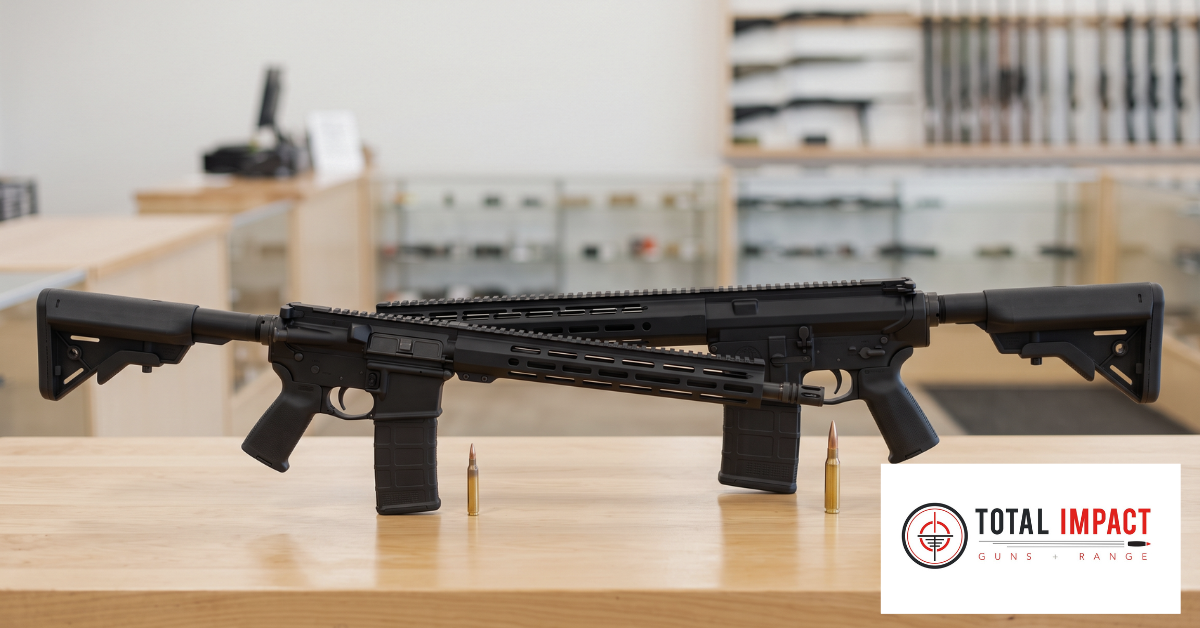
AR-15 vs AR-10: How to Choose the Right Platform
Posted by Joel Sheran on Jul 7th 2026
Walk into any gun counter and ask about an AR, and the follow-up question is always the same: 15 or 10? They look like the same rifle scaled up, and in a lot of ways they are. But the caliber difference underneath changes what each one is actually good at, and picking the wrong one for your use case is an expensive mistake to walk back. Buy an AR-10 for home defense and you're carrying more rifle than the job needs. Buy an AR-15 for 600-yard hunting and you're underpowered for the shot. The right call comes down to matching the cartridge to the job, not picking whichever number sounds more serious at the counter.
The short answer: which AR platform fits you
If you want the verdict without the spec sheet, go AR-15 for home defense, training, and everyday shooting. Go AR-10 for long-range shooting and big-game hunting, where you need more energy downrange than 5.56 can deliver.
This isn't a "which rifle is better" question. It's a "which job are you hiring it for" question. The AR-15 wins on cost, weight, recoil, and ammo availability. The AR-10 wins on range and knockdown power. Neither beats the other across the board, because they're not built for the same board. Ask an AR-15 to reach out past 500 yards and it struggles. Ask an AR-10 to be your light, easy-shooting home defense rifle and you're carrying more gun, more weight, and more recoil than that job calls for.
If you're a first-time buyer and genuinely unsure which one you need, start with an AR-15. It's cheaper to buy, cheaper to feed, and easier to shoot well for a full range session. Once you've put a few hundred rounds through one and figured out what you actually want to do with a rifle, an AR-10 is an easy addition rather than a guess you're stuck with. And if you want to understand what you're actually buying before you commit, it's worth knowing what actually goes into an AR-15 before you compare it to anything bigger.
AR-15 and AR-10: what actually separates the two platforms
Both rifles run the same operating system. Same manual of arms, same basic controls, same trigger feel once you're behind one. If you've shot an AR-15, an AR-10 won't feel foreign in your hands. The difference is what's under the hood. The AR-10 is the larger-frame sibling, built around a full-power rifle cartridge instead of the AR-15's intermediate round.
That caliber split is the whole story. The AR-15 fires 5.56 NATO or .223 Remington. The AR-10 fires .308 Winchester or 7.62x51 NATO, a cartridge that carries roughly double the energy of 5.56 downrange. Everything else in this comparison, weight, recoil, range, cost, traces back to that one difference. A bigger cartridge needs a bigger bolt, a bigger receiver, and a bigger magazine well to feed it, and that size difference is the reason an AR-10 in your hands feels like a different rifle even though the controls are identical.
Here's the twist people don't expect. The AR-10 actually came first. Eugene Stoner and ArmaLite designed it in the 1950s, and the AR-15 came later as a scaled-down, lighter-caliber variant for military adoption. But the AR-15 is the one that got standardized to military spec and mass-produced by nearly every gun maker in the country, according to Guns.com's rundown of the two platforms. That's why AR-15 parts are everywhere and cheap, while AR-10 parts are pricier and less interchangeable across brands, a point worth understanding before you shop either one.
"AR" stands for ArmaLite, the company that designed the platform, not "assault rifle," a mix-up worth clearing up if you're newer to rifles. If you're still working out the caliber question specifically, the 5.56 and .223 ammunition question is worth a read before you buy either platform.
Head-to-head: caliber, weight, recoil, range, and cost
Here's how the two platforms compare on the numbers that actually matter when you're deciding.
| AR-15 | AR-10 | |
|---|---|---|
| Caliber | 5.56 NATO / .223 Remington | .308 Winchester / 7.62x51 NATO |
| Typical weight | 6-8 lb | 7-9.5 lb |
| Recoil | Light, easy follow-up shots | Noticeably stiffer, more fatiguing over a long session |
| Effective range | Strong out to 300-400 yards | Holds energy well past 500-600 yards |
| Standard magazine | 30 rounds | 20 rounds |
| Cost per round | Lower | Roughly double the AR-15 |
The weight difference sounds small on paper, a pound or two, but it matters after a few hours carrying a rifle in the field or holding one up during a training drill. The AR-15's lighter recoil is the bigger deal for most shooters. Less muzzle rise means faster, more accurate follow-up shots, and less fatigue by round 100 of a range day.
Range is where the AR-10 earns its keep. The .308 round holds velocity and energy much farther out than 5.56, which is why it's the platform serious long-range shooters and hunters reach for once distances stretch past what a 5.56 rifle handles well, a gap USCCA breaks down in more detail. The AR-15's 30-round magazine versus the AR-10's typical 20-round mag is a direct result of cartridge size. The bigger .308 case just takes up more room, so fewer of them fit in the same magazine body.
Cost of ownership follows the same pattern across the board. The AR-10 itself usually costs more than a comparable AR-15, and every trip to the range costs more too. Run 200 rounds through an AR-15 for a practice day, and you're paying for 200 rounds of 5.56. Run the same 200 rounds through an AR-10, and you're paying for 200 rounds of ammunition priced at roughly double per round, which doubles your ammo bill without adding a single extra shot of trigger time.
Matching the platform to how you'll actually use it
For home defense, the AR-15 is the more common pick, and for good reason. It's lighter to maneuver through a hallway, easier to control under stress, and the 5.56 round is generally considered lower risk for over-penetration through interior walls compared to a full-power .308 round. If your rifle's job is sitting by the bed for a worst-case night, the AR-15 does that job well.
Hunting splits the two platforms cleanly by what you're after. Going after varmints, coyotes, or small game, the AR-15 is plenty of rifle, and the lighter recoil means more practice shots without beating yourself up before the season even starts. Going after deer, hogs, or anything bigger at real distance, you want the AR-10's extra energy on target. A 5.56 round just isn't built to reliably put down a 200-pound animal the way .308 is, and no amount of shot placement fully makes up for a cartridge that's simply carrying less energy downrange.
Long-range and precision shooting is where the AR-10 pulls ahead outright. Once you're stretching shots past the AR-15's effective range, the .308's ability to hold velocity and energy becomes the deciding factor, not a preference. This is also where the AR-10's extra weight stops being a downside. A heavier rifle settles better on a bipod or bench and holds steadier through a long-range shot, so the same pound or two that's a burden on a defense carbine works in your favor at a shooting bench. If you're chasing distance and don't want to commit to a semi-auto platform at all, bolt-action rifles as a long-range alternative are worth a look too.
And for the reader who wants one rifle to cover everything, the AR-15 usually wins that argument. It's cheaper to buy, cheaper to run, lighter to carry, and versatile enough to cover defense, training, and small-game hunting without complaint. You give up long-range reach and stopping power on big game, but if you can only own one AR platform, the AR-15 covers more ground for more people.
Ownership realities: ammo cost, magazines, and parts compatibility
The specs matter, but so does what it actually costs to own and shoot each rifle over time. .308-class ammunition typically runs about twice the price per round of 5.56, which adds up fast if you shoot regularly. A shooter who puts 200 rounds through a rifle on a training day is looking at a meaningfully bigger bill every time if that rifle is an AR-10.
Magazines, most barrels, and a lot of handguards are platform-specific. An AR-15 magazine doesn't fit an AR-10, and most parts don't cross over between the two, so building out spare mags and accessories effectively means building two separate kits if you own both. Owning one of each also means two separate range bags in practice, since the spare mags, cleaning gear sized to the bore, and most replacement small parts for one platform won't do you any good on the other.
It gets more complicated inside the AR-10 world itself. There's no single AR-10 standard the way there is for the AR-15. The two dominant patterns, DPMS and ArmaLite, look nearly identical side by side but aren't cross-compatible, meaning a DPMS-pattern upper won't reliably mate with an ArmaLite-pattern lower. AR15.BUILD's breakdown of the two patterns is worth reading before buying parts for an AR-10, because mixing patterns by accident is a common and avoidable headache.
The AR-15, by comparison, benefits from decades of mil-spec standardization. Parts from different manufacturers generally fit together without issue, which keeps the AR-15 aftermarket bigger, more competitive, and cheaper. The AR-10 never got that same standardization, so shopping for one means paying closer attention to which pattern you're buying into.
AR-15 vs. AR-10: the final call
Boiled all the way down, default to the AR-15 for defense, training, and everyday shooting. Step up to the AR-10 when long-range performance or big-game hunting is the actual goal, and you're fine paying more per round to get there.
If you're still torn, the best next step isn't more research, it's handling both rifles in person. Come shoulder an AR-15 and an AR-10 side by side on our indoor range, and the weight and recoil difference will tell you more in five minutes than any spec sheet will. It's a low-pressure way to feel the actual difference before you spend money on either one, and our staff can walk you through both platforms in person if you're still weighing the trade-offs after reading all this.
Ready to pick one? Browse our AR-15 rifles if defense, training, or general use is the goal, or shop AR-10 rifles if you're ready to reach farther and hit harder.