
AR-15 Parts Names: A Plain-English Guide to the Upper, Lower, BCG, and Everything in Between
Posted by Joel Sheran on May 9th 2026
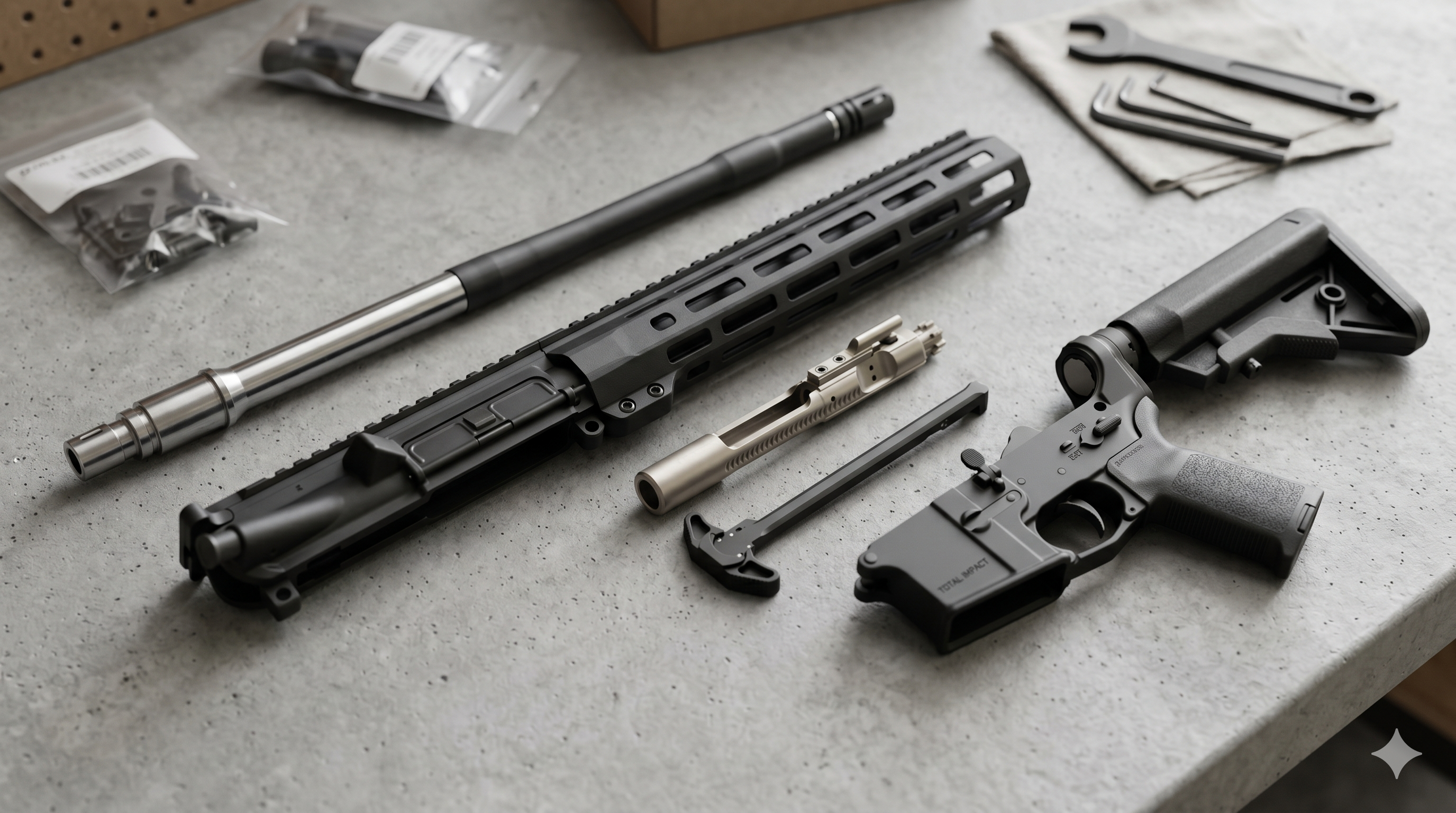
An AR-15 is built from two main halves: the upper receiver and the lower receiver. The lower carries the serial number and is the only federally regulated part of the rifle. The upper houses the barrel, gas system, and bolt carrier group, which together cycle each round. Everything else attaches to one of those two halves.
If you've spent any time on parts pages, you've already run into a wall of acronyms: BCG, LPK, gas key, mil-spec, M-LOK. The good news is that all of the AR-15 parts names map back to the same two-piece skeleton. Once you know which half does what, every buying decision (barrel length, gas system, trigger, buffer weight, stock) gets easier to think through. This guide names every major component and flags the rules and tradeoffs that actually matter. We're not telling you which AR-15 to buy; that's a different post.
The two halves of an AR-15 (and which one is the actual firearm)
Every AR-15 splits into two groups that connect with two pins. The upper receiver group sits on top and does the firing work: it holds the barrel, the gas system, and the bolt carrier group, and it's the part that turns a chambered round into a fired one. The lower receiver group sits underneath and does the control work: trigger, safety, magazine well, grip, and the buffer assembly that pushes the bolt back into battery. The two halves snap together with a takedown pin at the rear and a pivot pin at the front. Pop those pins and the rifle hinges open like a shotgun for cleaning.
Which AR-15 part is the actual firearm?
Under federal law, only the lower receiver is the firearm. The lower carries the serial number and is the only piece that has to be transferred through a federally licensed dealer (an FFL). Per the ATF's frame-and-receiver rule, the lower is the regulated piece; the upper is not.
That distinction has a practical payoff. Every other major component (uppers, barrels, BCGs, charging handles, triggers, handguards, buffer assemblies, stocks, lower parts kits, magazines) ships to your door without an FFL transfer. That's the underlying reason the AR is the most modular rifle in America: the federal touch point is one machined hunk of aluminum, and everything else is just parts.
The Upper Receiver Group: where the round actually fires
Walking the upper from front to back gives you the firing cycle in roughly the order it happens.
Barrel
The barrel sets more of the rifle's character than any other component. Three numbers drive the conversation: length, profile, and twist rate.
Length is the big one. A barrel under 16 inches with a stock attached makes the rifle a Short-Barreled Rifle (SBR) under the National Firearms Act, which requires a $200 federal tax stamp and ATF approval before assembly. Sixteen inches is the practical floor for a non-NFA build. Longer barrels (18 to 20 inches) gain accuracy at distance; shorter barrels are easier to maneuver. (AR pistols sidestep the SBR rule by skipping the buttstock.)
Profile is the barrel's contour: government, pencil, heavy, M4-style. Heavier profiles resist heat better at the cost of weight; pencil profiles are light and shift point of impact faster as they warm up. Twist rate is how fast the rifling spins the bullet (1:7, 1:8, 1:9). A 1:7 stabilizes heavier bullets (77 grain and up); a 1:9 favors lighter rounds. Most 16-inch 5.56 barrels ship at 1:7 or 1:8. The chamber matters too: the difference between 5.56 NATO and .223 Remington is its own post.
Gas block and gas tube
After the round fires, propellant gas exits a small port drilled into the top of the barrel. That gas hits the gas block sitting over the port, which redirects it into the gas tube, a thin steel tube running back along the barrel that ends right above the bolt carrier group. Most factory rifles use a fixed gas block. An adjustable gas block lets you tune how much gas reaches the BCG, useful if you're running a suppressor or want to soften the recoil impulse.
Gas system length
The AR-15 spec that gets named most often and explained the least. The four standard gas system lengths are pistol, carbine, mid-length, and rifle, named for the distance from the chamber to the gas port (roughly 4, 7, 9, and 12 inches), each paired with different barrel lengths.
What matters for a buyer: gas system length controls dwell time (how long gas pushes on the bolt) and the recoil impulse you feel at the shoulder. Shorter systems run hotter and snappier; longer systems run softer and cooler. Mid-length is the standard pairing with a 16-inch 5.56 barrel because the timing lines up nicely, recoil stays manageable, and the BCG doesn't get beaten on the way most carbine-length 16-inch builds do.
Bolt carrier group (BCG)
The bolt carrier group is the assembly inside the upper that loads, fires, and ejects every round: the bolt, the carrier surrounding it, the firing pin, the cam pin, the extractor, and the gas key bolted to the top.
The cycle is worth understanding. The trigger releases the hammer, which strikes the firing pin and sets off the primer. The round fires. Gas vents through the port in the barrel, runs back down the gas tube, and slams into the gas key on top of the BCG. That pressure drives the carrier rearward, pulls the bolt out of the chamber, ejects the spent case, and lets the buffer spring shove the assembly forward to chamber the next round.
That mechanism is direct impingement (DI), the original Eugene Stoner design the AR-15 is built around. BCGs come in a range of coatings (phosphate, nickel boron, nitride) and materials (Carpenter 158, 9310). A nitride or phosphate full-auto-profile BCG from a known maker covers most buyers.
Charging handle
The charging handle is the T-shaped lever at the back of the upper. You pull it to manually cycle the bolt: load the first round, lock the bolt back, or clear a malfunction. A standard mil-spec handle works fine; ambidextrous, extended, and gas-buster variants exist for left-hand shooters, scope clearance, or suppressor use.
Forward assist
The forward assist is the push button on the right rear of the upper. Press it and a plunger nudges the BCG forward to seat the bolt fully if it didn't close on its own. Whether it's genuinely necessary is one of the longest-running AR debates. Experienced shooters are split: some report never needing one; others want it as reliability insurance for the moment a dirty chamber catches them out. Both views are defensible.
Dust cover
The dust cover (or ejection port cover) is the spring-loaded flap on the right side of the upper. Closed, it keeps dirt out of the BCG. The first round fired pops it open.
Handguard
The handguard is the tube or rail surrounding the barrel forward of the upper. It shields your support hand from a hot barrel and gives you mounting space for accessories. Drop-in handguards clamshell around the barrel and rest on the front sight base or delta ring (cheap, what shipped on most M4-pattern carbines). Free-float handguards clamp to the upper receiver via a barrel nut and never touch the barrel, which improves accuracy because nothing you do to the handguard flexes the barrel.
Most free-float handguards use one of three mounting systems: Picatinny (continuous 1913 slots), M-LOK (open slots that accept low-profile mounts), or KeyMod (largely replaced by M-LOK). M-LOK is the current de facto standard.
Muzzle device
The muzzle device threads onto the front of the barrel and shapes what comes out of it. Four common categories:
- Compensator — vents gas upward to fight muzzle rise during rapid fire.
- Muzzle brake — vents gas sideways to reduce felt recoil.
- Flash hider — disrupts visible muzzle flash, useful for low-light shooting.
- Suppressor — reduces report and flash. Federally regulated under the NFA; requires its own $200 tax stamp.
Plenty of devices blur the lines (the "comp/brake hybrid" is a common marketing pitch). Most factory rifles ship with a basic A2 flash hider, which is fine until you decide you care about something specific.
The Lower Receiver Group: where you control the rifle
The lower is the half you hold, aim with, and pull the trigger on. It's also the half that ships through an FFL.
Stripped lower
A stripped lower is the bare aluminum receiver with no internals installed. It's still federally a firearm because it carries the serial number, so it ships through an FFL transfer. Most builders start here because the lower is the easier half to assemble; the upper requires more specialized tooling. If you'd rather skip assembly entirely, complete lowers ship the same way; browse the stripped and complete lowers we carry.
You'll also see 80% lower: an unfinished receiver that requires the buyer to machine the trigger pocket and other features to complete it. Historically these did not require an FFL transfer because they weren't yet considered firearms under federal law, but the ATF's 2022 Frame or Receiver Final Rule (2021R-05F) changed the regulatory landscape, and the rule remains contested in court. We're not walking you through an 80% build here. If you're considering one, check current ATF guidance and your state's law first.
Lower Parts Kit (LPK)
The LPK is a small bagged set of parts that turns a stripped lower into a functioning lower assembly. A typical LPK contains:
- Trigger, hammer, disconnector (with springs)
- Detents and detent springs
- Pivot and takedown pins
- Bolt catch
- Magazine release button and spring
- Safety selector
- Pistol grip screw and lock washer
- Trigger guard
Two things to know. First, basic kits don't include a trigger worth keeping for serious use; the trigger in a budget LPK is functional but uninspiring. Drop-in kits include a better trigger pre-assembled in a cassette. Second, if you're already buying an aftermarket trigger separately, get an LPK labeled "minus FCG" so you're not paying for one you'll throw away.
Trigger group
The trigger group (also called the fire control group) is the trigger, hammer, disconnector, sear, springs, and pins. Two main flavors. A single-stage trigger has one continuous pull from start to break; most factory triggers are single-stage. A two-stage trigger has a defined first stage of light take-up, then a wall, then a crisp break at a higher weight. Two-stage triggers are popular for precision and competition because the wall gives a consistent reference point.
Pull weight matters. The U.S. military's standard M4 trigger runs 5.5 to 8.5 pounds; aftermarket match triggers commonly run 3.5 to 4.5 pounds. Anything below about 3 pounds is generally considered too light for defensive use. You'll also see binary, drop-in cassette, and adjustable triggers, real options most first builds don't need.
Buffer tube, buffer, and spring
The buffer tube (also called the receiver extension) threads into the rear of the lower and houses the buffer and recoil spring. It's also the attachment point for the stock. The buffer is a weighted slug; after each shot, the BCG slams rearward into the buffer, which compresses the spring and drives the BCG forward again. Buffer weight tunes the cycling. Common weights:
- Carbine — 3.0 oz
- H — 3.8 oz
- H2 — 4.6 to 4.7 oz
- H3 — 5.0 to 5.4 oz
- HSS (heavy) — 6.5 oz
A heavier buffer slows the cycle and softens the impulse, which helps with an over-gassed system or a suppressor. For a typical 16-inch mid-length build, an H or H2 is a reasonable starting point.
Compatibility note: buffer tubes come in mil-spec and commercial outer diameters. Mil-spec is slightly smaller. Stocks are built for one or the other, so match the stock to the tube.
Buttstock and pistol grip
The buttstock attaches to the buffer tube and sits against your shoulder. Most modern ARs use an adjustable stock that slides along the tube to set length-of-pull; fixed A2-style stocks still have their fans for precision shooting. The pistol grip below the trigger is pure preference: try a few angles and pick what feels good.
Magazine and magazine well
The magazine seats into the magazine well at the front of the lower and feeds rounds into the chamber. The standard AR-15 mag is a 30-round box in polymer (Magpul's PMAG is the dominant choice) or aluminum (the original GI design).
For Florida buyers, capacity is unrestricted: per NRA-ILA's Florida state gun laws summary, Florida imposes no magazine capacity limit and no AR-feature restrictions. New residents from states with capacity caps don't have to think about either at the state level. Municipal rules can still apply.
How the parts come together (and what's NOT serialized)
You don't need a build guide to picture how all the AR-15 parts names you've now seen actually fit. The conceptual sequence:
- Buffer tube threads into the back of the lower, with the buffer and spring inside.
- Lower parts kit installs into the lower (trigger, safety, magazine catch, bolt catch, takedown and pivot pins).
- Buttstock slides over the buffer tube.
- Upper receiver mates to the lower with the takedown pin at the rear and the pivot pin at the front.
- BCG slides into the upper from the rear, followed by the charging handle that locks above it.
- A loaded magazine seats into the magazine well, the bolt strips a round off the top, and the rifle's ready to fire.
Now the practical payoff of the serialization rule. Everything except the lower receiver can ship directly to your home with no FFL transfer required: complete uppers, BCGs, barrels, charging handles, triggers, LPKs, buffer tubes, buffers and springs, handguards, stocks, pistol grips, and magazines. Only the lower (or a complete rifle, which contains a lower) has to route through an FFL. That's why the AR-15 build path exists at all.
Buy a complete rifle, build your own, or split the difference?
Most readers land on a parts-explained post because they're trying to decide between buying a complete rifle and assembling one. The honest answer in 2026: for most first-time AR owners, a quality budget complete rifle from a known maker (PSA, Ruger, Bear Creek at the entry level; Daniel Defense, BCM at the higher end) lands at similar pricing or cheaper than the parts-list equivalent once you account for tools, jigs, and shipping on each box. Build economics work better as a learning experience than as a savings strategy on a first AR.
Three legitimate paths:
- Buy a complete rifle. Fastest, easiest, often cheapest. Best for buyers who want to shoot, not assemble. We've covered entry-level AR-15s worth buying and our guide to buying your first AR-15 for buyers going this direction. If home defense is the use case, our roundup of the best AR-15s for home defense walks through the configurations that matter.
- Build the whole thing. Maximum customization, full understanding of how your rifle works, and the satisfaction of putting it together. Costs more than people expect, but the experience is real.
- Split the difference. Buy a quality complete upper and pair it with a stripped lower plus an LPK. You skip the harder upper work (barrel nut torque, headspacing, gas block alignment) but learn the lower hands-on. Common middle path.
None of these is wrong. Pick the one that matches what you want.
A quick word on direct impingement vs. piston systems
You'll occasionally see AR-15s described as "piston-driven" instead of DI. Standard AR-15s use direct impingement (the original Stoner design), and that's what the vast majority of the market runs. Piston-driven variants (LWRC, POF, HK416) replace the gas tube with a short-stroke piston pushing an operating rod against the BCG. Piston systems run cooler and cleaner but cost more, weigh more, and add complexity. For nearly every buyer, a quality DI rifle is the right answer.
Pulling it all together
The AR-15 is the most modular rifle in America for one reason: federal law touches exactly one piece. The lower receiver is the firearm; everything else is parts. Knowing the AR-15 parts names and what each one does turns every downstream buying decision (barrel length, gas system, trigger, buffer weight, handguard) into a manageable choice about which half you're tuning.
If you've decided you want a complete rifle, see what's currently in stock in our AR-15 Rifles selection and pair it with the buying guides linked above. If you're going the build route, we ship lowers and a curated parts selection nationally. For Florida buyers, the same selection is on the floor at the Nokomis shop, with the standard 3-day waiting period on firearm transfers (CWL holders skip it).