
9mm vs .45 ACP: Which Caliber Is Right for You?
Posted by Joel Sheran on Jul 7th 2026
TL;DR. For most shooters, especially first-time buyers, 9mm is the more practical everyday choice than .45 ACP, thanks to lighter recoil, higher capacity, and cheaper ammo. 9mm pistols typically hold 20 to 30 percent more rounds than a comparable .45, and 9mm ammo costs less per round while sitting on shelves more consistently. The recoil gap matters most day to day, since 9mm lets you shoot faster and straighter, especially early on.
The stopping-power argument that used to favor .45 ACP has mostly closed too. Modern defensive ammo puts both rounds close enough to even that shot placement matters more than caliber.
The 9mm vs .45 ACP debate has been going on in gun shops and at the range for decades, and it's not going away anytime soon. Both are proven defensive rounds carried by serious shooters and issued by serious agencies. The right answer isn't about which caliber wins on paper. It's about which one you'll actually shoot well, carry comfortably, and practice with often enough to trust when it counts.
9mm and .45 ACP at a glance
Neither round is objectively better than the other. They're built around different tradeoffs, and the "right" one depends on your hand, your budget, and what you're using the gun for.
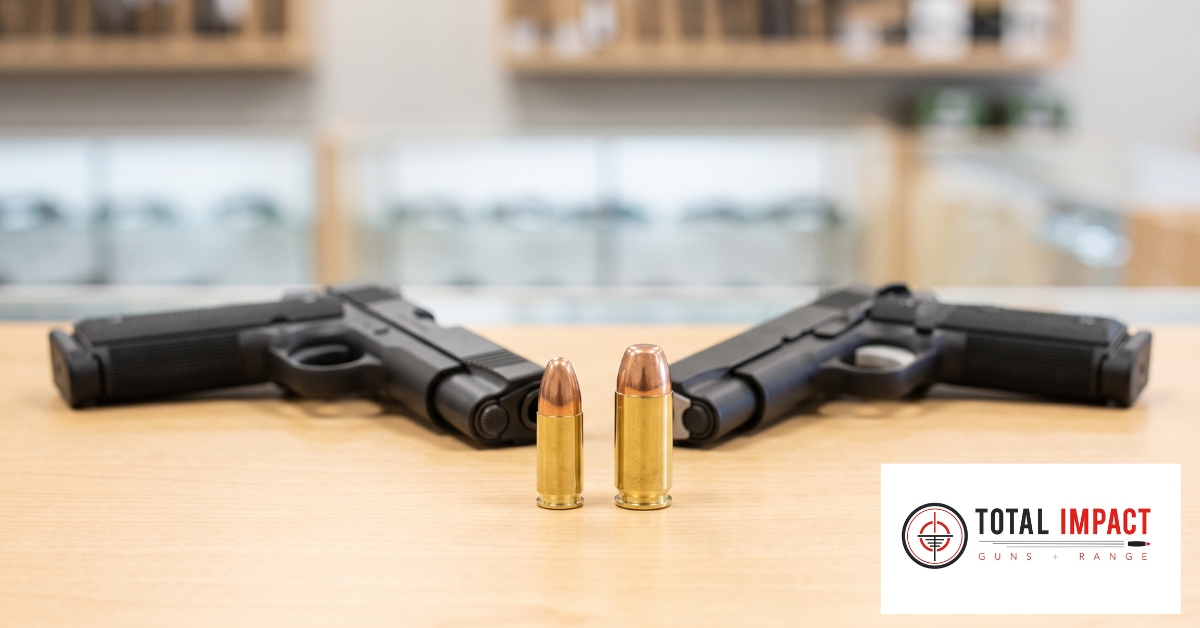
9mm fires a lighter bullet, usually 115 to 147 grains, at a fast clip of roughly 1,100 to 1,300 feet per second. .45 ACP goes the other direction, sending a heavier 185 to 230 grain bullet moving slower, around 800 to 950 feet per second. Same basic idea (send a bullet downrange that stops a threat), two different ways of getting there.
9mm has become the default chambering for most modern duty, carry, and defense pistols on the market today. Walk into almost any police department's issued sidearm and you're looking at a 9mm. .45 ACP hasn't gone anywhere, though. It's still a respected, established round with a loyal following, and plenty of shooters wouldn't carry anything else. If you're just starting to sort through the options, our complete handgun buying guide is a good place to get oriented before you narrow things down to caliber.
Recoil and shootability
This is the difference you'll feel the first time you shoot both back to back. .45 ACP produces noticeably more felt recoil than 9mm in comparably sized pistols. That extra kick isn't just uncomfortable, it slows you down. Follow-up shots take longer to line up, and your groups open up as the gun pushes your sights off target.
Softer recoil isn't a small perk. It's what lets a newer shooter actually build good habits: a solid grip, a clean trigger press, and sight alignment that holds together shot after shot. Heavy recoil trains the opposite. Shooters start anticipating the kick before it happens, which turns into a flinch, and a flinch will wreck your accuracy no matter which caliber you're holding.
Recoil isn't only about the cartridge, though. A full-size, heavy .45 can feel more manageable than a small, lightweight 9mm, because the extra weight and grip surface soak up recoil that a compact gun can't. Pistol size and weight matter as much as caliber does. If you've only ever shot a subcompact 9mm and assumed that's what all 9mms feel like, you're not getting the full picture. The same goes in reverse: a lightweight, single-stack .45 will kick a lot harder than a full-size steel-frame 1911 chambered in the exact same round.
That's why handling before buying matters so much more than reading a spec sheet. Two guns in the same caliber can feel like two different calibers depending on weight, grip texture, and frame material.
Magazine capacity
A 9mm cartridge is physically smaller around than a .45 ACP round, which means more of them fit in the same size magazine. That translates directly into rounds on tap.
A full-size 9mm like a Glock 17 holds around 17 rounds. A comparable .45, the Glock 21, holds about 13. Step down to a single-stack 1911 in .45 and you're often looking at just 7 or 8 rounds in the magazine.
Capacity matters for home defense and concealed carry, but it's worth keeping in perspective rather than treating it as the deciding factor on its own. Most defensive encounters don't run a gun dry, and a well-placed shot from a lower-capacity .45 does the job a spray of 9mm rounds fired poorly won't. Still, more rounds in the gun means more margin, and margin is never a bad thing to have. If capacity and concealability are both on your list, our Glock 19 vs Sig P320 comparison is worth a look.
Ammo cost and availability
A lot of first-time buyers don't think about what it actually costs to shoot the gun until after they've already bought it.
9mm range ammo runs around 17 cents a round. .45 ACP runs closer to 36 cents, more than double. Defensive hollow points follow the same pattern, with 9mm loads consistently cheaper than their .45 equivalents. Run the math over a few hundred rounds of practice and the difference adds up fast, especially if you're trying to get comfortable with a new gun.
9mm is also the logistics standard across law enforcement, the military, and most gun shops, which means steadier supply and less price swinging around. .45 ACP tends to see bigger price and availability swings, particularly when ammo shortages hit and shooters compete for a smaller slice of shelf space.
That cost gap compounds the more you shoot. A box of 50 rounds a week adds up to a very different annual number depending on which caliber is in the gun, and ammo cost is one of the biggest reasons new shooters quietly stop practicing. The cheaper the round, the easier it is to justify another range trip.
Defensive performance and stopping power
This is where the debate usually gets loudest, and it's worth clearing up. With modern defensive hollow-point ammunition, the real-world performance gap between 9mm and .45 ACP has closed to near parity. Shot placement and adequate penetration do far more work than the size of the hole the bullet makes.
The clearest sign of where the industry landed is the FBI's own move back to 9mm as its standard-issue round, made after some of the most rigorous ammunition testing in the country. The agency's testing found modern 9mm performs about as well as .45 ACP on terminal ballistics, while offering lower recoil, higher capacity, and lower cost per round.
.45 ACP still earns its keep, though. Plenty of shooters like the idea of a bigger, heavier bullet doing the work, and there's nothing wrong with that preference. It also suppresses well, since standard .45 ACP loads run subsonic right out of the box, no special ammo required to keep it quiet. If you're building a home defense setup and want to weigh caliber against other choices like shotguns and rifles, our complete home defense firearms guide covers the full picture.
Concealed carry and pistol selection
9mm dominates the concealed carry market for a simple reason: manufacturers build far more slim, lightweight, and compact options in 9mm than they do in .45 ACP. If you're shopping for a carry gun, the sheer number of 9mm options at every price point makes the search easier.
.45 ACP hasn't disappeared from the carry conversation, though. The classic 1911 is still a go-to for shooters who grew up on the platform, and modern polymer-framed full-size and compact pistols keep the caliber relevant for defense and carry alike. It's a smaller lineup than 9mm's, but it's far from an afterthought.
Whatever you land on, handle both calibers before you buy, and shoot them both if you can get to a range that lets you rent or try before committing. Felt recoil and how a grip fits your hand are personal. What feels great in someone else's hand might not feel right in yours, and the only way to know for sure is to put rounds through it yourself. Bring a friend who shoots the other caliber, swap guns for a magazine each, and you'll walk away with a much better sense of which one you'd actually reach for.
Which caliber is right for you
If this is your first defensive handgun, lean 9mm. It gives you higher capacity, cheaper practice ammo, and recoil that's easier to control while you're still building the fundamentals. That combination lets you shoot more often, and shooting more often is what actually makes you good with a gun.
.45 ACP makes sense if you prefer a heavier bullet, you're drawn to the 1911 platform, you're planning to run a suppressor, or you simply shoot .45 more confidently than you shoot 9mm. That last part matters more than people give it credit for. A gun you shoot well beats a gun that wins an argument on paper.
The best caliber is the one you'll actually train with and shoot accurately, not the one that sounds tougher at the counter. Once you've made the call, browse our 9mm pistols or .45 ACP pistols and find the one that fits your hand.