
5.56 NATO vs .223 Remington: What Every AR Owner Should Know
Posted by Joel Sheran on May 9th 2026
You see it at the gun counter all the time. Someone holds up a box of 5.56 NATO, points at an AR stamped ".223 REM," and asks if they can shoot it. The answer from the guy in line behind them is usually "yeah, totally interchangeable." That answer is wrong often enough to be dangerous.
The short version on .223 vs 5.56: the two cartridges look identical and physically fit in each other's chambers, but they are not loaded to the same internal pressure. You can safely fire .223 Remington in a 5.56 NATO chamber. You should not fire 5.56 NATO in a chamber marked ".223 REM" only. The deciding factor is the chamber your barrel is cut for, not the round on the shelf.
This post is for AR owners who want a clear, technically accurate reference, including the third chamber spec almost no one talks about (.223 Wylde), how to read your barrel rollmark, and a simple decision tree for what to feed your rifle at the ammo counter. We are not going to recommend home-defense loads or rank specific AR-15s here. Those are different posts.
Are 5.56 NATO and .223 Remington the Same Thing?
Externally, yes. Both cartridges are 5.56x45mm by case dimensions. A round of either will physically chamber in the other rifle, and an eyeball check will not tell them apart. The headstamp on the case head is the only visual giveaway, marked ".223 REM" or "5.56 NATO" (or "M193" / "M855" on military ball loadings).
Internally, they are not the same. They are loaded to different chamber pressures and governed by two different standards bodies. The Sporting Arms and Ammunition Manufacturers' Institute (SAAMI) sets the spec for .223 Remington at roughly 55,000 PSI. The NATO Standardization Agreement (NATO STANAG) covering 5.56x45mm sits closer to 58,000 PSI per Hornady's law-enforcement technical bulletin. That 3,000 PSI gap does not sound like much, but inside a chamber not designed to absorb it, the math runs the wrong way fast.
A useful analogy from MeatEater: 5.56 NATO is essentially a +P version of .223 Remington. Same external dimensions, more energy, more pressure, and a chamber built to handle it.
The Real Difference: Chamber, Leade, and Pressure
Here is the part most counter conversations skip. The cartridge does not decide whether your rifle is safe. The chamber does.
Every rifle chamber has a short unrifled section forward of the case mouth called the leade (also called the throat). It is the runway between where the bullet sits and where the rifling grabs it. The longer that runway, the more time the bullet has to accelerate before it engages the rifling, and the lower the chamber-pressure spike when the round fires.
The 5.56 NATO chamber is cut with a longer leade than the .223 Remington chamber. Per USCCA's technical breakdown by Paul Peng, the .223 Remington leade measures roughly 0.085 inches; the 5.56 NATO leade measures roughly 0.0975 inches. Hornady's data describes a total throat-geometry difference of about 0.125 inches between the two specs. Sources measure slightly different segments of the throat, but all agree on the direction: the 5.56 chamber has more room before the rifling engages.
That extra room is what makes the higher-pressure 5.56 round safe in a 5.56 chamber. Fire the same round in a tighter .223 chamber and the bullet hits the rifling almost immediately. Pressure spikes. Per Hornady, firing 5.56 NATO in a .223-chambered rifle can drive chamber pressure past 65,000 PSI, well above the .223 chamber's design limit.
The standards bodies do not soften this. SAAMI's official position, on the SAAMI FAQ page, is that firing 5.56 NATO in a rifle chambered for .223 Remington can result in serious injury or death to the user and bystanders, as well as damage to the firearm. That is the language SAAMI itself uses. It is not marketing copy.
NSSF's joint piece with SAAMI walks through the failure modes in more detail: dropped primers, increased bolt velocity, damage to buffer tubes, and jams in modern sporting rifles. Those are the warning signs of overpressure, and the symptoms of a rifle wearing itself out faster than it should.
Can You Shoot .223 in a 5.56 Chamber? Can You Shoot 5.56 in a .223 Chamber?
The asymmetric rule, stated in both directions:
- .223 Remington in a 5.56 NATO chamber: safe. The lower-pressure round in the larger chamber works the way the chamber was designed to work. Velocity may run a hair lower and accuracy may give up a small amount because of the looser freebore, but nothing about it is dangerous.
- 5.56 NATO in a .223 Remington chamber: not safe. Pressure spikes past the .223 chamber's design limit. Failure modes range from broken parts on a good day to a destroyed rifle and shooter injury on a bad one.
You will hear people say the casual shooter never notices the difference, and at the range, that is sometimes true. Plenty of rounds get fired in mismatched chambers without an immediate problem. The catch is that the failure mode when it does happen is severe enough that no responsible shop is going to give you the green light.
One nuance: bolt-action rifles chambered in .223 Remington can sometimes tolerate 5.56 NATO rounds because the bolt-gun lockup has more reserve strength than a semi-automatic action. Frank C. Barnes notes in Cartridges of the World (quoted in MeatEater's Caliber Battles entry) that semi-autos can experience "reliability issues and as unsafe as blown primers and even firearm damage and shooter injury." Your AR is a semi-auto. The bolt-action exception does not apply to you.
Enter .223 Wylde: The Third Chamber Spec AR Owners Should Know
Here is what almost none of the top search results will tell you. There is a third chamber spec that solves the problem entirely, and it is one of the more popular options on quality AR uppers.
.223 Wylde is a hybrid chamber specification, not a cartridge. It was designed by Bill Wylde to safely accept both .223 Remington and 5.56 NATO while preserving the tighter freebore that gives .223 its accuracy edge. The leade and throat dimensions sit between the two SAAMI and NATO specs, which means a Wylde chamber absorbs the higher pressure of a 5.56 NATO round without the overpressure problem and still shoots .223 match ammo with the precision a true .223 chamber gives you.
Wylde chambers show up most often on match-grade or accuracy-focused AR uppers. Quality barrel makers offering Wylde-chambered options include Bartlein, Aero Precision, Wilson Combat, Faxon, and others (we are not picking a single "best"; any of them will outperform a generic mil-spec barrel for accuracy work).
If you want to feed an AR upper both cheap 5.56 surplus on practice days and quality .223 match ammo on accuracy days, a Wylde chamber is the cleanest way to get both without compromise.
How to Tell What Your AR Is Chambered For
Before you buy a single round, verify what your rifle is cut for. The order of operations:
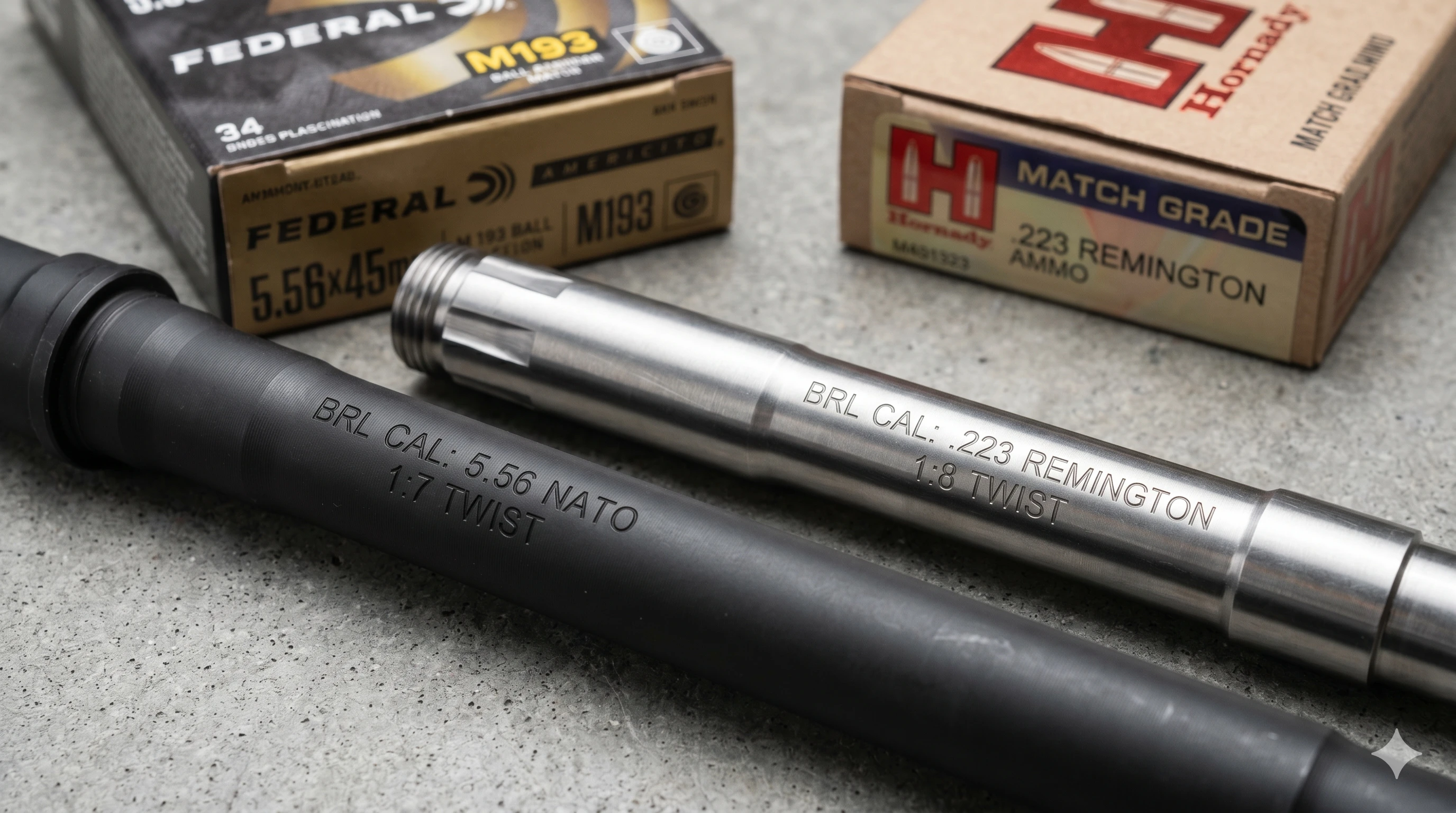
- Check the barrel rollmark. The engraved designation on the barrel itself, usually forward of the chamber and in front of the gas block. The most authoritative marking on the rifle.
- If the barrel is unmarked or hidden by a handguard, check the upper receiver. Some manufacturers stamp the chambering on the upper instead.
- If both are silent, check the manufacturer documentation. The product page or manual should list the chamber spec explicitly.
- If you cannot confirm, default to .223 Remington only. It is safe in any of these chambers. The conservative choice is the only safe choice.
Here is what the common rollmark variants mean in practice:
- .223 REM (or ".223 Remington"): The barrel is cut to SAAMI .223 Remington spec only. Feed it .223 Remington exclusively. Do not chamber 5.56 NATO.
- 5.56 NATO (or "5.56"): The barrel is cut to NATO 5.56x45mm spec. Both .223 Remington and 5.56 NATO are safe.
- 5.56/.223 (or "MultiCal"): Same as above. The manufacturer is explicitly telling you both are safe. Both .223 Remington and 5.56 NATO are fine.
- .223 WYLDE: The hybrid chamber. Both .223 Remington and 5.56 NATO are safe, with .223 match ammo giving you the tightest groups.
If you are working through your first AR purchase, our guide for first-time AR-15 buyers walks through what to look at on the spec sheet before you commit.
Why Is .223 Sometimes Faster Than 5.56?
This one surprises people. Compare a 55-grain .223 Remington against a 55-grain 5.56 NATO from the same manufacturer, and the .223 round often shows a slightly higher muzzle velocity. Per Federal Premium's published spec sheets (referenced in MeatEater's caliber comparison), a 55-grain Federal .223 runs around 3,240 fps, while the equivalent 55-grain 5.56 NATO runs around 3,165 fps from the same nominal barrel length.
That looks backwards. The 5.56 has more powder, so why is it slower? The chamber, again. A larger 5.56 chamber gives expanding gas more volume to fill before the bullet starts moving, so the initial pressure spike is lower than it would be in a tight .223 chamber. The .223 chamber's smaller freebore concentrates pressure earlier and gets the bullet moving faster from the same powder charge. More powder is not always more velocity.
These numbers are reference-grade, not gospel. Real-world muzzle velocity depends on barrel length, gas system, and ammo lot variation. The spec-sheet comparison is not as one-sided as the powder charges suggest.
Why Does the Military Use 5.56 Instead of .223?
Short version: standardization, performance under field conditions, and a spec written for service rifles instead of sporting rifles.
The cartridge that became 5.56x45mm NATO was developed in 1957 for the Armalite AR-15. The U.S. military adopted it in 1964 as the 5.56mm Ball M193 for what would become the M16, and NATO standardized the round shortly after. The higher-pressure spec around a longer chamber leade gave the round better terminal performance and made the chamber more tolerant of the dirt, carbon, and grit service rifles accumulate in the field. NATO interoperability sealed it.
You will run into the M193 and M855 designations the first time you shop military surplus 5.56:
- M193: 55-grain ball, the original NATO spec. Standard surplus 5.56. Inexpensive, reliable, plenty for range work.
- M855: 62-grain "green tip," named for the green-painted bullet tip. Includes a steel-tip penetrator. Also NATO spec.
Both are unsafe in chambers marked .223 Remington only. Both are fine in 5.56 NATO, 5.56/.223, MultiCal, or .223 Wylde chambers.
The AR Owner's Ammo-Buying Decision Tree
Once you know your chamber, the buying decision is simple:
- Chamber marked .223 Remington only: buy .223 Remington only. Do not substitute 5.56 NATO. If you want to shoot 5.56 surplus, you need a different rifle or a different barrel.
- Chamber marked 5.56 NATO, 5.56/.223, or MultiCal: either is safe. M193 or M855 surplus 5.56 is usually cheapest per round and runs reliably for general practice. Quality .223 Remington loads work for hunting or accuracy.
- Chamber marked .223 Wylde: either is safe. Quality .223 match ammo gives you the tightest groups; 5.56 surplus gives you cheap practice volume.
One cycling caveat from Hornady: firing .223 Remington in a 5.56 chamber on a rifle with a 14.5-inch or shorter barrel can cycle improperly. The lower powder charge plus the pressure drop in the longer 5.56 chamber may not generate enough gas pressure to drive the bolt fully. If you run an SBR or AR pistol, run 5.56 in a 5.56 chamber and skip the .223.
If you are shopping right now, you can find AR-15 rifles in our online store covering all three chamber variants. If you are early in the research phase and price is a filter, our writeup on entry-level AR-15s we recommend covers the value-tier picks worth a serious look.
A Quick Word on Reloading
If you reload, one detail matters. Military 5.56 brass is heavier and thicker than commercial .223 Remington brass, so the same powder charge generates more pressure inside a smaller case volume. Per MeatEater's reloading note, if you reload military 5.56 brass for a .223 rifle, drop the maximum load by at least 10 percent and work back up cautiously. Do not assume your existing .223 load data is safe in mil-surplus cases.
The Bottom Line
The chamber drives the safety story, not the cartridge. Read the rollmark before you load. .223 Remington is safe in any of these chambers; 5.56 NATO is only safe in chambers cut for it (5.56 NATO, 5.56/.223, MultiCal, or .223 Wylde). When in doubt, default to .223 Remington.
If you are in the market, shop AR-15 rifles in 5.56 NATO and .223 Wylde on our site. We ship nationally and handle the FFL paperwork at delivery. If you are local to Sarasota County and you would rather walk through chamber identification at the counter, the Nokomis shop is open seven days a week. Bring the rifle and we will read the rollmark with you.